
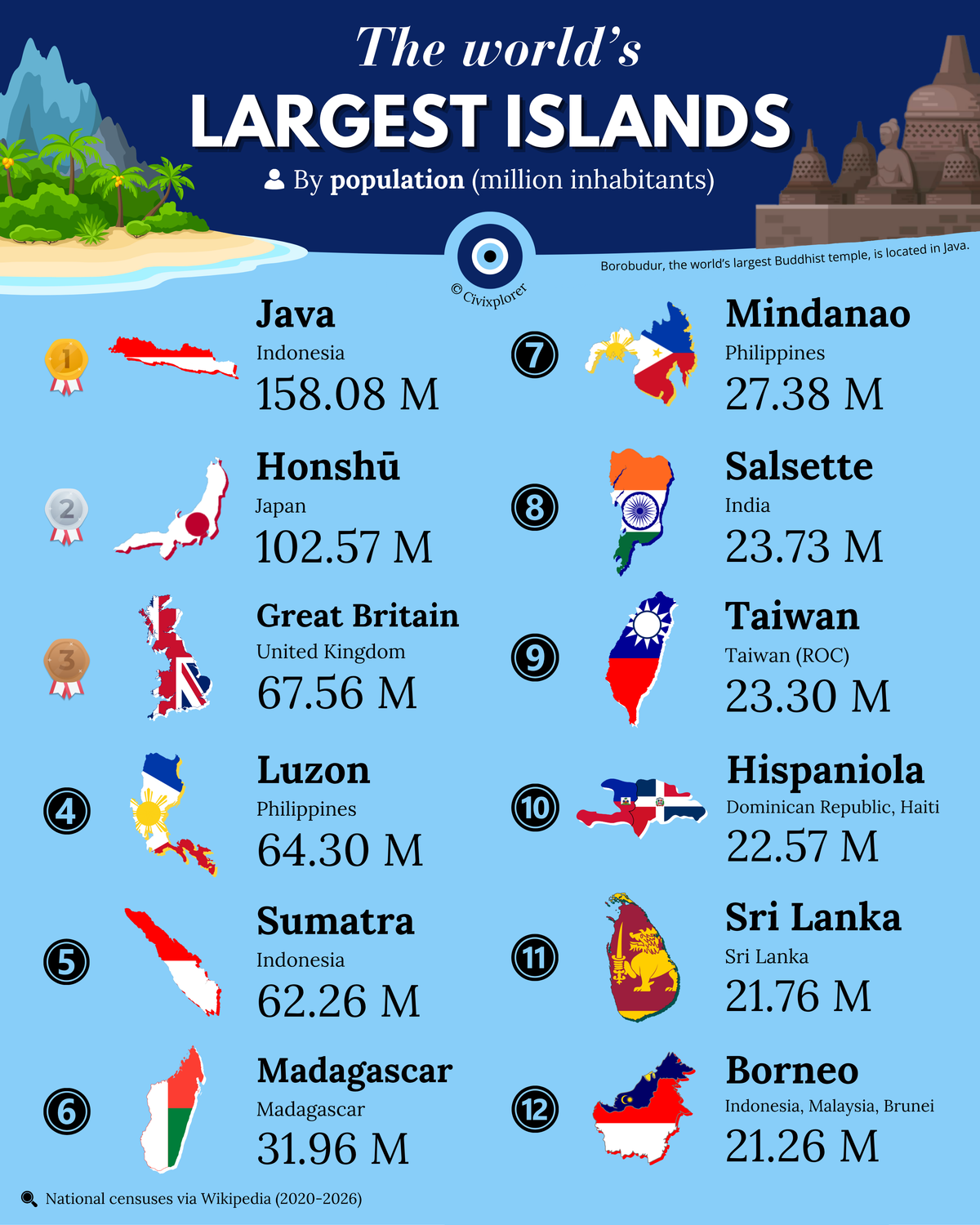
The relationship between an island's physical geographic area and its human demographic weight reveals one of the most fascinating patterns in global geography. While vast landmasses can remain sparsely inhabited, relatively compact islands frequently support tens or even hundreds of millions of residents. This global distribution shows that human settlement on islands is driven not by sheer surface area, but by a complex interplay of volcanic soil fertility, historical trade networks, rapid industrialization, and modern urban centralization.
At the very top of global rankings sits Java, an island in Indonesia that houses over 158 million people despite accounting for only a small fraction of the nation's total land area. Positioned along the active Ring of Fire, Java benefits from mineral-rich volcanic ash that created exceptionally fertile soils. Over centuries, this agricultural advantage enabled intensive wet-rice farming, sustaining dense rural populations long before modern urban growth. Coupled with Dutch colonial centralization in Jakarta, Java established an enduring role as both an economic magnet and political core.
In contrast, islands like Honshu in Japan and Great Britain reflect an entirely different demographic driver centered around early industrialization and sprawling urban corridors. Honshu, home to over 102 million residents, concentrates its massive population along coastal plains and the Pacific industrial belt connecting the Tokyo metropolitan region. Similarly, Great Britain's rich mineral deposits sparked the Industrial Revolution, fostering dense manufacturing hubs and commercial centers that continue to attract global commerce today.
Beyond broad landmasses, small islands can experience dramatic population concentration through hyper-urbanization. A prime example is Salsette in India, which covers roughly 619 square kilometers yet holds approximately 23.7 million inhabitants due to encompassing the megacity of Mumbai and surrounding urban centers. Salsette illustrates how intense economic migration can transform a small coastal island into one of the most densely populated places on Earth.
Finally, comparing islands across Southeast Asia and the Americas highlights how colonial history and shared borders shape human settlement. Islands like Borneo, physically the third largest in the world, hold roughly 21 to 23 million people spread across three nations because its interior consists primarily of dense tropical rainforests and nutrient-poor soils. Meanwhile, Hispaniola demonstrates how two distinct sovereign nations, Haiti and the Dominican Republic, evolved divergent economic and demographic paths on a single shared landmass. Analyzing these global patterns reveals that an island's population is ultimately a living reflection of natural resources, historical migration, and economic opportunity.

Comments (0)
Join the Conversation
Login to share your thoughts with the community.
Login to Comment