
At the dawn of the seventeenth century, the global urban hierarchy looked radically different from today's Western-centric landscape. Before the advent of modern industrialization and steam-powered transportation, the world's largest population centers were overwhelmingly concentrated across the vast agrarian empires of Asia and the Islamic world. Rather than stemming from factory manufacturing, early modern urban growth was fueled by political administrative centralization, massive agricultural surpluses, and strategic trade choke points. Imperial courts, standing armies, and extensive merchant networks concentrated millions of people into bustling metropolises that dwarfed their Western European counterparts.
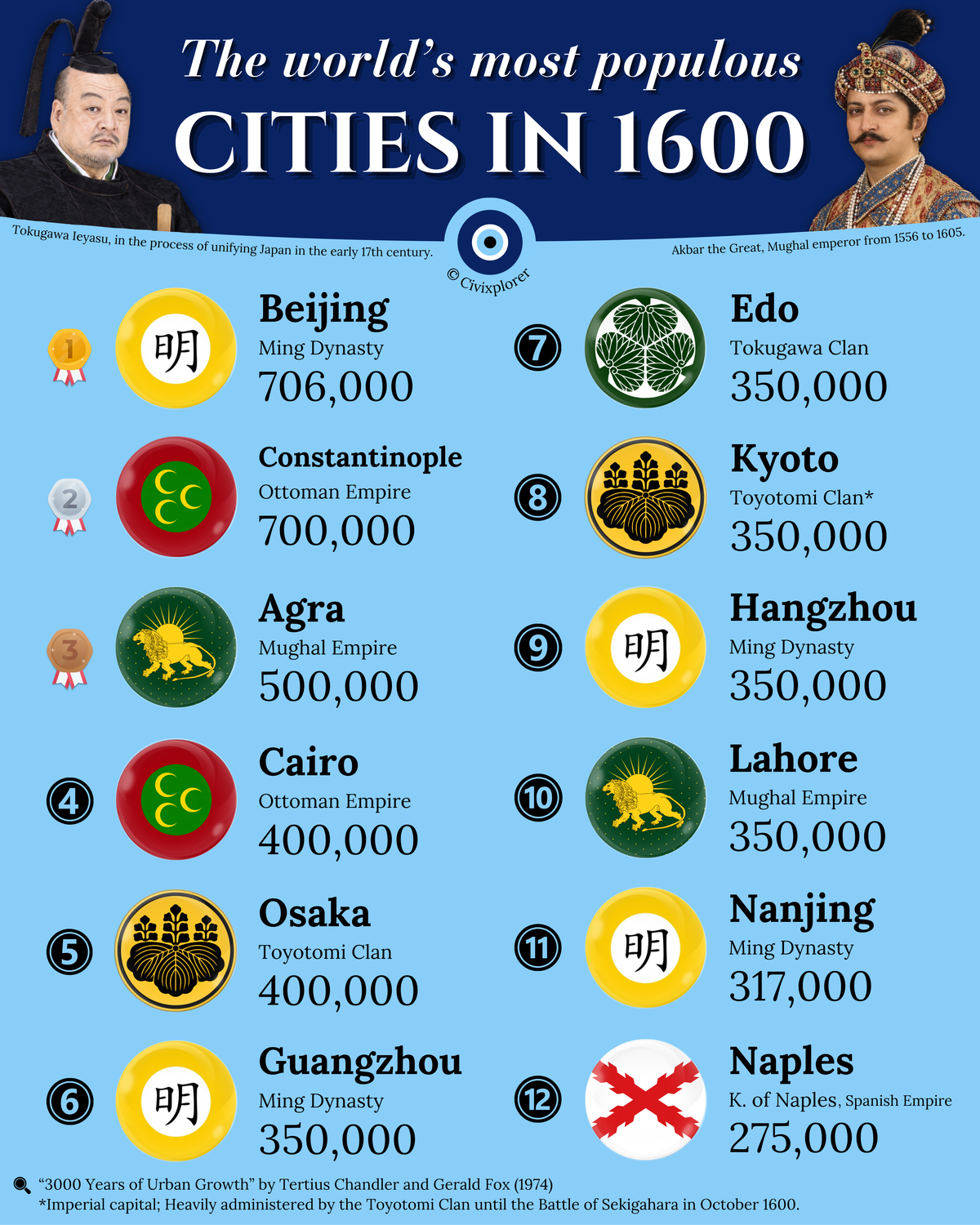
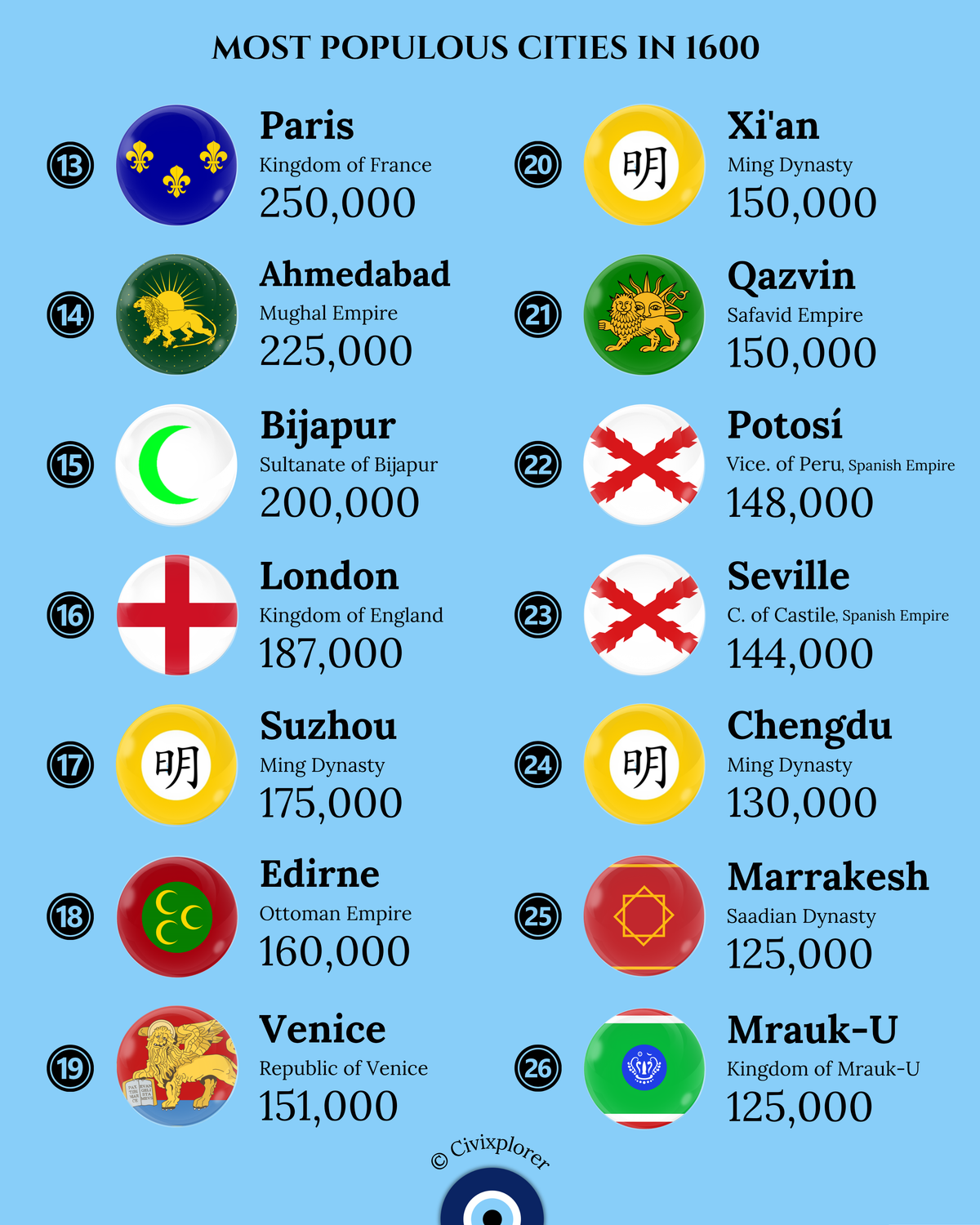
At the pinnacle of this global network stood Beijing, the Ming Dynasty capital, which anchored the global urban system with an estimated population of 706,000 residents. Sustained as a monumental political organism, Beijing relied on the engineering marvel of the Grand Canal and state-managed grain transport systems to funnel agricultural yields from southern China to the northern imperial court. Beyond the capital, Ming China featured an exceptionally dense urban hierarchy with commercial and cultural centers such as Nanjing, Hangzhou, Guangzhou, and Suzhou driving a vibrant riverine and maritime economy. Meanwhile, in the Ottoman Empire, Constantinople (Istanbul) ranked second globally with approximately 700,000 inhabitants, commanding the vital trade crossroads between Europe, Asia, and the Mediterranean.
Further east, the Mughal Empire under Emperor Akbar transformed the Indian subcontinent into a powerhouse of urban demography. The imperial capital of Agra reached an estimated population of 500,000, supported by vast Gangetic agricultural revenues and court administration, while regional centers like Lahore and the textile hub of Ahmedabad flourished along major trade corridors. Concurrently, Japan was experiencing a dramatic urban transition leading up to the pivotal Battle of Sekigahara in 1600. The rise of Tokugawa authority laid the foundation for a unique tripartite urban network comprising the political stronghold of Edo, the commercial market metropolis of Osaka, and the traditional imperial and craft capital of Kyoto.
While Asian land empires dominated the top rankings, the global silver trade created one of the most extraordinary demographic anomalies in human history high in the South American Andes. At an elevation of 4,000 meters, Potosí exploded into a mining boomtown of nearly 148,000 residents under Spanish colonial rule. Driven by the extraction of silver from the Cerro Rico, Potosí operated as a global economic engine that funneled precious metals through Seville to bankroll European trade and backstop China's silver-backed currency. In stark contrast, Western European capitals like Paris and London remained comparatively modest in scale, hovering around 250,000 and 187,000 inhabitants respectively, as they stood on the threshold of their future Atlantic expansion and nineteenth-century industrial takeoff.

Comments (0)
Join the Conversation
Login to share your thoughts with the community.
Login to Comment