
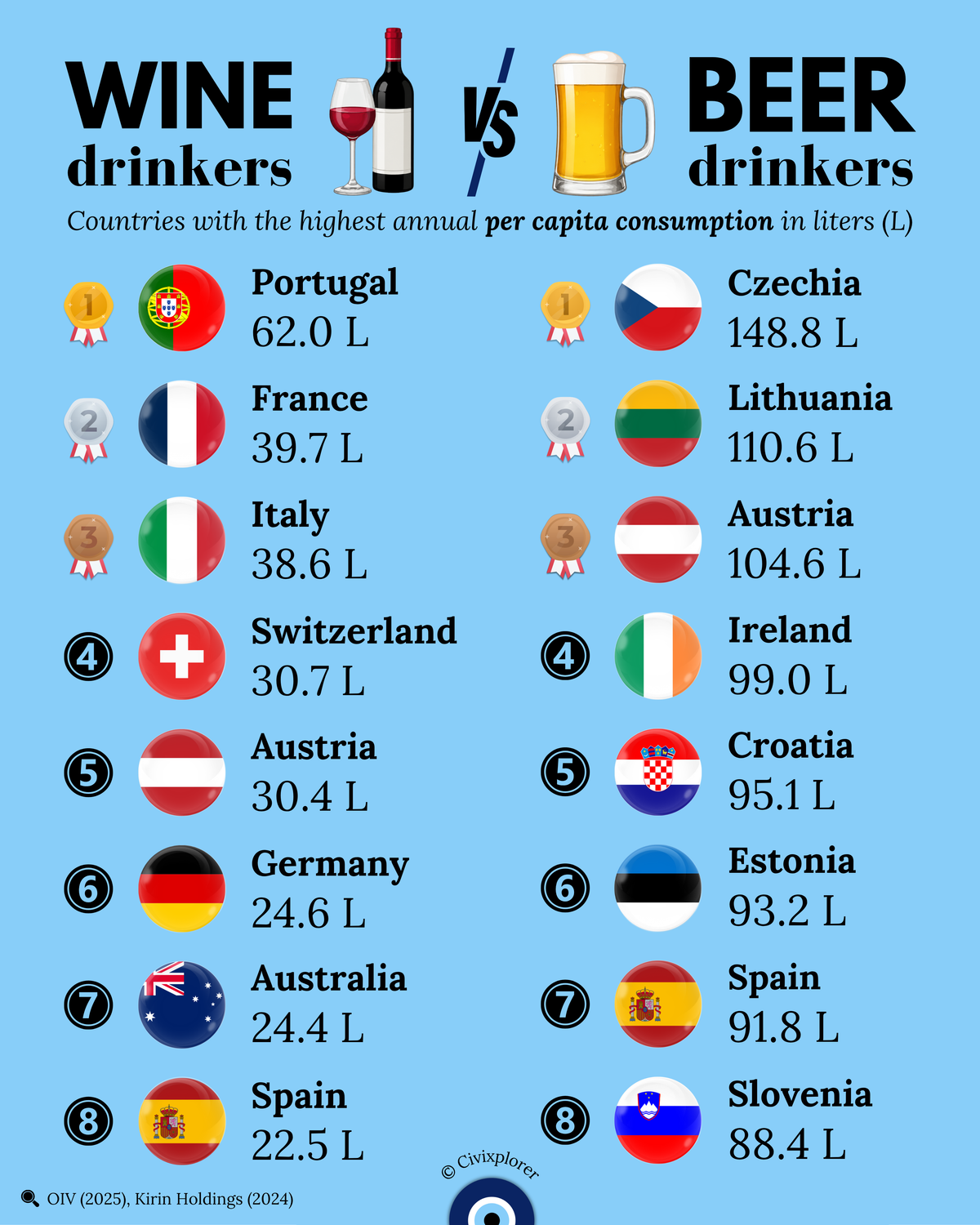
The global landscape of beverage consumption is far more than a matter of personal taste; it is a vivid map of agricultural history, geography, and cultural identity. When we look at the world's top countries by annual per capita consumption of wine versus beer (measured in liters of the beverage itself rather than pure alcohol), a striking cultural boundary emerges. On one side, we see the historical dominance of wine in Mediterranean and Latin-influenced societies; on the other, the deeply rooted beer cultures of Central, Northern, and Eastern Europe.
Based on the latest data from the International Organisation of Vine and Wine (OIV) and Kirin Holdings, this comparison reveals fascinating statistical outliers, surprising omissions, and countries that successfully bridge the gap between both worlds.
The Undisputed Kings: Portugal and Czechia
At the pinnacle of both rankings, we find two massive statistical outliers that tower over their respective columns.
- Portugal's Wine Supremacy: Portugal leads global wine consumption by a stunning margin at 62.0 liters per capita annually, far outpacing traditional giants like France (39.7 L) and Italy (38.6 L). In Portugal, viticulture dates back to ancient Roman times and was heavily integrated into rural life. Today, affordable table wines are a daily staple of the Mediterranean diet, enjoyed regularly with lunch and dinner. While this number is partially inflated by Portugal's high tourist-to-resident ratio, the domestic lifestyle remains deeply intertwined with the vine.
- Czechia's Unrivaled Beer Culture: On the beer side, Czechia sits entirely unchallenged in first place, consuming an astonishing 148.8 liters of beer per capita. This marks Czechia’s 32nd consecutive year leading the global beer rankings since 1993. To put this into perspective, 148.8 liters equals roughly 235 large bottles (633 ml) per person per year, or about 4.5 bottles every single week for every citizen, including children and non-drinkers. Czech beer (which birthed the famous Pilsner style in Plzeň in 1842) is a highly democratic beverage, historically cheap, and serves as the social glue of local communities.
The Dual-Drinkers: Austria and Spain
It is highly unusual for a country to rank in the global top eight for both beverages, but two European nations successfully bridge the geographic divide:
- Austria: Austria ranks 3rd in beer consumption (104.6 L) and 5th in wine consumption (30.4 L). This unique balance is a direct result of Austria's geography. The eastern regions of the country boast a rich, thriving viticulture tradition inherited from the Romans, while the rest of the nation belongs culturally to the Central European lager-brewing zone.
- Spain: Spain claims 7th in beer (91.8 L) and 8th in wine (22.5 L). While Spain is globally famous for its wine production, its daily social life has experienced a massive cultural shift. Driven by warmer climates, tourism, and a highly active outdoor tapas culture, light and refreshing lagers have increasingly overtaken wine for casual, daily get-togethers.
The German Paradox and Changing Trends
Perhaps the most surprising revelation of the data is the complete absence of Germany from the top eight beer-drinking nations. Though globally synonymous with Oktoberfest and heavy brewing traditions, Germany has recently slipped to 10th place in global per capita beer consumption.
This decline is driven by aging demographics, health-conscious lifestyle changes, and a massive rise in the popularity of non-alcoholic beers, which are typically excluded from these volume statistics. Interestingly, Germans consume more wine than beer-lovers might think, landing at 6th place globally in wine with 24.6 liters per capita.
This fits into a broader global trend. While global wine consumption has been in a structural decline for years (dropping roughly 14% since 2018 due to younger generations choosing lower-alcohol alternatives), beer has maintained modest global growth, supported by emerging markets outside Europe.
A Map of Cultural and Agricultural History
Ultimately, this data maps the agricultural adaptations and environmental realities of Europe. Historically, the colder climates of Northern and Eastern Europe were unsuitable for grapevines, leading these societies to ferment hardy grains like barley and wheat, paving the way for beer cultures in places like Lithuania (110.6 L), Ireland (99.0 L), Croatia (95.1 L), and Estonia (93.2 L). Conversely, the sunny Mediterranean sun-drenched hills fueled a thousands-of-years-old love affair with the grape.
While modern globalization and changing generational tastes are slowly blurring these historical borders, the top-ranking nations prove that centuries-old cultural habits still run incredibly deep.

Comments (0)
Join the Conversation
Login to share your thoughts with the community.
Login to Comment