
When we look at the global landscape of faith, broad labels often obscure the intricate reality of how people actually practice and identify. By examining specific religious branches rather than just general categories, we gain a far more nuanced understanding of the world's demographic and cultural makeup.
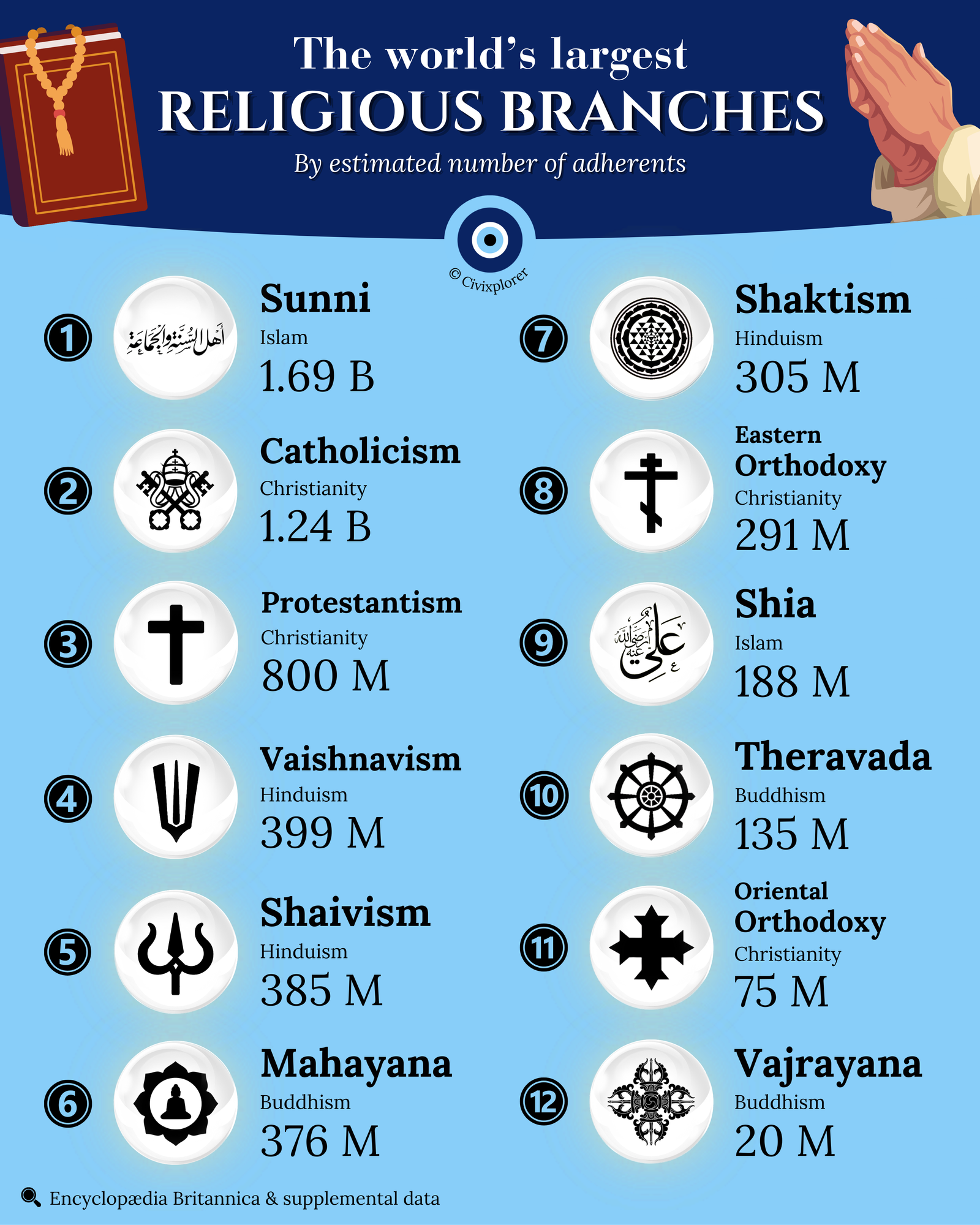
The global religious landscape is currently dominated by two massive branches: Sunni Islam and Catholicism. Sunni Islam stands as the largest single branch with approximately 1.69 billion followers, a footprint established through centuries of historical expansion across the Middle East, Africa, and Southeast Asia. Catholicism follows with 1.24 billion adherents, maintaining deep roots in Europe and Latin America while seeing significant growth in Sub-Saharan Africa. These are currently the only two traditions to exceed the one-billion mark, a scale largely influenced by historical trade routes and missionary expansion.
Protestantism, while ranking third with 800 million followers, functions differently than its counterparts. Rather than a single unified institution, it represents a vast collection of distinct and independent churches. This internal diversity is a common theme across many faiths, perhaps most notably in Hinduism. Often misunderstood as a monolith, Hinduism is composed of major branches like Vaishnavism and Shaivism, as well as Shaktism, which centers on the goddess as the supreme power. Seeing these broken down helps explain the varied nature of Hindu practice worldwide.
Geography also plays a critical role in the distribution of Buddhist traditions. Mahayana Buddhism, the largest branch, is predominantly found in East Asian nations like China and Japan. In contrast, the Theravada tradition is the primary faith in Southeast Asian countries such as Thailand and Myanmar, while the smaller Vajrayana branch remains culturally significant in regions like Tibet.
Even branches with smaller global totals can hold immense geopolitical weight. Shia Islam, despite having fewer followers than the Sunni branch, represents the majority in key regions like Iran and Iraq. Similarly, Eastern and Oriental Orthodoxy serve as the primary religious identity for much of Eastern Europe and Ethiopia, carrying profound historical and political influence.
Finally, any comprehensive look at global demographics must account for those outside traditional branches. Estimates suggest hundreds of millions of people identify with agnosticism or atheism, while others maintain deep connections to Chinese folk religions or African ethnic and tribal traditions. Ultimately, these figures are driven by demographic geography; the fastest-growing branches are those situated in the world's most populous and expanding regions.
Comments (0)
Join the Conversation
Login to share your thoughts with the community.
Login to Comment