
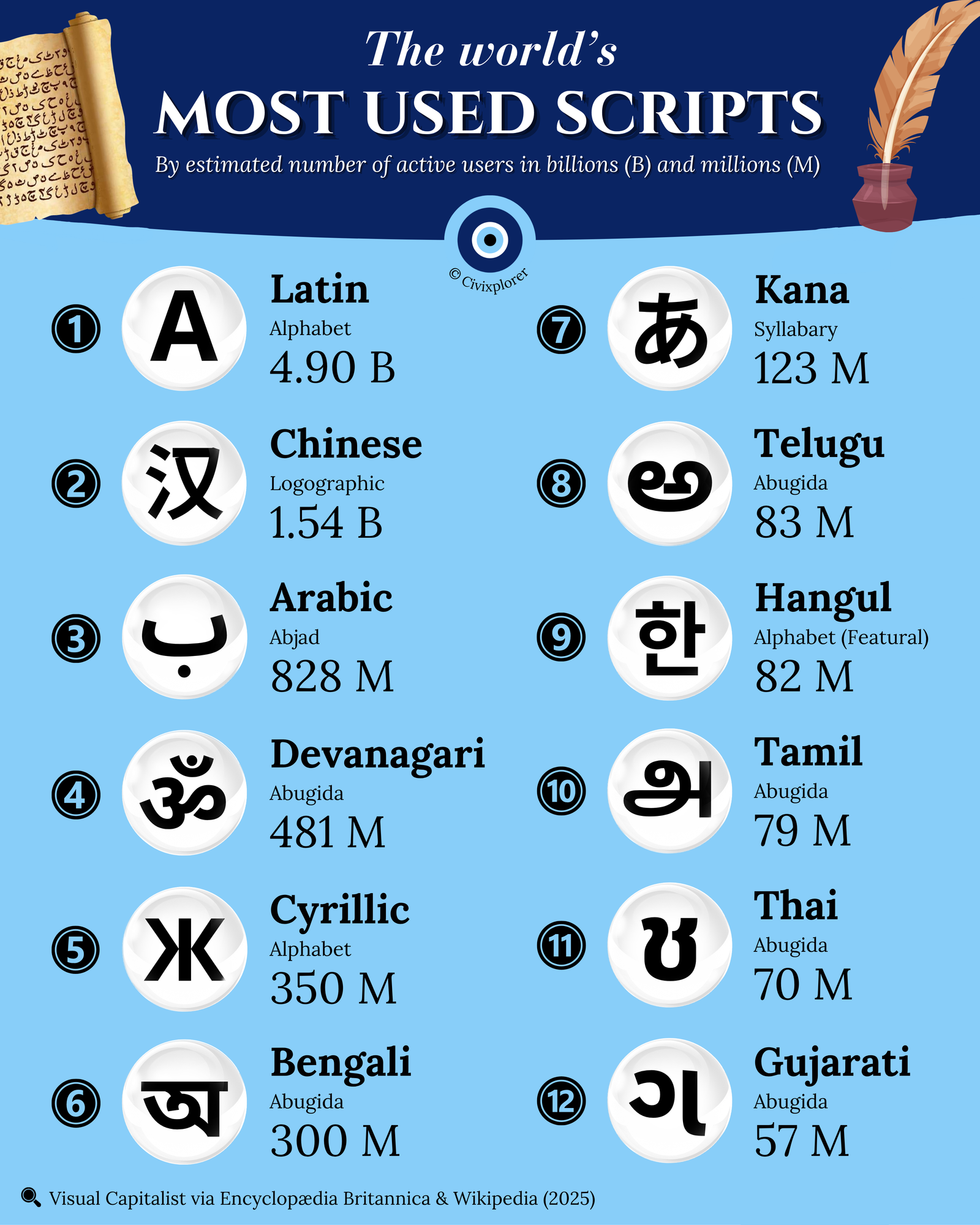
The way humanity records information is a testament to history, power, and cultural resilience. Across the globe, thousands of languages are represented by a surprisingly small number of major writing systems. Understanding these scripts offers a window into how empires, religions, and technological revolutions have shaped the modern world.
The Dominance of the Latin Alphabet
The Latin script is the undisputed leader, utilized by approximately 4.9 billion users, or roughly 60–70% of humanity. This massive reach is the result of several historical layers. Beyond its European origins, the script spread globally through colonial expansion and missionary activity, particularly across the Americas, Sub-Saharan Africa, and parts of Asia. In the 20th century, deliberate government reforms furthered this growth, such as Türkiye’s 1928 transition from Arabic script and similar shifts in Vietnam and Indonesia. Today, the Latin alphabet is cemented by its role as the primary script of the internet, global business, and science.
Logographic vs. Phonetic Systems
Ranking second is the Chinese writing system, with an estimated 1.54 billion users. As a logographic system, it represents entire words or ideas rather than individual sounds. This unique structure has allowed it to remain the oldest continuously used script in the world, spanning over 3,000 years. Its design ensures that speakers of mutually unintelligible dialects, such as Mandarin and Cantonese, can still communicate through the same written text.
In contrast, the Arabic script serves roughly 828 million people. Known as an Abjad, this system focuses primarily on consonants, with vowels often implied by context. Its rapid spread was driven by the expansion of Islam, as Arabic is the liturgical language of the faith. Over time, it was adapted for various non-Semitic languages, including Persian and Urdu, giving it a massive footprint across the Middle East, North Africa, and South Asia.
The Linguistic Mosaic of South Asia
A significant portion of the world’s most used scripts originates from the Indian subcontinent. Five of the top twelve systems—Devanagari, Bengali, Telugu, Tamil, and Gujarati—are Abugidas. In these systems, base letters represent consonants with an inherent vowel that is modified by specific marks. This diversity reflects the immense population of the region and a commitment to preserving distinct linguistic identities rather than adopting a single unifying script.
Engineered Precision: The Story of Hangul
One of the most remarkable entries is Hangul, the Korean script. Unlike systems that evolved organically, Hangul was deliberately engineered in the 15th century by King Sejong the Great to increase literacy. Classified as a featural alphabet, its characters were designed to mimic the physical shapes the mouth and tongue take when pronouncing sounds. Today, it is celebrated by linguists as one of the most logical and scientifically designed writing systems in existence.
These rankings demonstrate that writing systems are never neutral; they are living fossils of history. Whether through the legacy of the Roman Empire or the top-down design of a visionary monarch, these scripts continue to dictate how billions of people interact with the world around them.
Comments (0)
Join the Conversation
Login to share your thoughts with the community.
Login to Comment