
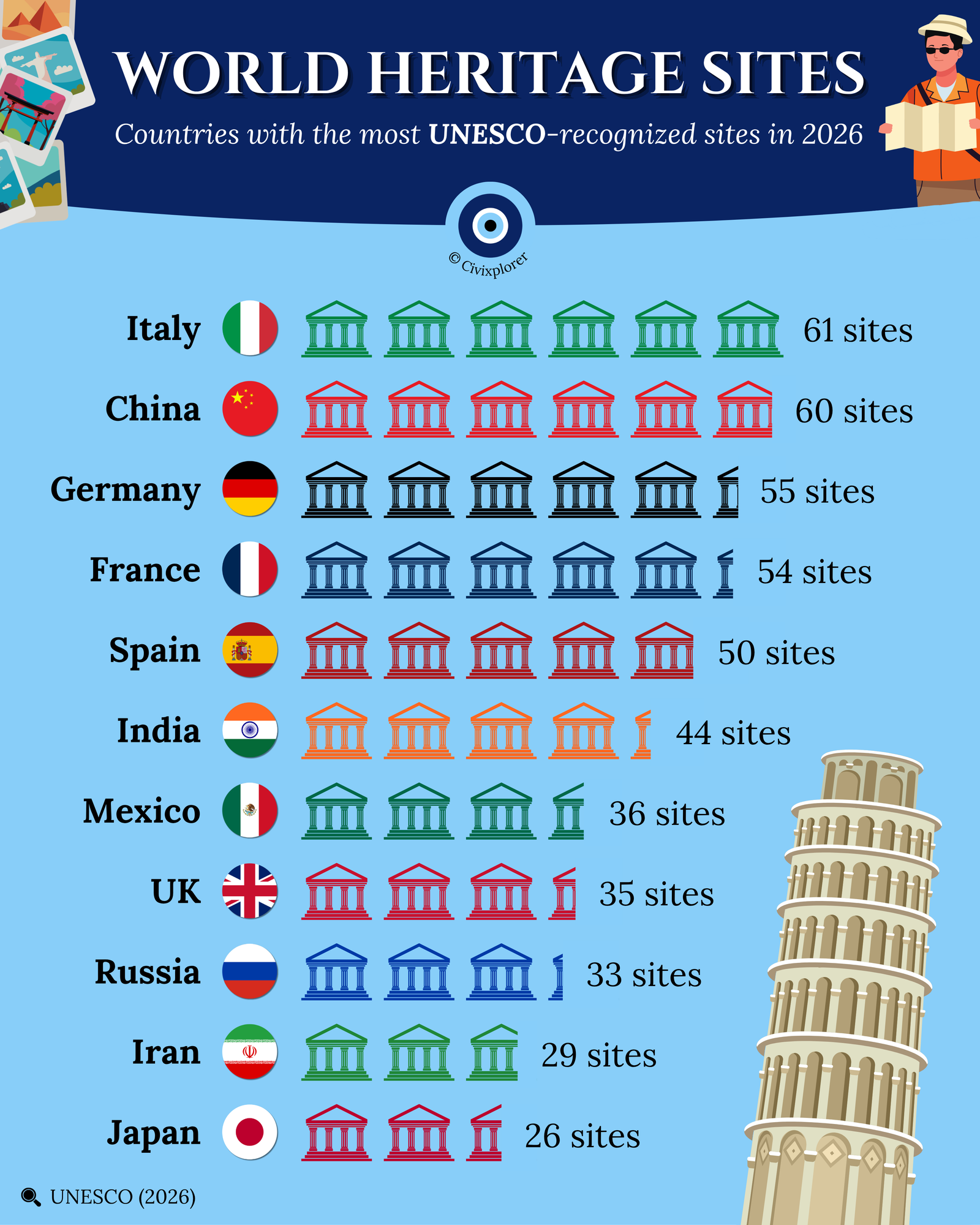
The global landscape of cultural and natural preservation has reached a new milestone in 2026. Following the latest inscriptions from the 47th World Heritage Committee session, the world now celebrates a total of 1,248 sites across 170 countries. This collection of "outstanding universal value" is more than just a list; it is a testament to the diverse and layered history of our civilization.
The Italy-China Rivalry: A Race for Heritage Supremacy
At the very top of the rankings, we see a fascinating neck-and-neck race. Italy leads the world with 61 sites, a position rooted in its status as a Mediterranean crossroads for over 3,000 years. From the ruins of the Roman Empire and the masterpieces of the Renaissance to the historic centers of Rome, Florence, and Venice, the Italian peninsula offers an unmatched density of historical epochs layered within compact geographic areas.
China follows closely with 60 sites, marking a rapid and strategic ascent. Since ratifying the Convention in 1985, China has utilized its massive geographical footprint and 5,000 years of continuous history to secure global cultural prestige. Their entries range from the iconic Great Wall and the Forbidden City to sprawling natural landscapes like the South China Karst, often emphasizing the traditional harmony between humanity and nature.
The European Concentration and Systemic Bias
A closer look at the top five—Italy, China, Germany (55), France (54), and Spain (50)—reveals a significant concentration in Western Europe. This dominance is not necessarily because Europe has "more history" than other regions, but rather due to historical and institutional factors. European nations were early adopters of the 1972 Convention and possessed the administrative infrastructure to navigate UNESCO’s complex nomination process. Furthermore, for decades, the criteria heavily favored "monumental" stone architecture, such as Gothic cathedrals and Romanesque castles, which aligned perfectly with European heritage.
Regional Champions: India, Mexico, and Beyond
Beyond the European core, other nations are making significant strides in rebalancing the list. India (44 sites) is a rising star, showcasing a diverse array of Mughal masterpieces like the Taj Mahal alongside ancient Buddhist and Hindu rock-cut temples. In the Americas, Mexico remains the undisputed leader with 36 sites. Its high ranking stems from a unique fusion of pre-Columbian archaeological wonders, like Teotihuacan, and impeccably preserved Spanish colonial cities.
Other nations rounding out the leaders include the United Kingdom (35), Russia (33), Iran (29), and Japan (26). Each brings a distinctive profile to the global stage, from Britain’s industrial landmarks to Iran’s ancient Persian gardens and Japan’s meticulously preserved Shinto shrines.
Why Heritage Status Matters
UNESCO recognition is far more than a prestigious label. It serves as a powerful engine for international cooperation, funding access, and global tourism. For countries like Italy and France, these sites are central to their cultural diplomacy and economic strength. However, the 2026 rankings also serve as a reminder of the challenges ahead. As the list grows, so does the responsibility to protect these irreplaceable sites from the threats of climate change, overtourism, and conflict, ensuring they remain for future generations to explore.
| Position | Country | Sites |
|---|---|---|
| 1 | Italy | 61 |
| 2 | China | 60 |
| 3 | Germany | 55 |
| 4 | France | 54 |
| 5 | Spain | 50 |
| 6 | India | 44 |
| 7 | Mexico | 36 |
| 8 | UK | 35 |
| 9 | Russia | 33 |
| 10 | Iran | 29 |
| 11 | Japan | 26 |
| 12 | United States | 26 |
| 13 | Brazil | 25 |
| 14 | Canada | 22 |
| 15 | Türkiye | 22 |
| 16 | Australia | 21 |
| 17 | Greece | 20 |
| 18 | South Korea | 17 |
| 19 | Poland | 17 |
| 20 | Portugal | 17 |
| 21 | Czech Republic | 17 |
| 22 | Belgium | 16 |
| 23 | Sweden | 15 |
| 24 | Netherlands | 13 |
| 25 | Peru | 13 |
| 26 | Switzerland | 13 |
| 27 | Argentina | 12 |
| 28 | Austria | 12 |
| 29 | Denmark | 12 |
| 30 | Ethiopia | 12 |
| 31 | South Africa | 12 |

Comments (0)
Join the Conversation
Login to share your thoughts with the community.
Login to Comment