
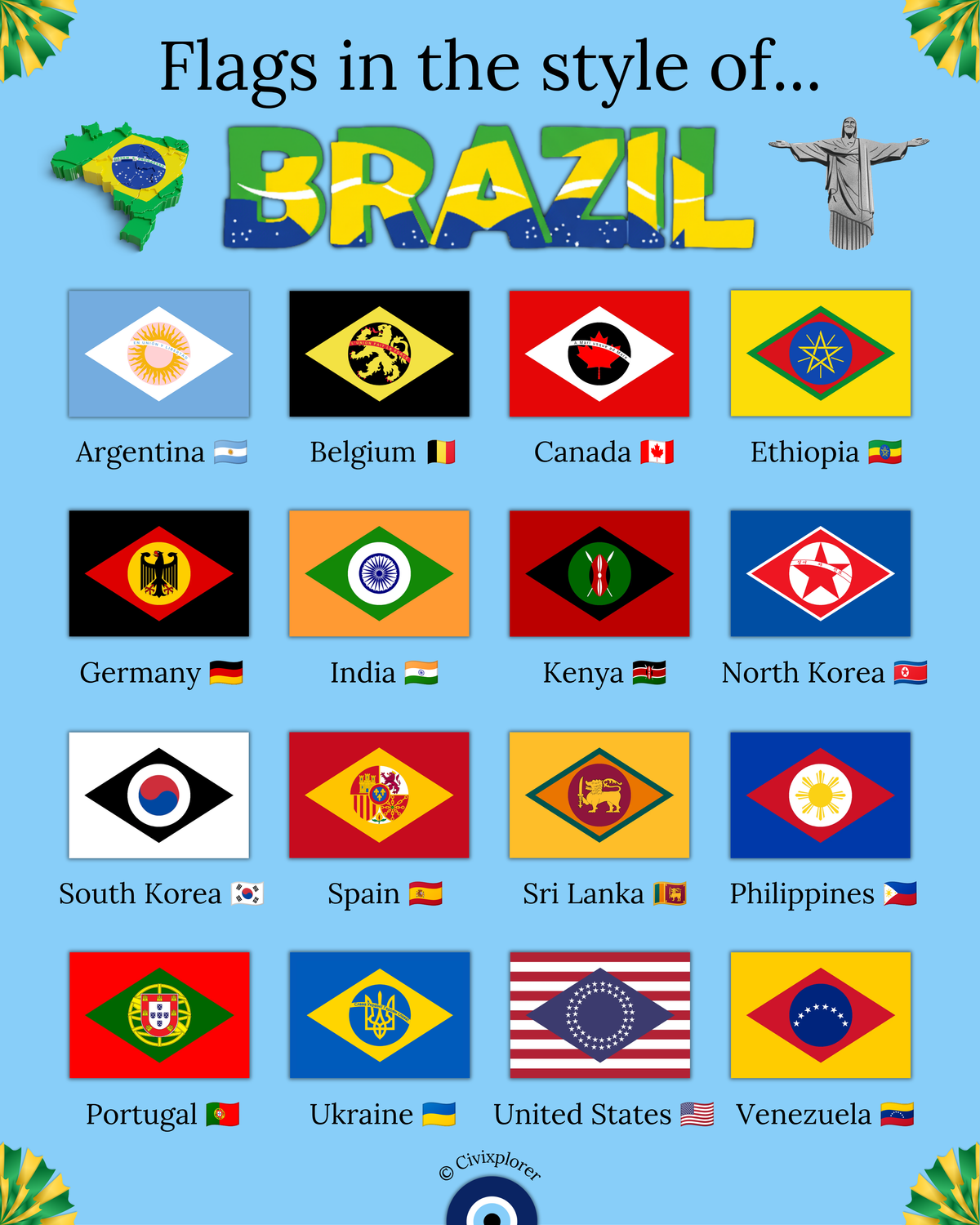
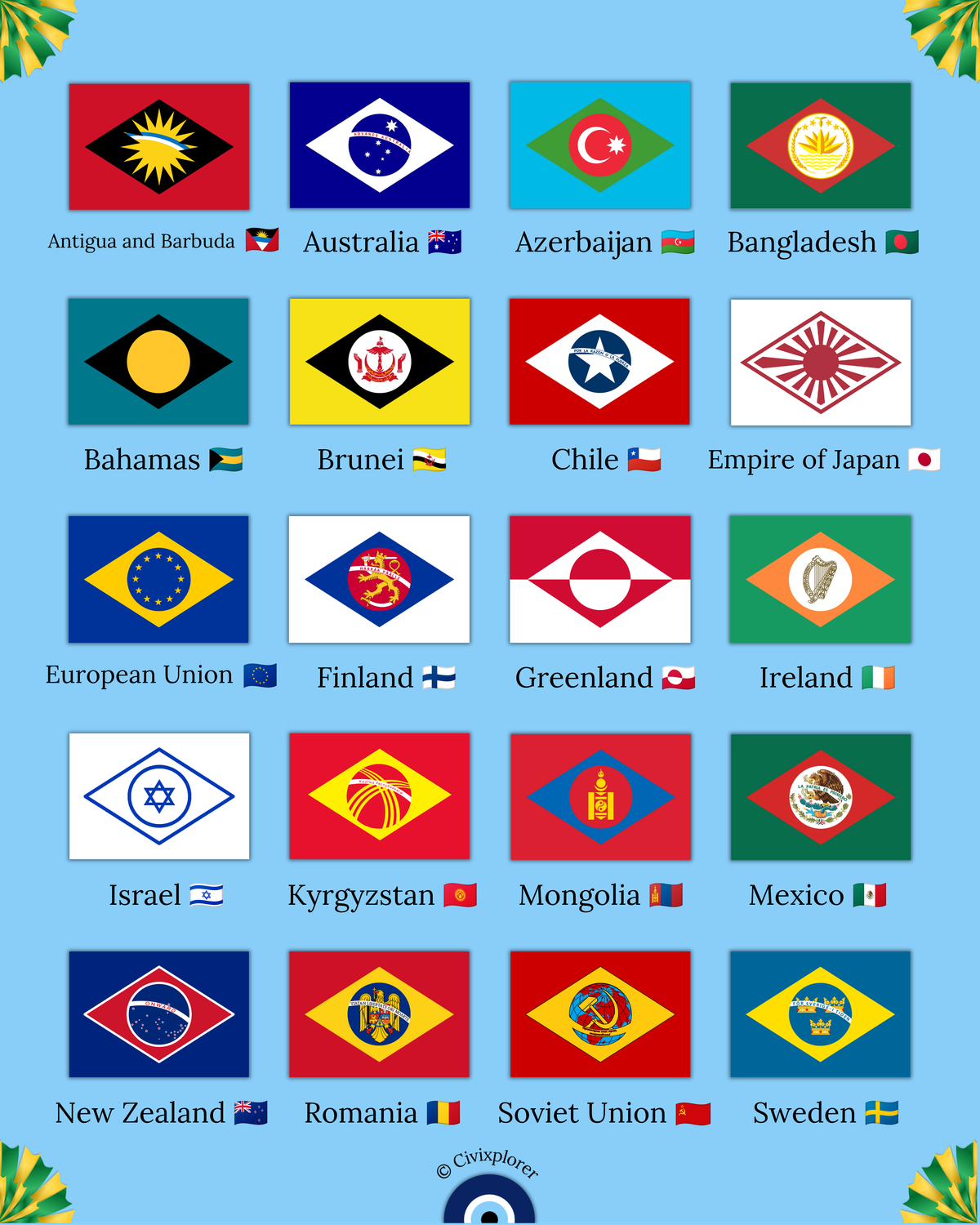
Brazil's national flag, adopted on November 19, 1889 following the Proclamation of the Republic, stands out as one of the most structurally distinctive emblems in modern vexillology. Defined by a three-layered geometric composition—a solid rectangular field, a central rhombus, and an inner celestial disc featuring a motto banner—its layout reflects a fascinating blend of historical continuity, astronomical accuracy, and Positivist philosophy. In a remarkable visual design experiment, thirty-six national, historical, and geopolitical banners are completely re-engineered within this rigid Brazilian template. By holding the structural geometry constant while interchanging colors, mottos, and central charges, the project examines the core principles that render a country's visual identity immediately recognizable.
Translating diverse international symbols into a uniform three-tier framework requires creative solutions depending on each flag's original composition. For traditional tricolors like Germany, the design maps the black, red, and gold sequence cleanly from the background field to the rhombus and central disc, whereas flags with central heraldic charges, such as Argentina's Sol de Mayo or South Korea's Taegeuk, adapt effortlessly by placing their primary symbols inside the central circle. Complex designs like the flag of the United States replace the solid field with iconic red and white stripes while arranging white stars into a circular ring within a blue lozenge. Similarly, Greenland's minimalist bicolour applies a seamless counterchanged split across all three geometric layers, demonstrating how flexible the Brazilian layout can be when reinterpreting intricate patterns.
One of the most compelling aspects of the redesign is how national text and motto banners are incorporated into the curved stripe where Brazil traditionally displays its motto "Ordem e Progresso". Because very few national flags feature written text, adapting banners across thirty-six flags required selecting official mottos, royal phrases, military battle cries, and popular national slogans. For instance, Canada integrates its Psalm-derived motto "A mari usque ad mare," Belgium features "L'union fait la force," and Finland utilizes the historic Thirty Years' War cavalry battle cry "Hakkaa päälle". Other entries incorporate powerful national or royal slogans, such as Mexico's "La patria es primero" or Sweden's royal motto "För Sverige – i tiden," highlighting how textual emblems add unexpected layers of political and cultural narrative to a flag.
Ultimately, this creative exercise reveals profound insights into how human cognition processes national symbols. Flags defined by distinctive color palettes and prominent central emblems—such as India's Ashoka Chakra, Mexico's Aztec eagle, or the Soviet Union's hammer and sickle—retain instant recognizability even when their original field structure is entirely dismantled. Conversely, flags that rely strictly on horizontal or vertical stripes lose part of their immediate identity when compressed into a rhombus. By stripping away conventional borders and reimagining global flags through South America's most famous banner layout, the collection demonstrates that a nation's visual essence lies in the delicate balance between its colors, heritage charges, and symbolic storytelling.

Comments (0)
Join the Conversation
Login to share your thoughts with the community.
Login to Comment