
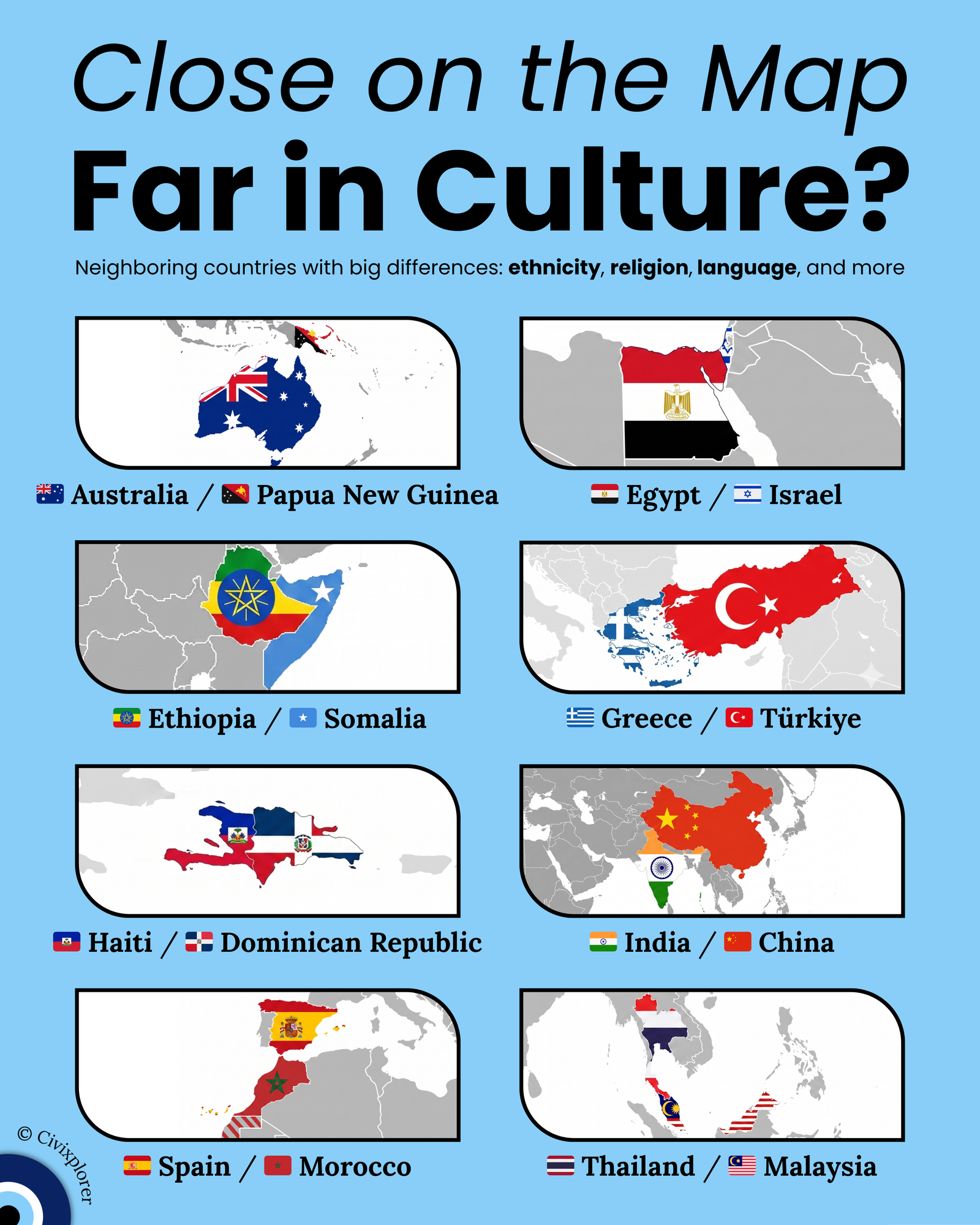
We often assume that geographical proximity automatically breeds cultural similarity. For centuries, trade, migration, and shared climates have typically blended the traditions of neighboring nations into a gradient. However, across the globe, there exist cultural fault lines—places where a single border, mountain range, or narrow strait separates two worlds that could not be more different in language, religion, and historical trajectory.
These sharp divides are rarely accidental. They are the result of powerful historical forces, such as divergent colonial legacies, extreme geological barriers, or engineered population shifts. By analyzing these "neighboring opposites," we gain a deeper understanding of how human identity is forged by decisions and disasters rather than just latitude and longitude.
The Island of Two Worlds: Haiti and the Dominican Republic
Perhaps the most striking example of a cultural fault line exists on the island of Hispaniola. Despite sharing a porous land border and the same Caribbean climate, Haiti and the Dominican Republic represent a classic case of divergent colonial history. In the west, the French colony of Saint-Domingue (Haiti) was built on a brutal plantation economy fueled by a massive population of enslaved West Africans. This created a nation that is overwhelmingly of African descent, speaks Haitian Creole, and practices a unique blend of Catholicism and Vodou.
In contrast, the eastern side remained under Spanish control as Santo Domingo. The economy there focused more on cattle ranching and mining, leading to a higher degree of ethnic intermarriage and a culture that remains deeply rooted in Hispanic heritage, the Spanish language, and Roman Catholicism. This historical divergence has created a socioeconomic and cultural gap so wide that the two nations are often described as "one island, two worlds."
The Himalayan Wall: India and China
While some borders are defined by treaties, the divide between India and China was dictated by extreme geology. The Himalayas, the highest mountain range on Earth, served as an impenetrable barrier for millennia, preventing mass migration and military conquest. As a result, two of the oldest civilizations in human history developed in almost total isolation from one another.
This natural wall separates entirely different linguistic families (Sino-Tibetan vs. Indo-Aryan) and distinct dominant religions. While Buddhism eventually crossed the mountains via the Silk Road, the foundational cultures remained distinct: one a Han-dominated state with a history of centralization, the other a pluralistic, religiously diverse democracy.
Engineered Borders: Greece and Türkiye
The contrast between Greece and Türkiye is unique because their cultures were once deeply intertwined under the Ottoman Empire. They share similar cuisines, music, and Mediterranean lifestyles, yet the modern border feels like a civilizational wall between the Orthodox Christian West and the Sunni Muslim East.
This "hardening" of the border was largely the result of the 1923 Population Exchange. Following the Treaty of Lausanne, approximately 1.5 million Christians were forced from Türkiye to Greece, and 500,000 Muslims were moved in the opposite direction. This abrupt act of demographic engineering eliminated centuries of multicultural coexistence, creating the rigid ethno-religious boundaries seen today.
The Civilizational Gate: Spain and Morocco
At the Strait of Gibraltar, a mere 14 kilometers of water separates Europe from Africa. This narrow gap represents one of the most significant cultural frontiers in the world. For nearly 800 years, Islamic Moorish empires ruled parts of Spain, leaving a permanent mark on its architecture and language. However, the Reconquista and the subsequent expulsion of Muslims and Jews re-oriented Spain toward the Catholic, European sphere. Today, that short maritime distance marks a definitive boundary between the European Union and the Arab-Berber world of North Africa.
A Maritime Contrast: Australia and Papua New Guinea
Though separated only by the Torres Strait, Australia and Papua New Guinea represent one of the sharpest contrasts between a developed settler society and a highly diverse developing nation. Australia is a largely urbanized, English-speaking nation shaped by British colonization. Across the water, Papua New Guinea is home to over 800 indigenous languages, maintaining a clan-based social structure that remains one of the most ethnically diverse on the planet.
Ultimately, these pairings remind us that borders are historical accidents, not cultural rules. Whether forged by the brutal economics of colonialism or the thrust of tectonic plates, these fault lines prove that being a "neighbor" is a geographic reality, but never a cultural guarantee.

Comments (0)
Join the Conversation
Login to share your thoughts with the community.
Login to Comment