
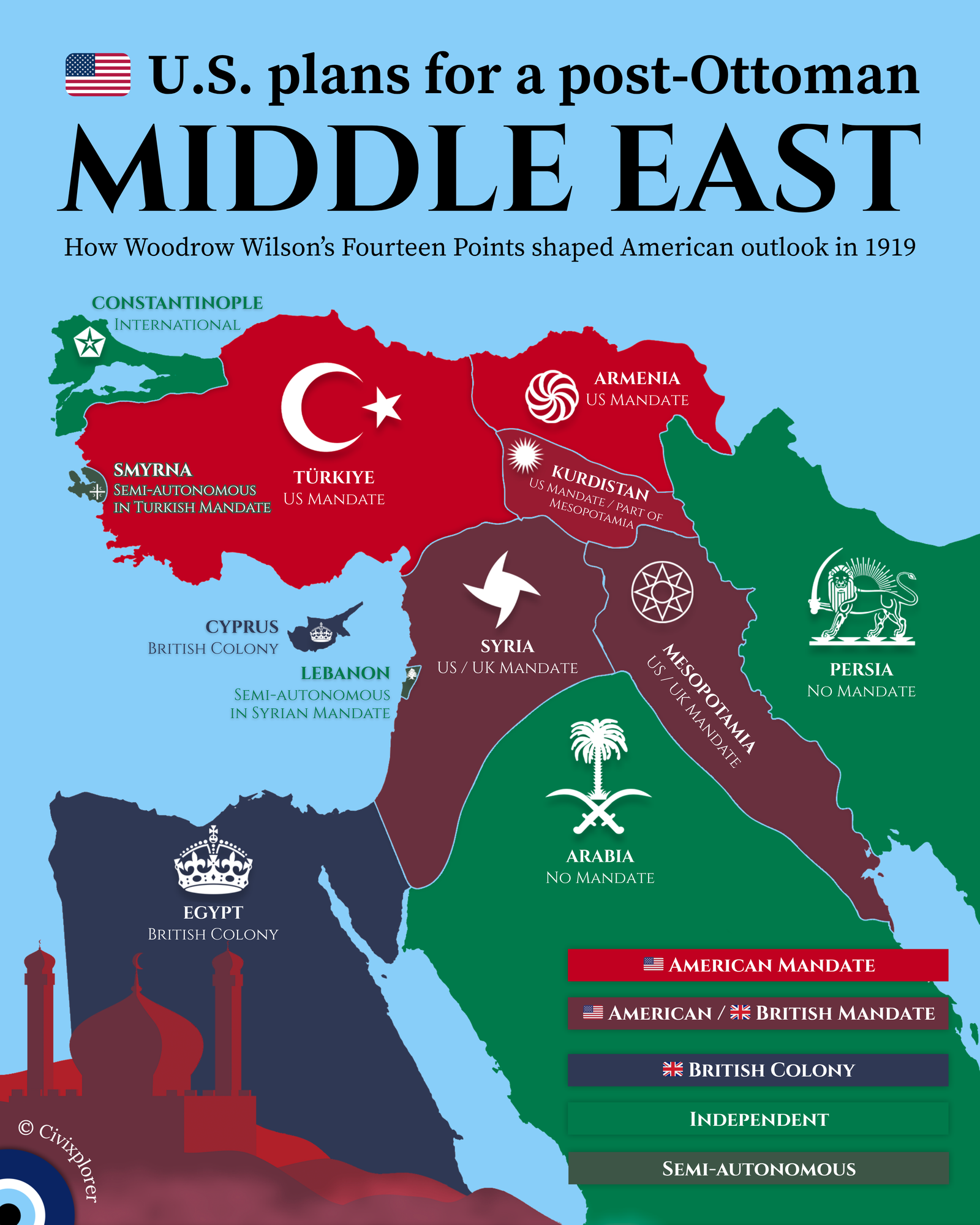
Following the collapse of the Ottoman Empire after World War I, the geopolitical future of the Middle East was a blank canvas—or rather, a battlefield of competing visions. While the British and French were busy negotiating the secret Sykes-Picot Agreement to carve out colonial spheres of influence, U.S. President Woodrow Wilson arrived at the 1919 Paris Peace Conference with a fundamentally different approach. Guided by his Fourteen Points, Wilson championed the concept of self-determination, envisioning a world where "mandates" were temporary trusteeships designed to guide nations toward full independence rather than serving as permanent colonies.
This unique infographic visualizes the "what-if" scenario of the American outlook in 1919. It reflects an idealized version of the region where the United States would have taken a direct, benevolent role in stabilizing the post-Ottoman world. Central to this vision was the King-Crane Commission, a fact-finding mission sent by Wilson to survey local populations. Their findings were revolutionary: they discovered that the people of the Levant vehemently opposed French rule and, if independence wasn't immediately possible, they vastly preferred a U.S. mandate because America was seen as a neutral power with no imperial history in the region.
One of the most striking features of this map is the presence of Wilsonian Armenia. Fueled by immense public sympathy following the Armenian Genocide, Wilson personally advocated for a large, independent Armenian state under U.S. protection. Similarly, the map acknowledges a proposed Kurdistan and an International Zone for Constantinople (modern-day Istanbul). The goal was to ensure that vital maritime chokepoints, like the Bosphorus and Dardanelles, remained open to global trade under international oversight rather than being controlled by a single power.
However, this vision of a reorganized Middle East remained a fantasy for two primary reasons. First, a wave of American isolationism took hold at home; the U.S. Senate ultimately rejected the Treaty of Versailles and the mandate for Armenia, wary of "entangling alliances" and the high cost of nation-building. Second, the Turkish War of Independence, led by Mustafa Kemal Atatürk, militarily dismantled the Allied plans for Anatolia. The resulting Treaty of Lausanne in 1923 established the modern borders of Turkey, effectively erasing the proposed Armenian and Kurdish states from the map. Without American involvement to check their ambitions, Britain and France reverted to traditional realpolitik, drawing the artificial borders that have defined many of the region's conflicts for the last century.

Comments (0)
Join the Conversation
Login to share your thoughts with the community.
Login to Comment