
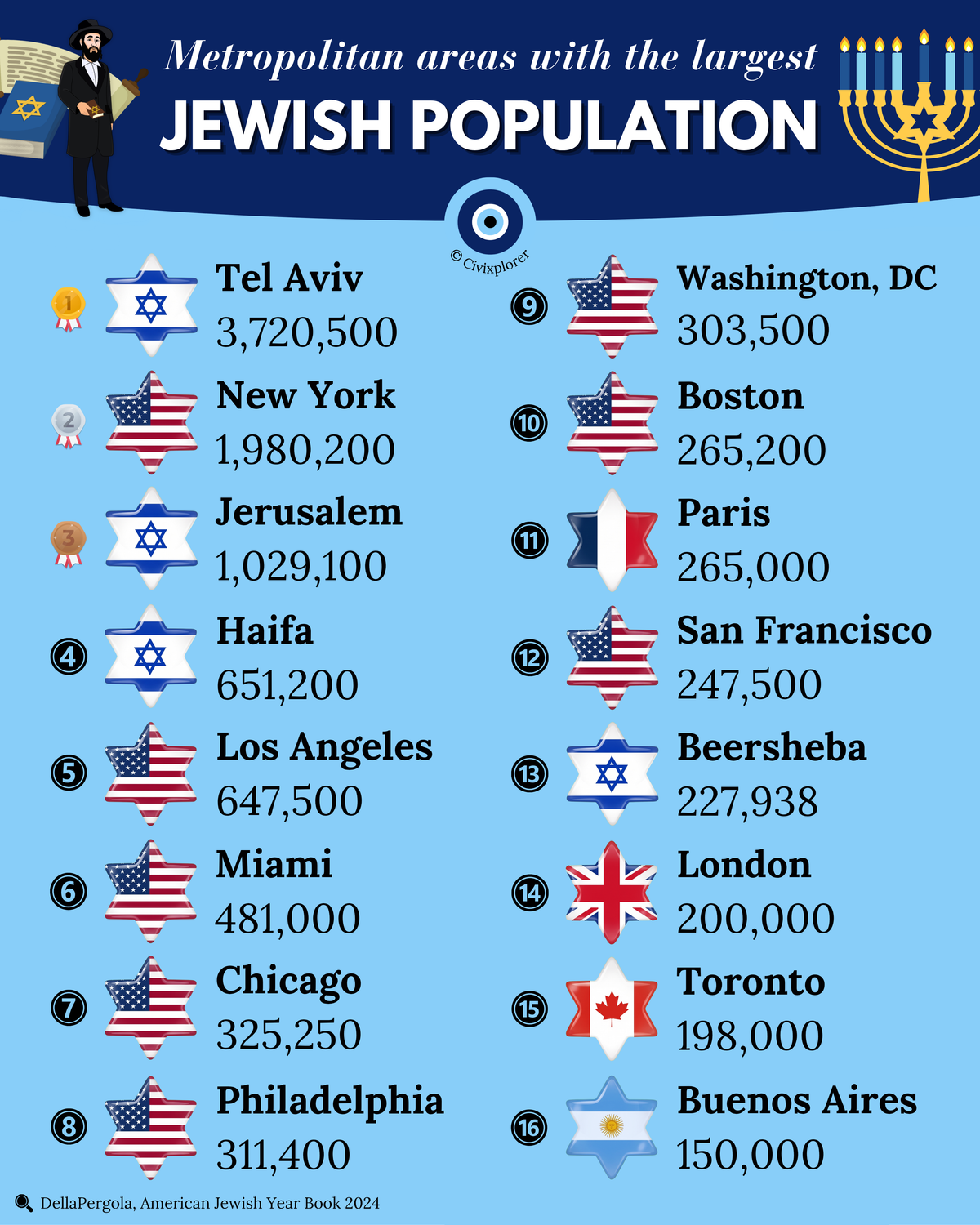
The modern demographic landscape of world Jewry reveals a dramatic pattern of urbanization and consolidation shaped by centuries of migration, geopolitical upheaval, and cultural shifts. According to data from Sergio DellaPergola's 2024 demographic study in the American Jewish Year Book, the global core Jewish population stands at approximately 15.74 million people. Rather than being evenly dispersed across the globe, over 70% of the world's Jewish population is concentrated in just 19 metropolitan areas, with more than 51% residing in the top five urban centers alone. This intense geographical focus has created a distinct bipolar reality, with 13 of the world's 16 largest Jewish metropolitan areas located in either Israel or the United States.
In Israel, rapid urban growth and high fertility rates have established unprecedented population density across major metropolitan regions. The Tel Aviv metropolitan area ranks first globally, hosting over 3.72 million Jewish residents. This statistic represents a broad statistical conurbation—spanning from Netanya to Ashdod—that serves as the economic, technological, and secular engine of the nation. By contrast, Jerusalem ranks third worldwide with more than 1.02 million Jewish inhabitants, functioning as the country's spiritual, historical, and political anchor. Israel's geographic distribution extends further to Haifa, ranking fourth with 651,200 residents, and Beersheba, ranking thirteenth with 227,938, demonstrating planned development and growth across northern and southern regions.
Across the Atlantic, the United States remains home to the largest Diaspora community, rooted in the massive waves of late nineteenth and early twentieth-century Eastern European immigration. New York holds the second spot globally with nearly 1.98 million Jews, serving as the historic port of entry and cultural heart of American Jewry. Internal migration patterns throughout the twentieth century expanded the Jewish presence into the Sunbelt, propelling Los Angeles to fifth place with 647,500 residents and Miami to sixth place with 481,000. Historical industrial centers and academic hubs also maintain substantial populations, including Chicago at seventh with 325,250, Philadelphia at eighth with 311,400, Washington at ninth with 303,500, Boston at tenth with 265,200, and San Francisco at twelfth with 247,500.
Outside of Israel and North America, only a few major urban centers host significant Jewish communities, reflecting the catastrophic losses of the Holocaust and subsequent post-war relocations. Paris ranks eleventh globally with 265,000 residents, representing the largest Jewish community in Europe. The demographic landscape of French Jewry was fundamentally reshaped in the 1950s and 1960s following North African decolonization, when a massive influx of Sephardic Jews from Algeria, Morocco, and Tunisia revitalized Parisian Jewish life. London ranks fourteenth with 200,000 residents, while Toronto ranks fifteenth with 198,000. In South America, Buenos Aires ranks sixteenth with 150,000 residents, standing as the continent's primary cultural and demographic anchor.
Understanding these numbers requires recognizing that statistical definitions vary across international borders, as Israeli counts reflect broad household data while diaspora figures draw from community self-identification studies. Nevertheless, the overarching picture highlights how historic migration pathways, economic opportunity, and demographic trends have consolidated global Jewish life into a select group of vibrant, interconnected metropolitan regions.

Comments (0)
Join the Conversation
Login to share your thoughts with the community.
Login to Comment