
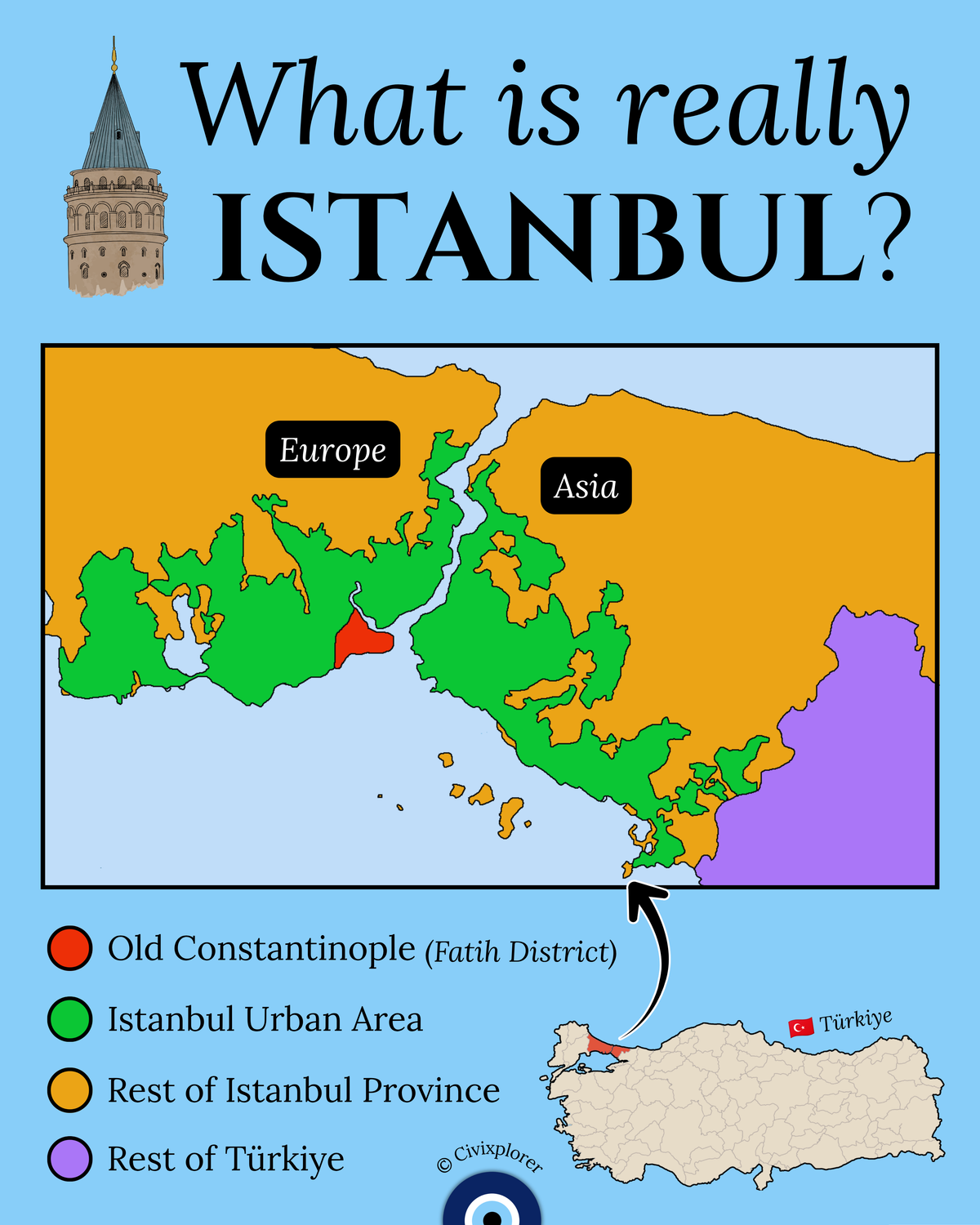
Istanbul is one of the world's most captivating urban paradoxes, where a single name refers to vastly different geographic and administrative realities. At its historic heart lies the Fatih district, occupying the famous Historic Peninsula that spans a mere 15.6 square kilometers. Enclosed by the Sea of Marmara, the Golden Horn, and the fifth-century Theodosian land walls, this compact territory served as the imperial capital for the Roman, Byzantine, and Ottoman Empires. Within this dense late-antique footprint, centuries of history are layered directly atop one another, housing world-famous monuments such as the Hagia Sophia, Topkapi Palace, the Blue Mosque, and the Basilica Cistern. When Emperor Constantine refounded the ancient settlement of Byzantium as Constantinople in 330 CE, it was from this tiny, defensible point that an empire governed vast territories across Europe, Asia, and Africa.
While many assume that Istanbul only became a transcontinental metropolis in modern times, its connection across the Bosphorus Strait is deeply ancient. Settlements on the Asian shore, such as Chrysopolis (modern Üsküdar) and Chalcedon (modern Kadıköy), functioned as essential strategic and economic counterparts to the imperial core long before modern bridges were built. The Bosphorus served not as a barrier, but as a vital maritime highway and trade bridge linking the Mediterranean and Black Seas. Contrary to popular belief, the name Istanbul was not suddenly invented upon the Ottoman conquest in 1453 by Mehmed II. Derived from the medieval Greek phrase eis tin polin, meaning "to the city," the name coexisted alongside Konstantiniyye for centuries before official postal standardization occurred in 1930.
During the second half of the 20th century, Istanbul underwent an extraordinary demographic and physical transformation driven by massive rural-to-urban migration. From a population of roughly one million in 1950, the city expanded rapidly outward to accommodate over 15 million residents today. Rather than expanding in a uniform circle, the continuous urban area grew laterally along the coastlines of the Sea of Marmara and major transportation corridors. This linear development was strongly influenced by environmental protections designed to safeguard the Northern Forests and crucial water reservoirs. Across both shores, former Genoese outposts like Galata and sprawling suburban districts like Esenyurt grew into a unified, bustling urban fabric.
The broadest definition of Istanbul encompasses the entire Istanbul Province, which shares identical administrative boundaries with the Istanbul Metropolitan Municipality under reforms enacted in 2004. Spanning over 5,300 square kilometers, this official provincial territory includes 39 distinct districts—25 on the European side and 14 on the Asian side. Large expanses of this province remain rural or forested, yet administratively, every corner falls under a single municipal authority. Although political capital functions were relocated to Ankara in 1923, Istanbul remains Turkey's undeniable economic, cultural, and demographic powerhouse. Ultimately, understanding Istanbul requires recognizing this hierarchy of scales, where a tiny ancient peninsula gave rise to a sprawling transcontinental megalopolis.

Comments (0)
Join the Conversation
Login to share your thoughts with the community.
Login to Comment