
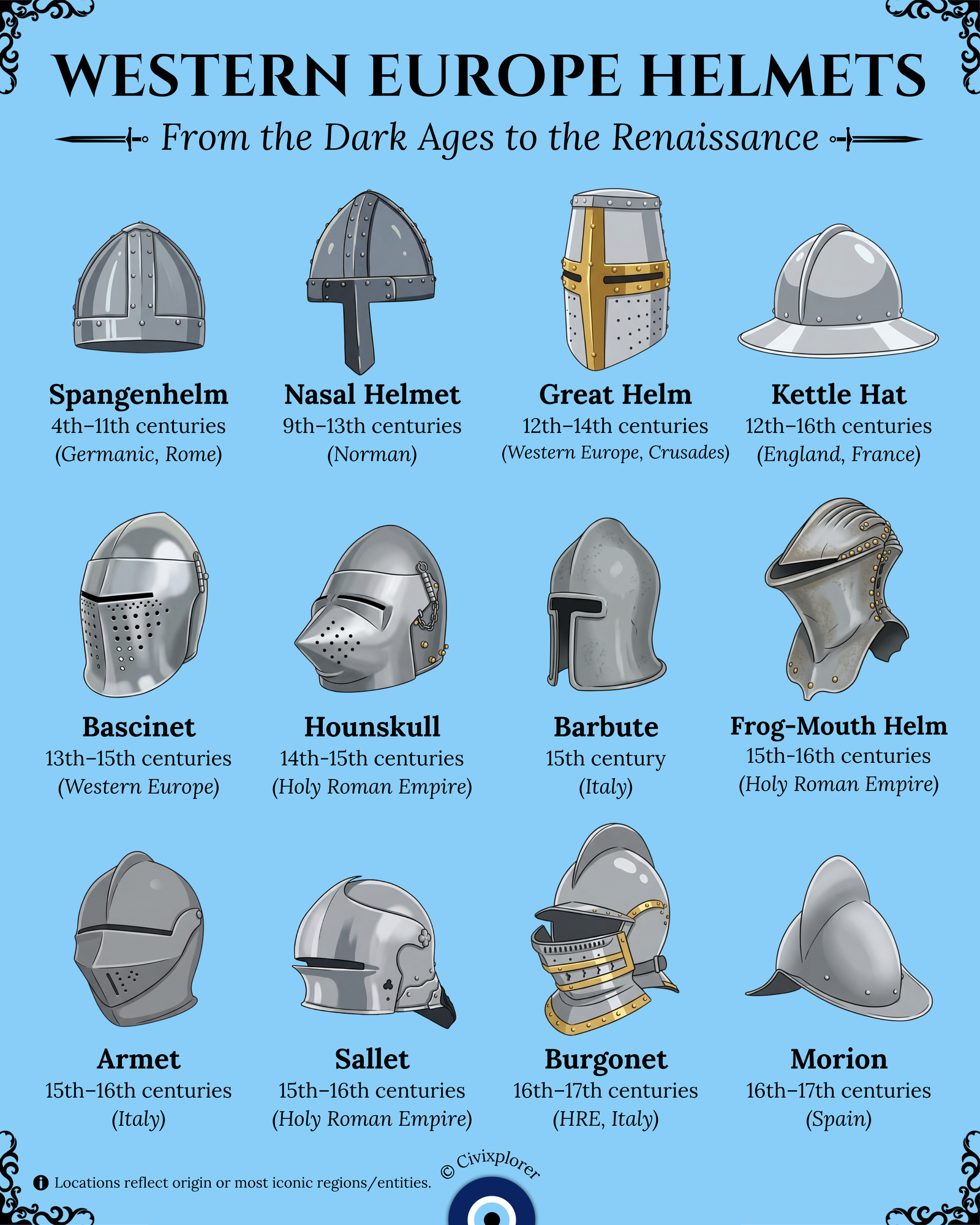
The history of Western European head protection from the 4th century to the 17th century illustrates a sophisticated arms race driven by changes in metallurgy, tactics, and weapon technology. This evolution saw armorers transition from simple, practical designs to highly specialized engineering before returning to lighter forms in the age of gunpowder.
The Era of Awareness: Dark Ages to Early Medieval
During the early Middle Ages, warfare was characterized by close-quarters infantry and light cavalry movements. Designs like the Spangenhelm and the Nasal Helmet prioritized situational awareness above all else. These helmets allowed the wearer to see clearly, breathe easily, and communicate orders effectively while providing essential cranial defense. The nasal bar was a particularly brilliant addition, offering facial protection from sword slashes without the weight or restriction of a full faceplate.
The Shift to Enclosure: The High Middle Ages
As the mounted lance charge became the dominant tactic on the battlefield, the need for facial protection became paramount. This led to the development of the Great Helm, a flat-topped design that provided near-total coverage against arrows and lances. While offering unmatched protection, its massive drawbacks included excessive weight, poor ventilation, and severely restricted peripheral vision. Consequently, many knights only wore them for the initial charge, switching to lighter, open-faced gear for the ensuing melee.
The Geometry of Survival: Late Medieval Engineering
A significant leap in armor technology occurred with the transition to the Bascinet and its "pig-faced" variant, the Hounskull. Instead of simply making the steel thicker, armorers utilized the glancing surface principle. The conical snout of the Hounskull was engineered so that incoming lances or arrows would slide off at an angle, protecting the eyes and neck. Ventilation holes were also angled away from the front to prevent weapons from finding a purchase.
Ritualized Protection: The Frog-Mouth Helm
Perhaps the most specialized design in history is the Frog-Mouth Helm. Unlike other helmets, this was not a battlefield piece but was engineered specifically for the highly ritualized sport of jousting. It was bolted directly to the breastplate, and its unique shape allowed a knight to see while leaning forward but completely protected the eyes behind a steel "mouth" once they sat upright at the moment of impact.
The Gunpowder Revolution and the Open Face
The advent of reliable firearms in the 16th and 17th centuries fundamentally changed the necessity of plate armor. Heavy faceplates could not stop musket balls at close range, making them a poor trade-off for the loss of visibility. Warfare moved toward large, disciplined infantry formations where communication and battlefield awareness were critical. This led back to open-faced designs like the Burgonet and the Morion, which protected the head while keeping the face entirely free for breathing and observation.
Comments (0)
Join the Conversation
Login to share your thoughts with the community.
Login to Comment