
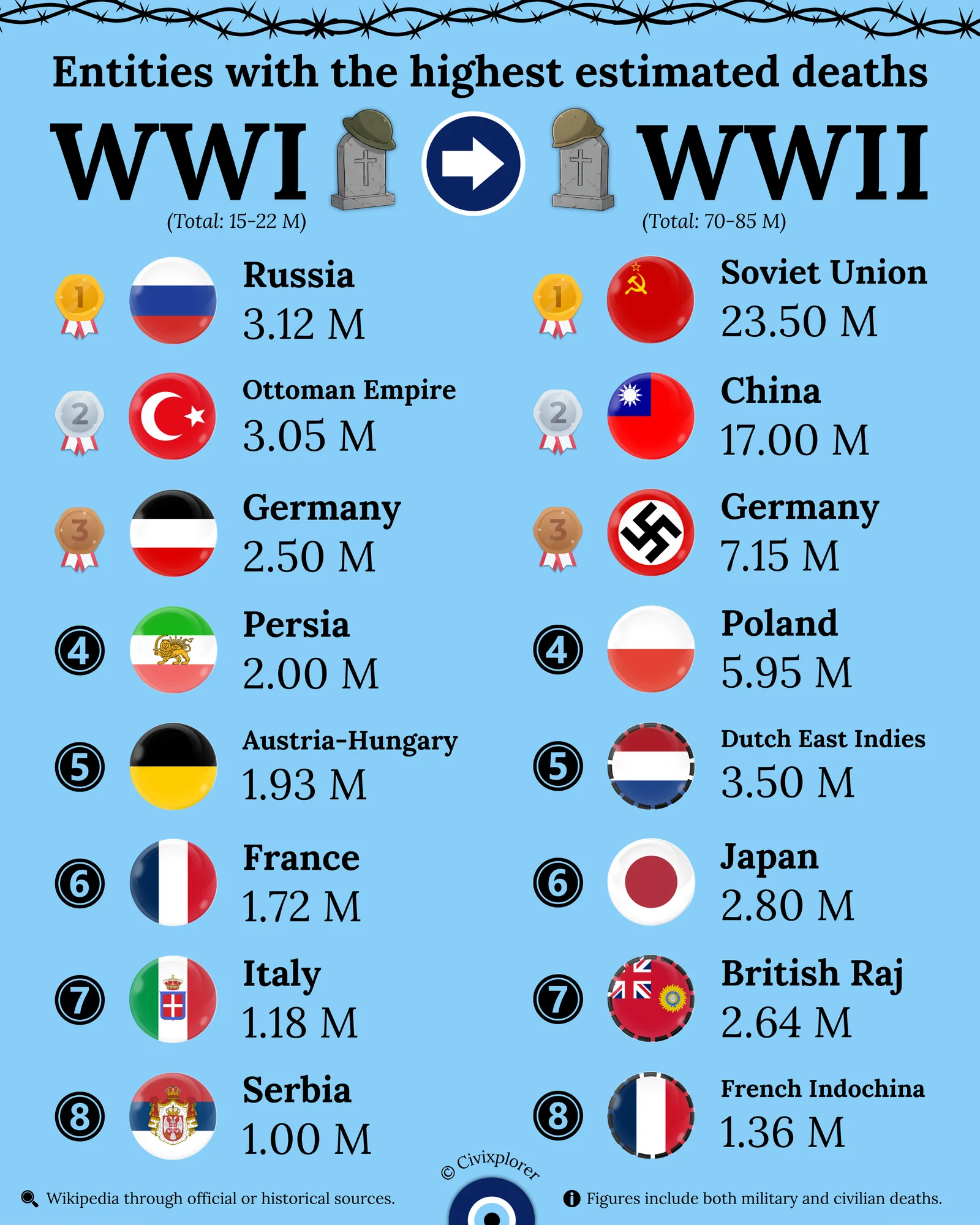
The transition from the 15–22 million deaths of World War I to the 70–85 million lost in World War II represents a sobering reality in human history. While the first global conflict was a catastrophe of industrial warfare, the second evolved into a "total war" where the distinction between soldiers and civilians nearly vanished.
A defining feature of both wars was the immense toll on the Eastern Front, leaving Russia (later the Soviet Union) and Germany with the highest rankings on both lists. During World War I, Russia faced 3.12 million deaths amidst internal revolution and supply chain collapses. In World War II, this figure exploded to 23.5 million as the Soviet Union bore the brunt of a "war of annihilation," with nearly 80% of German combat deaths occurring on the Eastern Front. Germany’s own losses reflected its role as a multi-front aggressor, losing 2.50 million in the first war and 7.15 million in the second.
In World War I, the Ottoman Empire suffered 3.05 million losses due to brutal mountain warfare and internal state collapse. This trauma influenced the successor state, Türkiye, to remain strictly neutral for most of World War II to avoid another demographic catastrophe. Interestingly, Persia ranked fourth in WWI losses with 2 million deaths, despite being technically neutral, due to a Great Famine exacerbated by occupying forces.
The scale of World War II was further inflated by the Pacific Theater and Japanese imperialism. China suffered the second-highest toll of the era with 17 million deaths, the result of a decade-long resistance against occupation. Additionally, colonial nations like the Dutch East Indies and the British Raj appears on the list with millions of deaths caused by occupation-induced famines and forced labor, such as the Bengal Famine of 1943.
Finally, the tragedy of Poland in World War II stands as a unique example of non-combatant loss. With 5.95 million deaths—roughly 17% of its population—the majority were civilians caught in the crosshairs of the Holocaust and brutal occupations. This data serves as a haunting reminder of how 20th-century warfare moved from a conflict between armies to a conflict between entire populations.
Comments (0)
Join the Conversation
Login to share your thoughts with the community.
Login to Comment