
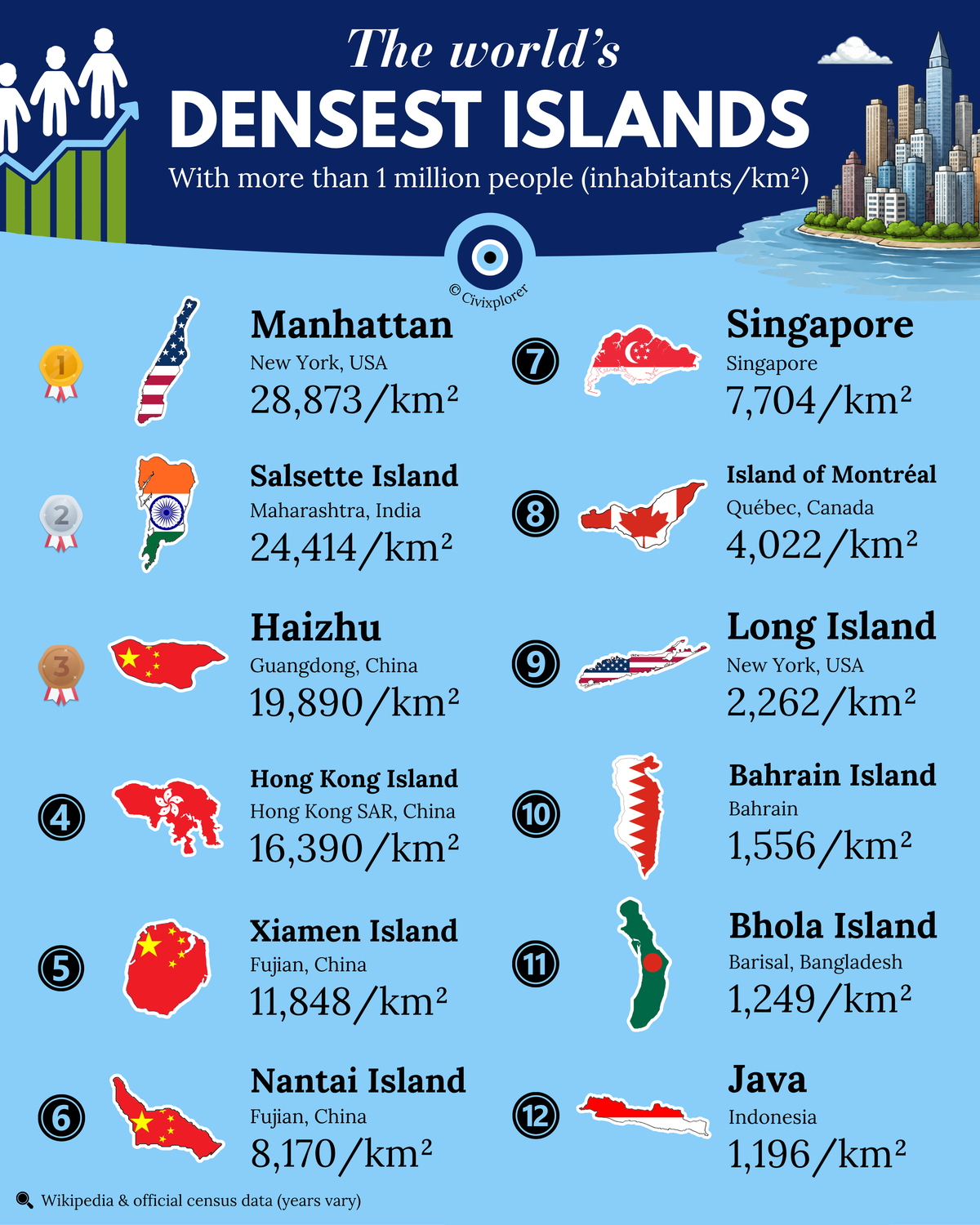
The traditional image of an island—an isolated, palm-fringed paradise—stands in stark contrast to the reality of the world’s most densely populated islands. These geographic features, ranging from river estuaries to oceanic nations, serve as the primary engines of global trade, finance, and culture. By focusing on islands with over one million inhabitants, we move beyond mere geographic curiosities to analyze large-scale urban systems where density shapes every aspect of daily life.
Manhattan currently leads the ranking with a staggering 28,873 inhabitants per square kilometer. This extreme concentration is a direct result of its geography: bounded by the Hudson, East, and Harlem rivers, the island could not expand outward. Instead, it grew upward, facilitated by the sturdy Manhattan schist bedrock and the rigid 1811 Commissioners' Plan. Interestingly, while Manhattan is a global financial heart, its density was actually higher in the early 20th century before the rise of modern suburbanization.
In second place, Salsette Island in India provides a masterclass in land transformation. Home to the bulk of Mumbai, this island was originally an archipelago of seven distinct islands that were physically joined through massive 18th and 19th-century reclamation projects. Today, with over 15 million residents, its density of 24,414/km² is driven by rapid rural-to-urban migration and the constraints of being trapped between the Arabian Sea and the Western Ghats.
China's rapid urbanization is represented by several "river islands" that function as the historic and economic cores of megacities. Haizhu, situated in the Pearl River of Guangzhou, boasts a density of 19,890/km², while Xiamen and Nantai follow with significant populations. Unlike Manhattan, which densified over a century, these Chinese hubs experienced extreme intensification in just a few decades due to state-directed economic liberalisation.
The Special Administrative Region of Hong Kong is often misunderstood through the lens of density. While the entire region includes vast green spaces, Hong Kong Island itself is incredibly crowded, with 16,390/km². Because the island is largely mountainous, the population is forced into narrow coastal strips, creating some of the world's most vertical urban forms and smallest average apartment sizes.
Contrastingly, Singapore represents a planned high-density success story. As a sovereign city-state with virtually no hinterland, it uses strict land-use management and extensive public housing to maintain a density of roughly 7,700/km² while offering high living standards and abundant greenery. This proves that density does not necessarily equal a lack of livability if urban design is prioritized,.
The ranking also features North American outliers like the Island of Montréal and Long Island. Montréal's density of 4,022/km² is contained by its river borders, centralizing its population in a way many sprawling North American cities are not. Long Island, at 2,262/km², is a unique case where the extreme urban density of Brooklyn and Queens at its western tip pulls up the average for the more suburban eastern counties.
Finally, we see islands where density is driven by agricultural fertility rather than skyscrapers. Java, Indonesia, is the most populous island on Earth, home to over 150 million people. Its density of 1,196/km² is sustained by volcanic soils that have supported intensive rice cultivation for centuries. Similarly, Bhola Island in Bangladesh reaches its density of 1,249/km² through high rural fertility and the settlement of fertile alluvial soils in the Meghna River delta.
Ultimately, these islands reveal that geographical constraints amplify human pressure. Whether through vertical skyscrapers, land reclamation, or intensive agriculture, humanity has consistently found ways to thrive within the finite borders of the world's most strategic islands.

Comments (0)
Join the Conversation
Login to share your thoughts with the community.
Login to Comment