
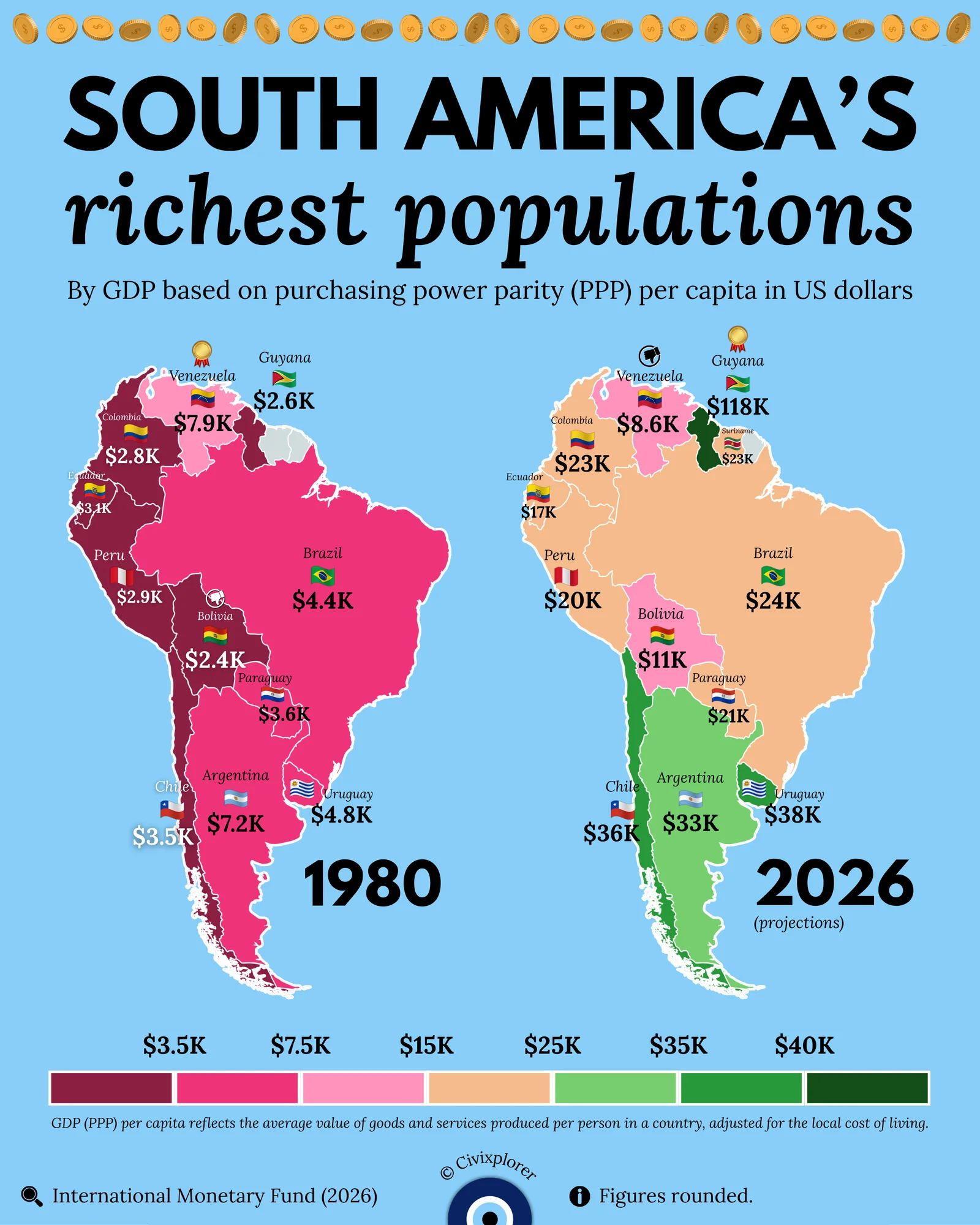
The economic landscape of South America has undergone a staggering transformation over the last 46 years. By comparing the GDP based on purchasing power parity (PPP) per capita from 1980 to the projected figures for 2026, we see a story of dramatic rises, tragic falls, and the enduring power of institutional stability.
To truly understand these shifts, we must look at the metric of GDP (PPP) per capita. While GDP measures total national wealth, the "PPP" adjustment accounts for the local cost of living. This provides the most accurate reflection of the actual standard of living—measuring what an average person can truly afford in their own country.
A Tale of Two Models: Stability vs. Decline In 1980, 🇻🇪 Venezuela was the "shining star" of the region, boasting the highest per capita production. However, a lack of diversification, the institutional decay, and the hyperinflation associated with "Chavismo" led to a tragic collapse, leaving it at the bottom of the rankings by 2026. The fall of Nicolás Maduro and future 🇺🇸 U.S. investments in infrastructure could mean a change in the current situation. We will see how political events actually unfold.
The Rise of the New "El Dorado" The most explosive change on the map is undoubtedly 🇬🇾 Guyana. In 1980, it was among the poorest nations in the region with a GDP (PPP) per capita of just $2.6K. Fast forward to 2026, and it is projected to hit a staggering $118K. This "triple-digit" growth was ignited by the 2015 discovery of massive offshore oil reserves. While the country faces the challenge of the "Resource Curse," it currently stands as the continent's most significant economic surge.
Conversely, Uruguay and Chile have emerged as the regional models for sustainable development. Uruguay, often called the "Switzerland of the Americas," is celebrated for its low corruption and strong middle class. Chile has utilized its vast mineral reserves to build a market-oriented model that remains a leader in regional infrastructure.
Argentina’s Road to Recovery The 2026 projections also capture Argentina in a pivotal moment of transition. After decades of chronic overspending and hyperinflation, the country is undergoing "shock therapy" under new leadership. The data reflects a painful but necessary attempt to deregulate the economy and restore long-term growth.
Ultimately, the map tells a story of institutional quality. Nations that maintained stable rules and diversified their interests have thrived, while those that succumbed to populism have seen their early leads evaporate.
Comments (0)
Join the Conversation
Login to share your thoughts with the community.
Login to Comment