
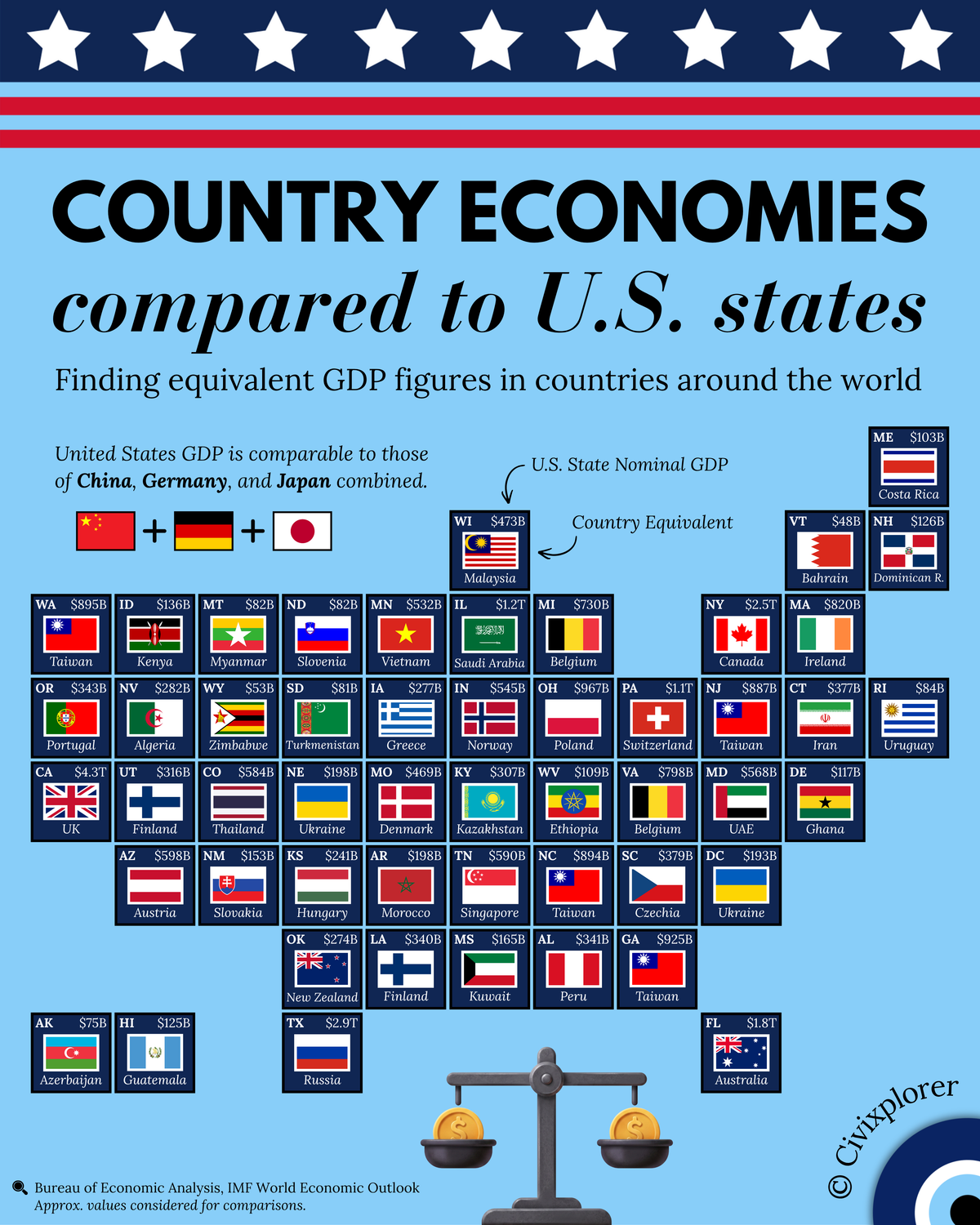
The sheer scale of the American economic engine is often difficult to grasp until you visualize it through a global lens. By mapping the nominal Gross Domestic Product (GDP) of individual U.S. states against the total output of sovereign nations, we reveal a startling reality: the United States is essentially a collection of some of the world’s most powerful economies functioning under a single flag. Recent data from the Bureau of Economic Analysis (BEA) and the IMF indicates that the total U.S. nominal GDP has reached approximately $30.8 trillion, a figure so massive that it roughly equals the combined economic output of China, Germany, and Japan.
When we break this down state-by-state, the comparisons become even more fascinating. California, with a nominal GDP of approximately $4.3 trillion, now stands as an economic peer to the United Kingdom. What makes this comparison truly remarkable is the efficiency of the California workforce; the state achieves this output with only 39 million people, compared to the UK’s 67 million. This hyper-productivity is driven by a unique "quadruple threat" of industries: the high-tech innovation of Silicon Valley, the global reach of Hollywood’s entertainment industry, a massive agricultural sector, and its role as a primary logistics gateway to Asian markets.
Similarly, Texas—with a GDP of $2.9 trillion—parallels the entire national output of Russia. While Russia has a population of over 140 million, Texas matches its economic weight with just 30 million residents. While both are energy powerhouses, Texas has successfully diversified into aerospace, advanced manufacturing, and technology, creating a more resilient and high-value economic structure than its sovereign counterpart. Meanwhile, New York State produces $2.5 trillion, matching the total output of Canada. The concentration of financial capital in Lower Manhattan allows New York to rival a G7 nation despite having less than half of Canada's population.
Further down the list, we see a "multiple match" phenomenon that highlights the strength of mid-tier states. Countries like Taiwan—a global semiconductor leader—find their economic equivalents in multiple states, including Washington ($895B), New Jersey ($887B), and Georgia ($925B). This illustrates that American economic power is not just limited to the "Big Three" states but is distributed across a network of highly specialized regional hubs.
This economic dominance is made possible by the U.S. functioning as a continental-scale unified market. Unlike independent nations, U.S. states benefit from a common currency, no internal trade barriers, and shared federal institutions, allowing for extreme sectoral specialization. While nominal GDP is sensitive to currency fluctuations and does not account for the cost of living (Purchasing Power Parity), these comparisons serve as a powerful testament to the productivity, capital concentration, and technological leadership that define the American economy today.

Comments (0)
Join the Conversation
Login to share your thoughts with the community.
Login to Comment