
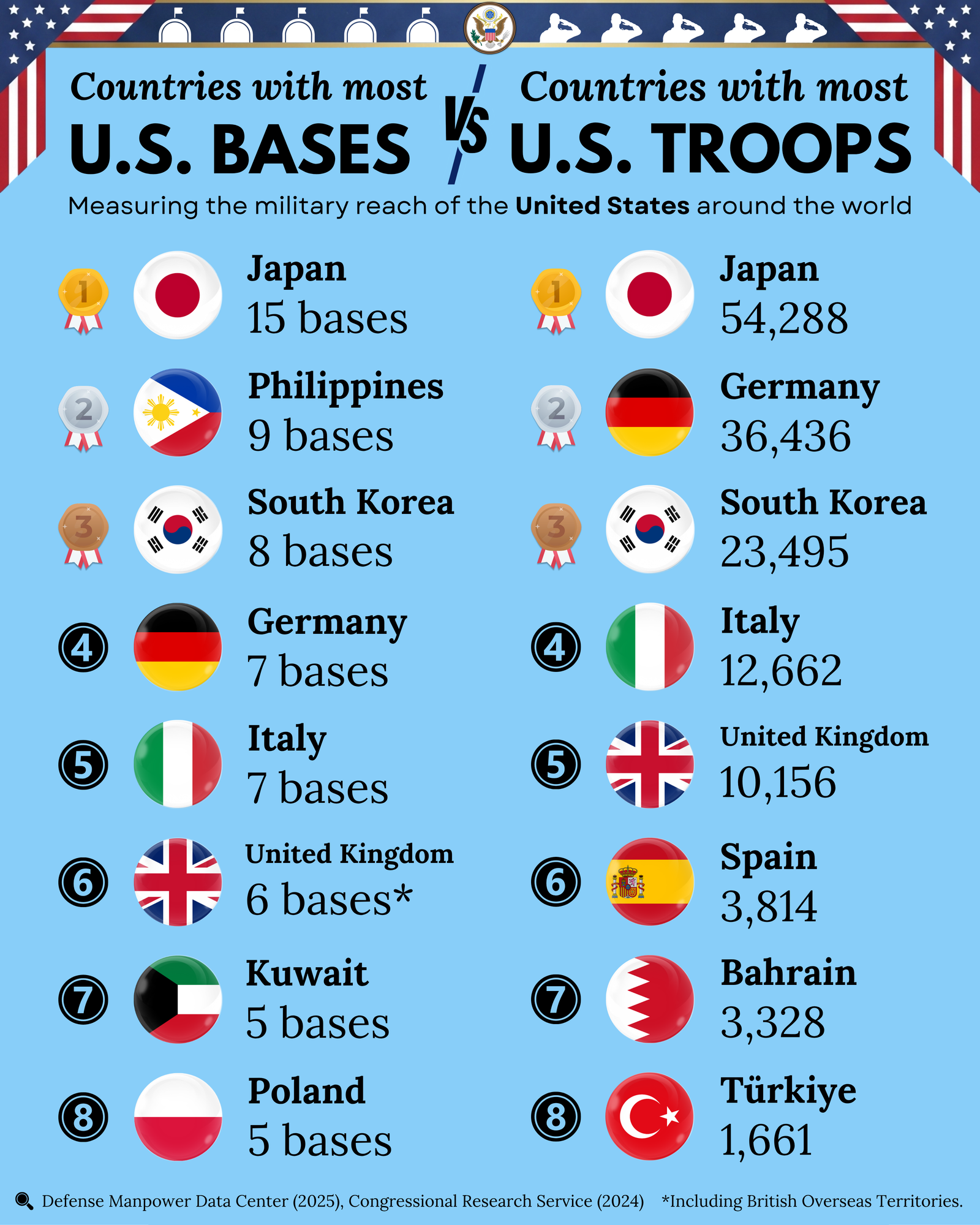
The global military reach of the United States is defined by a complex network of permanent installations and rotational deployments designed to project power and maintain regional stability. As of May 2026, this footprint is undergoing a significant transformation, moving from the static alliances of the post-WWII era toward a more transactional and volatile posture. By analyzing the distribution of over 160,000 personnel across dozens of theaters, we can see the clear strategic priorities of the current administration.
The Indo-Pacific: Containment and Deterrence
The primary focus of U.S. strategy has shifted decisively toward the Indo-Pacific to counter China's rising military influence and deter North Korean nuclear ambitions. Japan remains the absolute anchor of this presence, hosting the most U.S. bases (15) and the highest number of troops, exceeding 54,000 personnel. These forces, which include the U.S. Seventh Fleet, ensure a "Free and Open Indo-Pacific" and protect sea lanes responsible for nearly 40% of global maritime trade. Meanwhile, South Korea hosts over 23,000 troops and 8 bases, acting as a strategic "tripwire" to ensure an immediate response to any aggression on the peninsula. A fascinating data point is the Philippines, which ranks second in total bases (9) despite having low permanent troop numbers; this reflects a modern strategy of rotational access and "lily-pad" sites that allow for rapid deployment without the friction of a permanent garrison.
The European Theater: A Strategic Rupture
Historically the logistical backbone for global operations, the U.S. presence in Europe is currently facing unprecedented diplomatic and political pressure. On May 1, 2026, the Pentagon officially announced a withdrawal of approximately 5,000 troops from Germany, representing roughly 14% of the contingent stationed there. This move is a direct response to friction between the Trump administration and German Chancellor Friedrich Merz over the ongoing conflict in Iran. Similar threats of withdrawal have been aimed at Italy and Spain, as the U.S. demands greater allied support for securing the Strait of Hormuz. Despite these tensions, Germany remains the most vital logistics hub in the region, housing the Ramstein Air Base and major command headquarters.
Middle East and Global Chokepoints
In the Middle East, the U.S. footprint is highly specialized for maritime control and rapid-response logistics. Bahrain serves as the essential headquarters for the U.S. Fifth Fleet, making it the epicenter of efforts to secure global energy supply routes during regional hostilities. Kuwait remains the primary staging ground for the U.S. Central Command (CENTCOM), providing the infrastructure needed to move heavy armor and troops throughout the theater. While troop counts in places like Türkiye remain relatively low, these installations provide critical access to both Europe and the Middle East, serving as a strategic bridge for global power projection.
| Position | Country | U.S. Bases |
|---|---|---|
| 1 | Japan | 15 |
| 2 | Philippines | 9 |
| 3 | South Korea | 8 |
| 4 | Germany | 7 |
| 5 | Italy | 7 |
| 6 | United Kingdom | 6 |
| 7 | Kuwait | 5 |
| 8 | Poland | 5 |
| Position | Country | U.S. Troops |
|---|---|---|
| 1 | Japan | 54,288 |
| 2 | Germany | 36,436 |
| 3 | South Korea | 23,495 |
| 4 | Italy | 12,662 |
| 5 | United Kingdom | 10,156 |
| 6 | Spain | 3,814 |
| 7 | Bahrain | 3,328 |
| 8 | Türkiye | 1,661 |

Comments (0)
Join the Conversation
Login to share your thoughts with the community.
Login to Comment