
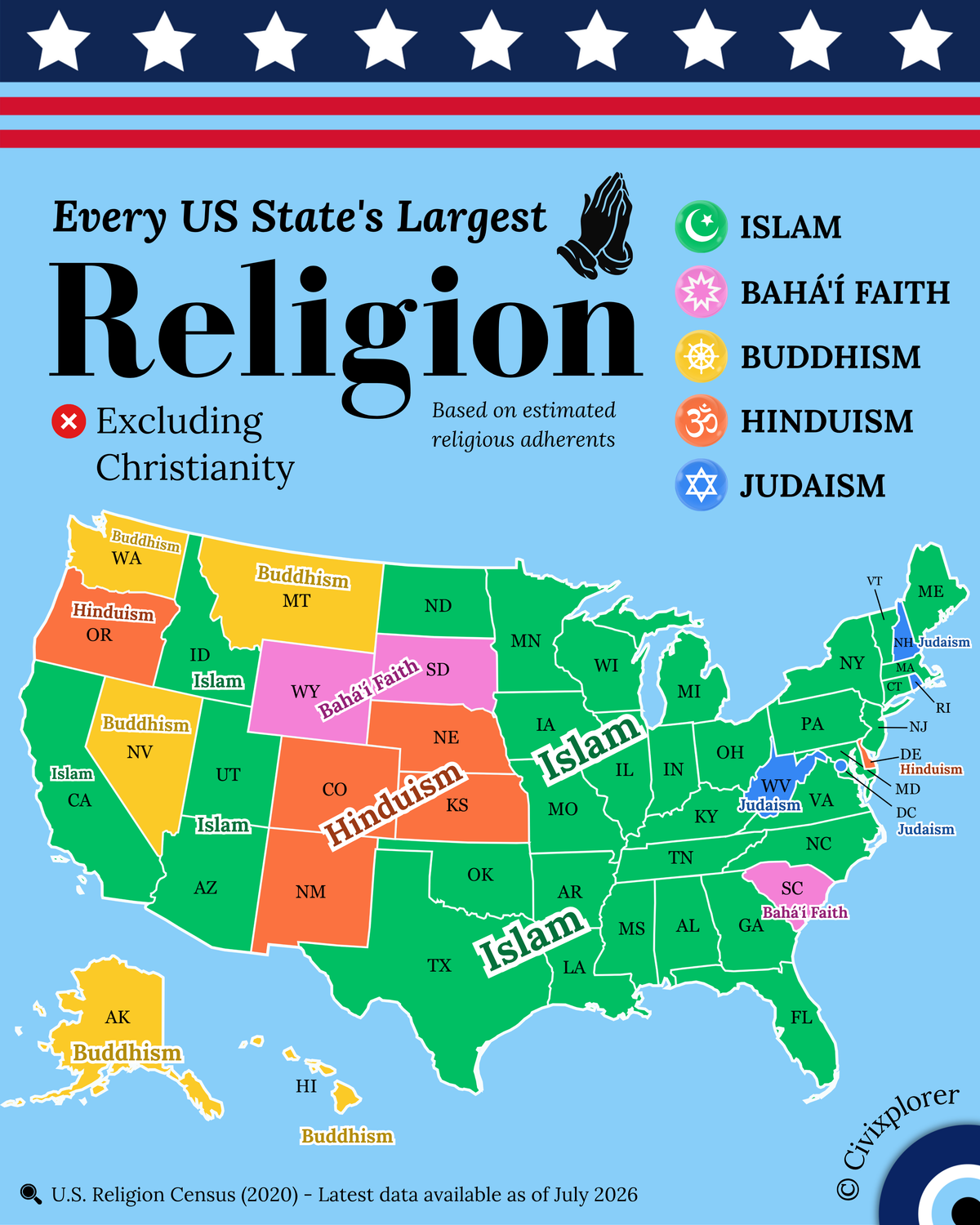
While Christianity remains the dominant religious force across all fifty states, stripping it away reveals a vibrant and complex demographic blueprint of American history, migration, and social evolution. Using the latest data from the 2020 U.S. Religion Census, we can visualize the single largest non-Christian religious tradition by estimated adherents in every region, highlighting the country's underlying religious diversity.
The National Reach of Islam
Islam accounts for nearly half of all recorded non-Christian adherents in the United States, ranking as the largest non-Christian religion in nearly half of all states. This geographic dispersion is driven by several factors, including the 1965 Immigration and Nationality Act, which opened pathways from the Middle East and South Asia, and federal refugee resettlement programs that anchored communities in the Midwest. Major urban centers like New York and California boast the highest numbers, with New York alone hosting roughly 724,000 Muslim adherents. Interestingly, Islam's presence is also rooted in a strong African American tradition and the influence of international professional corridors in states with smaller total populations.
Buddhism and Hinduism in the West
The Western and Pacific states showcase a different pattern. Buddhism leads in Hawaii, Washington, and Nevada, reflecting a blend of historical Asian immigration—particularly in Hawaii, where it accounts for 3.2% of the population—and a modern rise in Western convert communities. Hinduism emerges as a leader in states like Oregon, Colorado, and Delaware. This trend correlates strongly with professional migration in technology, medicine, and engineering, where South Asian professionals have established robust cultural and religious hubs over the last four decades.
Historical Outliers and the Bahá’í Faith
One of the most striking anomalies on the map is the prominence of the Bahá’í Faith in South Carolina, South Dakota, and Wyoming. In South Carolina, this is the result of a deliberate mid-20th-century social movement. During the Civil Rights era, Bahá’í teachings on racial unity resonated deeply within African American communities, leading to mass conversions and the establishment of institutions like the Louis G. Gregory Bahá’í Institute. In lower-population states like Wyoming, the faith’s highly organized administrative structure allows its documented adherents to outpace other non-Christian groups.
Methodological Nuances
It is important to note that these rankings are based on congregational membership and active participation rosters rather than broad self-identification surveys. This methodology explains why Judaism—while culturally and ethnically dominant in states like New York—may appear lower on congregational maps. Many Jewish Americans identify culturally rather than through formal synagogue membership, which the Association of Statisticians of American Religious Bodies (ASARB) specifically tracks. Ultimately, this map serves as a fascinating look at how 19th-century labor routes, modern visa policies, and regional historical movements continue to shape the American landscape today.

Comments (0)
Join the Conversation
Login to share your thoughts with the community.
Login to Comment