
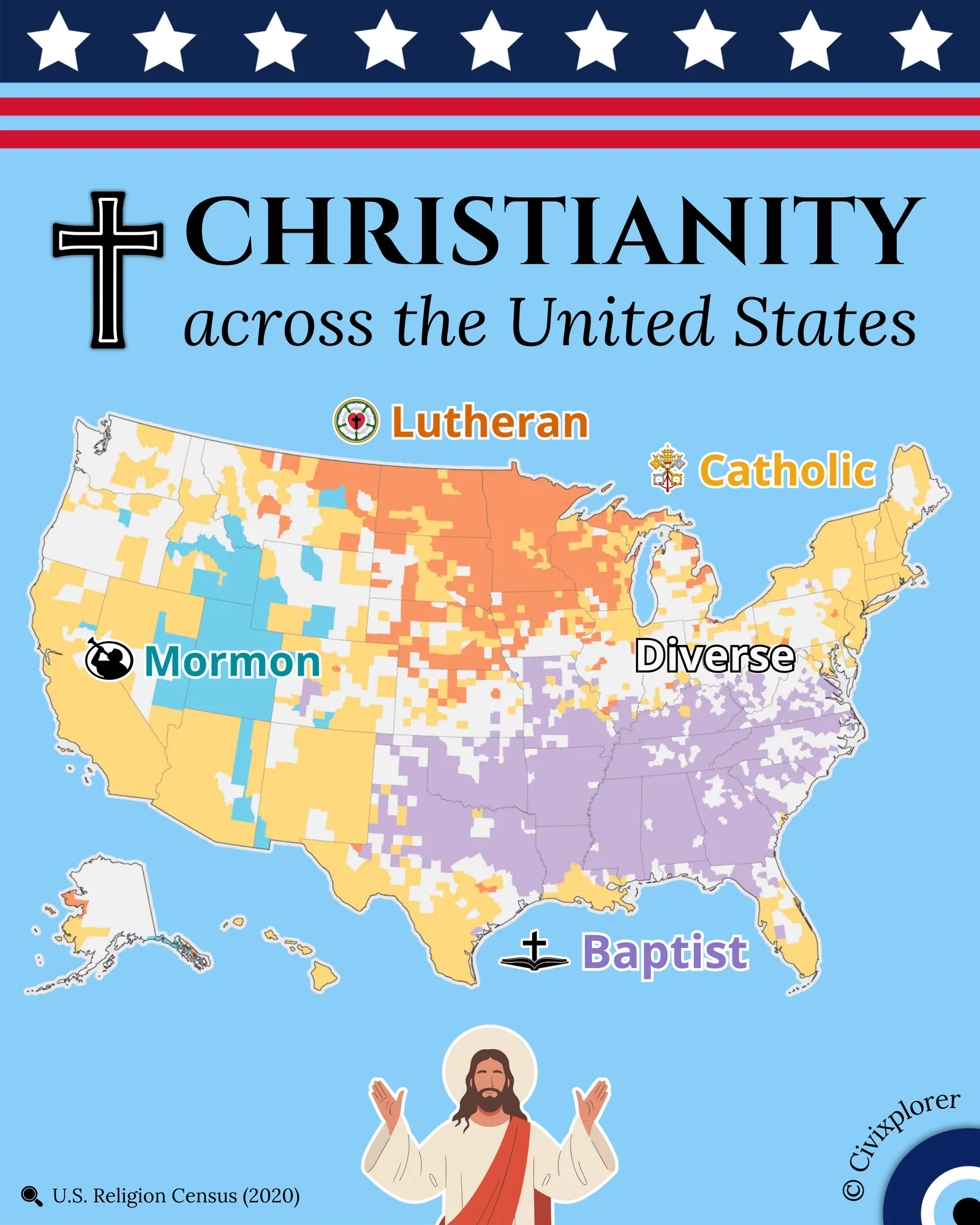
The religious geography of the United States is a complex mosaic formed over centuries, shaped by immigration, colonial history, and internal migration. Far from a monolith, the distribution of various Christian denominations reflects the specific paths taken by those seeking a new life on the American frontier.
Across the South, the Baptist tradition defines the "Bible Belt," an area profoundly molded by the Great Awakenings. In contrast, the "Lutheran band" stretching across the Upper Midwest stems from surges of Scandinavian and German immigrants who brought their traditions to the northern frontier.
Catholic zones have distinct origins depending on the coast. The Northeast was largely built by Irish and Italian immigration, while the Southwest is rooted in Spanish colonial legacies and modern Mexican migration. Meanwhile, the "Mormon Corridor" in the Mountain West reflects the 19th-century exodus led by Brigham Young, creating a region where religious adherence remains exceptionally high.
Comments (0)
Join the Conversation
Login to share your thoughts with the community.
Login to Comment