
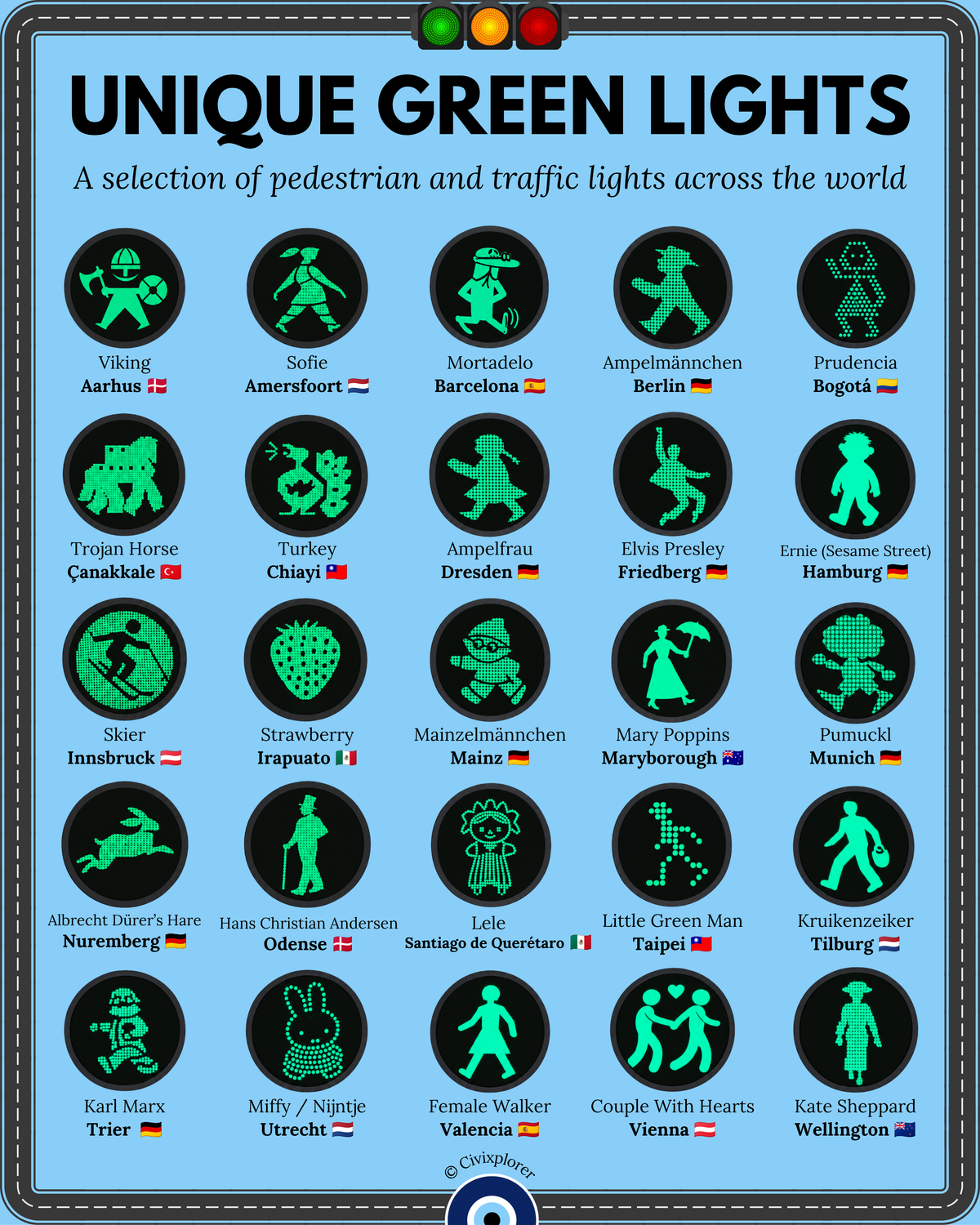
Everyday urban infrastructure is built primarily for functional safety, yet pedestrian signals across the globe are increasingly repurposed as micro-monuments of local identity and civic pride. While conventional traffic lights rely on standard standing or walking silhouettes to safely guide citizens, municipalities across Europe, Asia, Latin America, and Oceania have customized their green signals to feature historical figures, pop culture icons, local legends, and regional products. This visual shift transforms mundane waiting periods into engaging encounters with community heritage, seamlessly blending fundamental traffic control with municipal branding.
The movement toward customized pedestrian signals traces back to East Berlin's famous Ampelmännchen, created in 1961 by traffic psychologist Karl Peglau. Designed with a wide-brimmed hat and distinct broad silhouette to improve visual recognition, the figure survived post-reunification equipment replacements to become a world-famous symbol of East German heritage. Decades later in 1999, Taipei revolutionized signal technology by introducing the Little Green Man, combining a seven-frame walking animation with a countdown timer at the junction of Songzhi and Songshou Roads. Both examples demonstrate how functional street signals can transcend utility to become recognized cultural landmarks.
Many municipalities use crosswalks to pay homage to world-renowned historical and literary figures intimately tied to their local identity. In Trier, Germany, pedestrian signals feature philosopher Karl Marx stepping forward with a book under his arm to honor his birthplace, while Friedberg highlights Elvis Presley with a dynamic dancing green silhouette recalling his military service at the local barracks. Celebrated literary icons also grace city streets, including Hans Christian Andersen in Odense, Mary Poppins in Maryborough, and Miffy (Nijntje) in Utrecht. Popular culture figures like Mainz's broadcaster mascot Mainzelmännchen, Barcelona's comic detectives Mortadelo and Filemón, and Hamburg's Ernie and Bert similarly connect daily commuting with beloved regional media.
Beyond historical figures, custom signals celebrate unique agricultural traditions and modern social values. Tilburg's Kruikenzeiker figure reflects the town's historical textile industry where workers collected urine in jugs for wool processing, while Irapuato displays strawberry-shaped signals to showcase its status as an agricultural capital. In Querétaro, Mexico, the Lele doll signal celebrates indigenous Otomí craftsmanship. Traffic lights also champion social representation and inclusion, seen in Wellington's tribute to suffragette Kate Sheppard, female silhouettes like Bogotá's Prudencia, and Vienna's couple signals celebrating diversity. Ultimately, these personalized green lights show how cities embed their history, humor, and progressive values into the fabric of everyday urban life.

Comments (0)
Join the Conversation
Login to share your thoughts with the community.
Login to Comment