
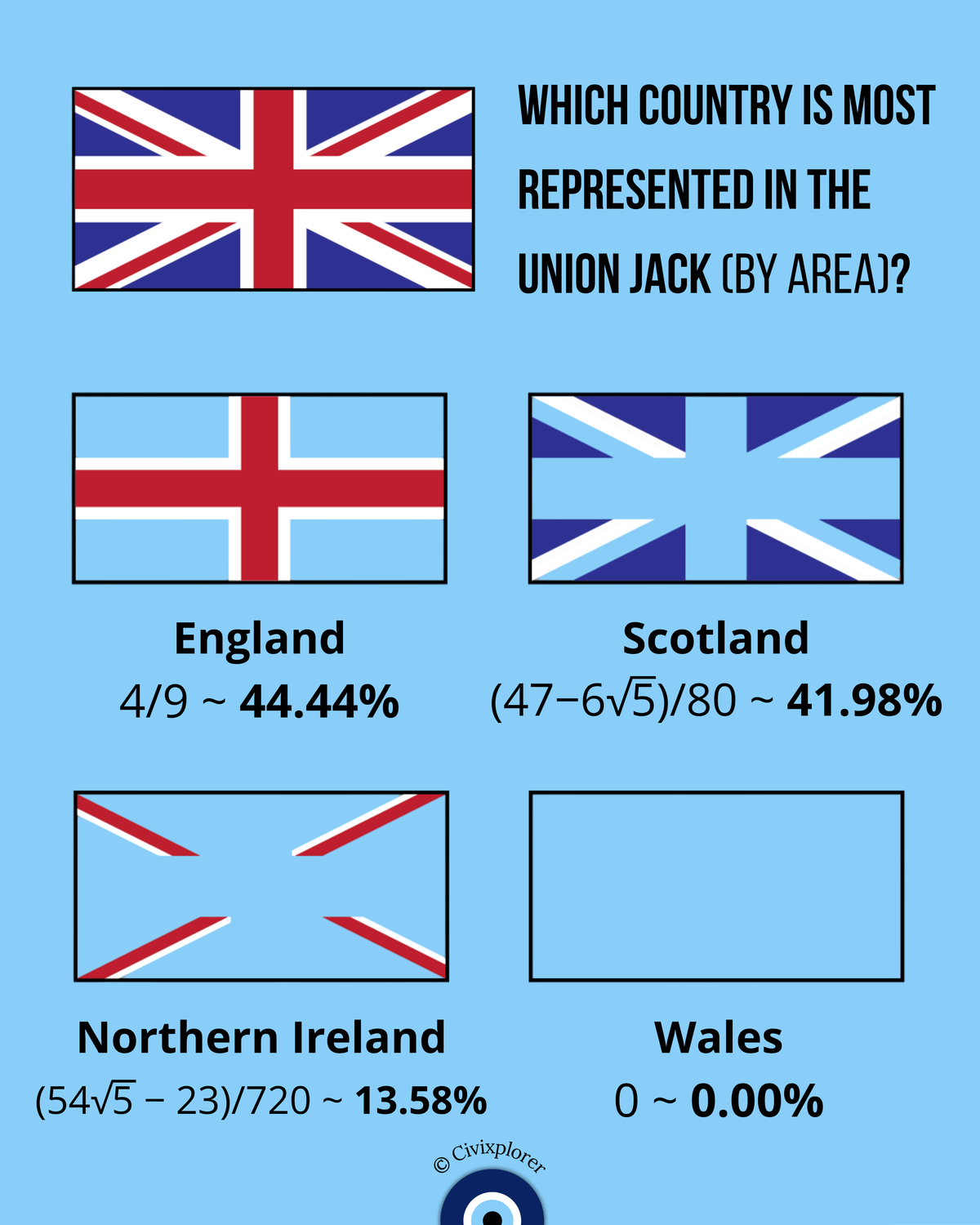
The Union Jack is arguably the most recognizable flag in the world, yet its design is far more than a simple overlay of colors. To the casual observer, it is a balanced symbol of the United Kingdom, but a closer look—and some rigorous mathematics—reveals a complex geometric puzzle. By dissecting the flag into its constituent parts, we can determine exactly how much physical surface area each nation occupies.
The Dominance of England
According to the official 1:2 naval proportions, England claims the largest share of the flag’s visual real estate. Represented by the St. George’s Cross, the central red cross and its white borders (fimbriation) account for exactly 44.44% of the area. This dominance is a result of the cross’s orthogonal placement, spanning the entire length and width of the design. While many assume England "is" the flag, the math shows it holds less than half of the total space.
Scotland’s Surprising Proximity
Despite being positioned "behind" the English cross, Scotland occupies a remarkably similar portion of the flag. Represented by the St. Andrew’s Cross, Scotland contributes the iconic blue field and the broad white diagonal lines. Mathematically, this accounts for approximately 41.98% of the flag. The reason this figure remains so high is the expansive nature of the saltire, which stretches across the entire field, ensuring that the blue background remains a primary visual force.
The Intricacy of Northern Ireland
The St. Patrick’s Cross, representing Northern Ireland, is the most delicate element of the design. It consists of the thinner red diagonal lines and their white borders, totaling roughly 13.58% of the area. The geometry here is fascinating; because the red saltire is deliberately offset—a practice known as counterchanging—it ensures that the Scottish white diagonal remains visible. This prevents one nation’s symbol from completely obscuring the other, though it results in a smaller total area for the Irish element.
The Mystery of the Missing 0%: Wales
Perhaps the most frequent question in British vexillology is: Where is Wales? As our data shows, Wales occupies exactly 0.00% of the Union Jack. This is not a modern oversight but a reflection of 17th-century geopolitics. When the first Union Flag was created in 1606, Wales had already been legally annexed and incorporated into the Kingdom of England via the Laws in Wales Acts of 1535–1542. Because Wales was not considered a separate kingdom or principality at the time of the union between England and Scotland, it was never granted a distinct symbol on the national flag. Its identity remains historically subsumed under the St. George’s Cross.
A Masterpiece of Asymmetry
The Union Jack is a rare example of a flag that looks balanced but is completely asymmetrical. The precise specifications require the broader white diagonal to be positioned closest to the flagpole (the hoist). This ensures that the Scottish Saltire takes precedence in the hierarchy of the design. This blend of heraldic tradition and geometric precision makes the Union Flag a unique subject of study, proving that every line and color is the result of centuries of history and rigorous calculation.

Comments (0)
Join the Conversation
Login to share your thoughts with the community.
Login to Comment