
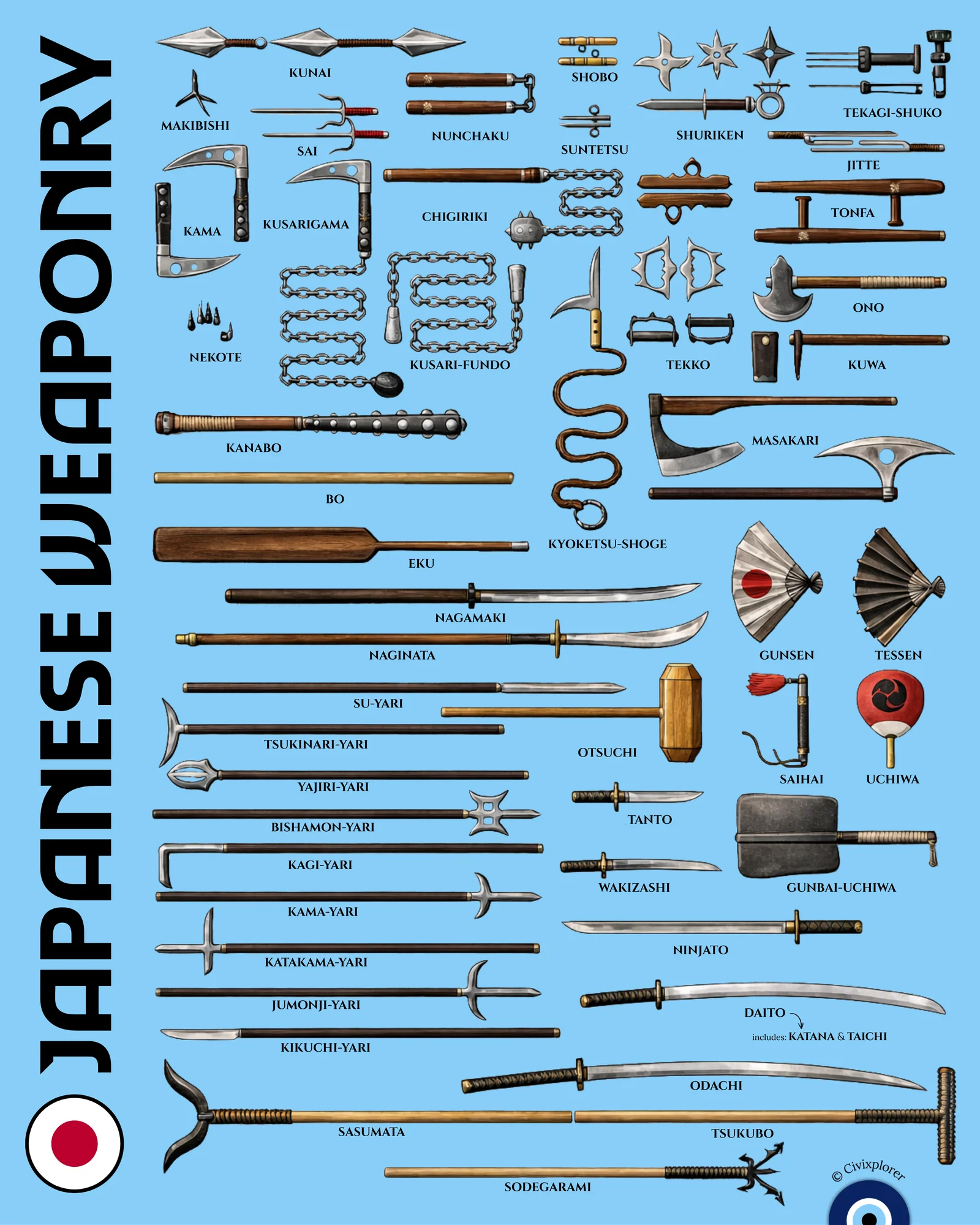
The weaponry of feudal Japan represents a fascinating intersection of strict social hierarchy and practical ingenuity. While the sword is often called the "soul of the samurai," the diversity of tools used by different social classes reveals a complex history of warfare and survival.
The samurai class held exclusive legal privileges, most notably the right to carry the daishō, a pairing of the Daitō (long sword) and the Wakizashi (companion sword). These weapons, along with the Tantō (dagger), served as both lethal instruments and symbols of status. In contrast, the shinobi or ninja utilized specialized gear like the Ninjatō, a shorter blade designed for multi-functional use. Historically, the Ninjatō featured a sturdy crossguard (tsuba) that could be used as a step for scaling walls, and its scabbard (saya) was often used to hide secret messages.
Interestingly, many iconic Japanese weapons originated as humble agricultural tools. Following "Sword Hunts" intended to disarm the peasantry and prevent uprisings, farmers developed martial arts, known as Kobudo, using repurposed gear. The Kama was originally a harvesting sickle, the Tonfa was derived from millstone handles, and the Nunchaku functioned as a rice flail. The Kusarigama added a weighted chain to a sickle, allowing a combatant to entangle a samurai's blade from a distance.
Public safety during the Edo period relied on specialized "arresting tools" known as the Torimono Sandōgu. These polearms, including the Sasumata (spear fork), Tsukubō, and Sodegarami (sleeve entangler), allowed the samurai police force to capture suspects alive by pinning their limbs or snagging their clothing with barbed spikes.
Warfare also integrated deceptive "hidden" weapons into daily life. Iron war fans, such as the Tessen and Gunsen, allowed commanders to signal troops or parry blows in areas where visible weapons were prohibited. For stealthy strikes, Neko-te (iron claws) and concealed spikes like the Suntetsu were used to target pressure points. Despite the fame of the sword, the Yari (spear) and Naginata (polearm) remained the primary kings of the open battlefield for foot soldiers, with variations like the Ju-monji Yari designed specifically to unseat riders from horseback.
Comments (0)
Join the Conversation
Login to share your thoughts with the community.
Login to Comment