
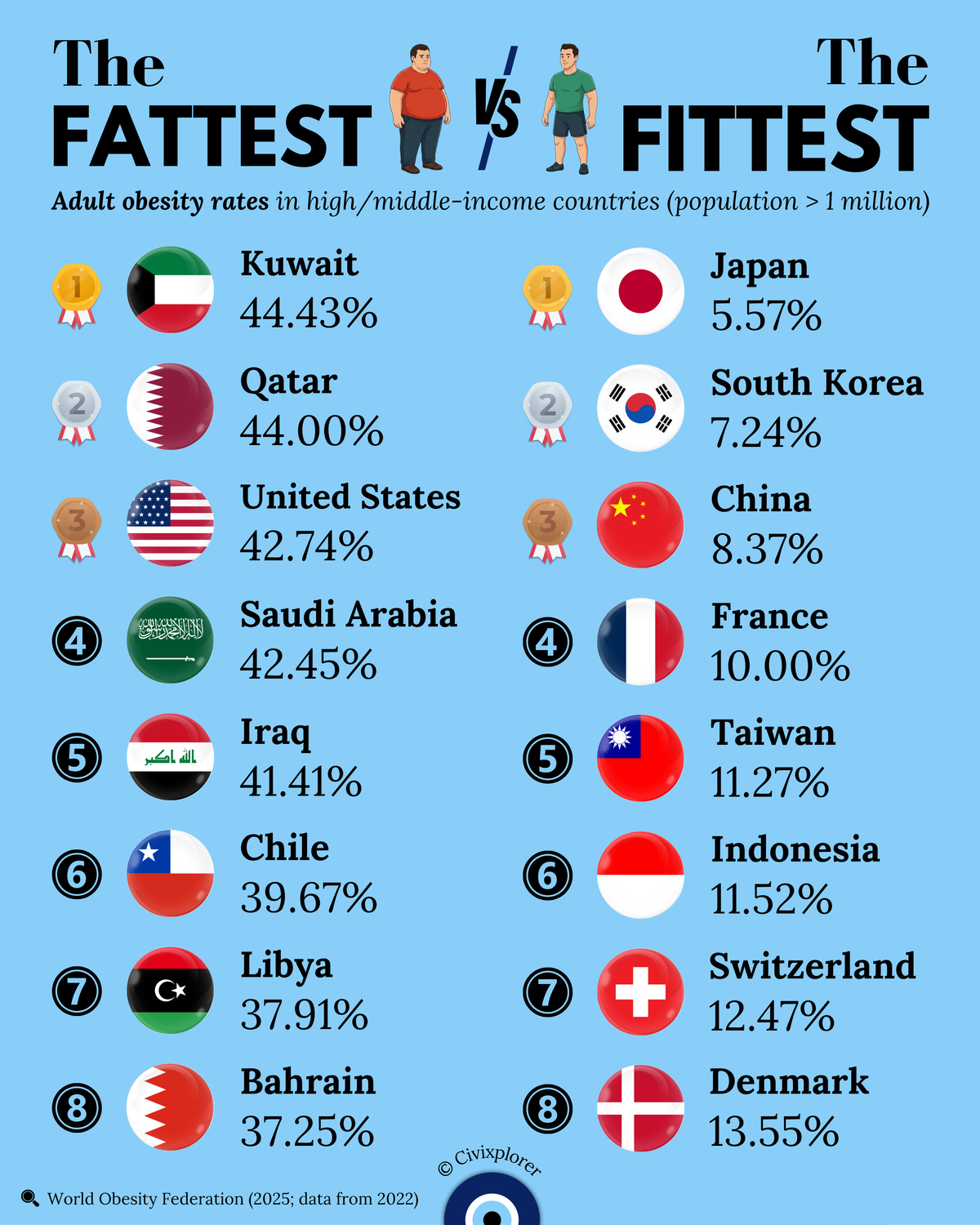
The global landscape of health is shifting, and the latest data from the World Obesity Federation reveals a stark contrast in how different societies navigate prosperity. When comparing adult obesity rates—defined by a Body Mass Index (BMI) of 30 or higher—the results suggest that economic development is not a guaranteed path to a specific health outcome. Instead, the "Fattest" and "Fittest" rankings tell a story of urban design, dietary traditions, and rapid socioeconomic transitions.
The Gulf Paradox: Wealth and Rapid Urbanization
At the top of the "Fattest" list, the Arab Gulf states show a dominant presence. Kuwait (44.43%) and Qatar (44.00%) lead the world in obesity prevalence among middle- and high-income nations. This is largely attributed to a rapid transition from traditional, physically demanding lifestyles to highly urbanized, energy-rich societies.
Several factors create this "obesogenic environment":
- Car Dependency: Modern cities like Riyadh and Doha are designed for automobiles, making walking nearly impossible.
- Extreme Climate: Intense summer heat discourages outdoor activity, pushing life indoors into air-conditioned, sedentary spaces.
- Dietary Shifts: Increased disposable income has led to the widespread adoption of ultra-processed foods and large communal portions, often overshadowing traditional dietary balances.
The United States and the Western Environment
The United States ranks third at 42.74%, a position driven by decades of established industrial food systems. The American environment is characterized by large portion sizes, aggressive marketing of sugary beverages, and suburban sprawl that limits incidental movement. While the U.S. remains a global leader in wealth, its infrastructure and food culture have historically favored convenience over caloric moderation.
East Asian Resilience: The "Fittest" Leaders
On the opposite end of the spectrum, East Asian nations demonstrate that high-income, technologically advanced societies can maintain exceptionally low obesity rates. Japan (5.57%) and South Korea (7.24%) provide the ultimate blueprint for health in a modern world.
Japan’s success is built on three pillars:
- Walkable Cities: Dense urban planning and world-class public transport mean that residents walk as a natural part of their daily commute.
- Traditional Dietary Patterns: Diets focused on fish, vegetables, and fermented foods—combined with smaller portion sizes—remain the norm.
- Social Norms: Cultural emphasis on moderation and proactive health monitoring, such as the "Metabo Law," encourages citizens to maintain a healthy weight.
The "French Paradox" and European Policy
France (10.00%) stands out as a unique case in the West. Despite a cuisine famous for its richness, the French maintain lower obesity rates through structured meal times, a lack of constant snacking, and a cultural value placed on savoring high-quality ingredients in smaller quantities. Similarly, countries like Switzerland and Denmark benefit from strong cultures of active transport, such as cycling, and robust public health policies.
The Bottom Line: Modernity vs. Lifestyle
The data proves that obesity is not an inevitable byproduct of wealth. While economic growth provides access to more calories and less physical labor, the ultimate health of a nation depends on how its cities are built and how its food culture is preserved. Whether through the walkable streets of Tokyo or the pioneering food labeling policies in Chile, the map of global health is constantly being redrawn by the choices societies make today.

Comments (0)
Join the Conversation
Login to share your thoughts with the community.
Login to Comment