
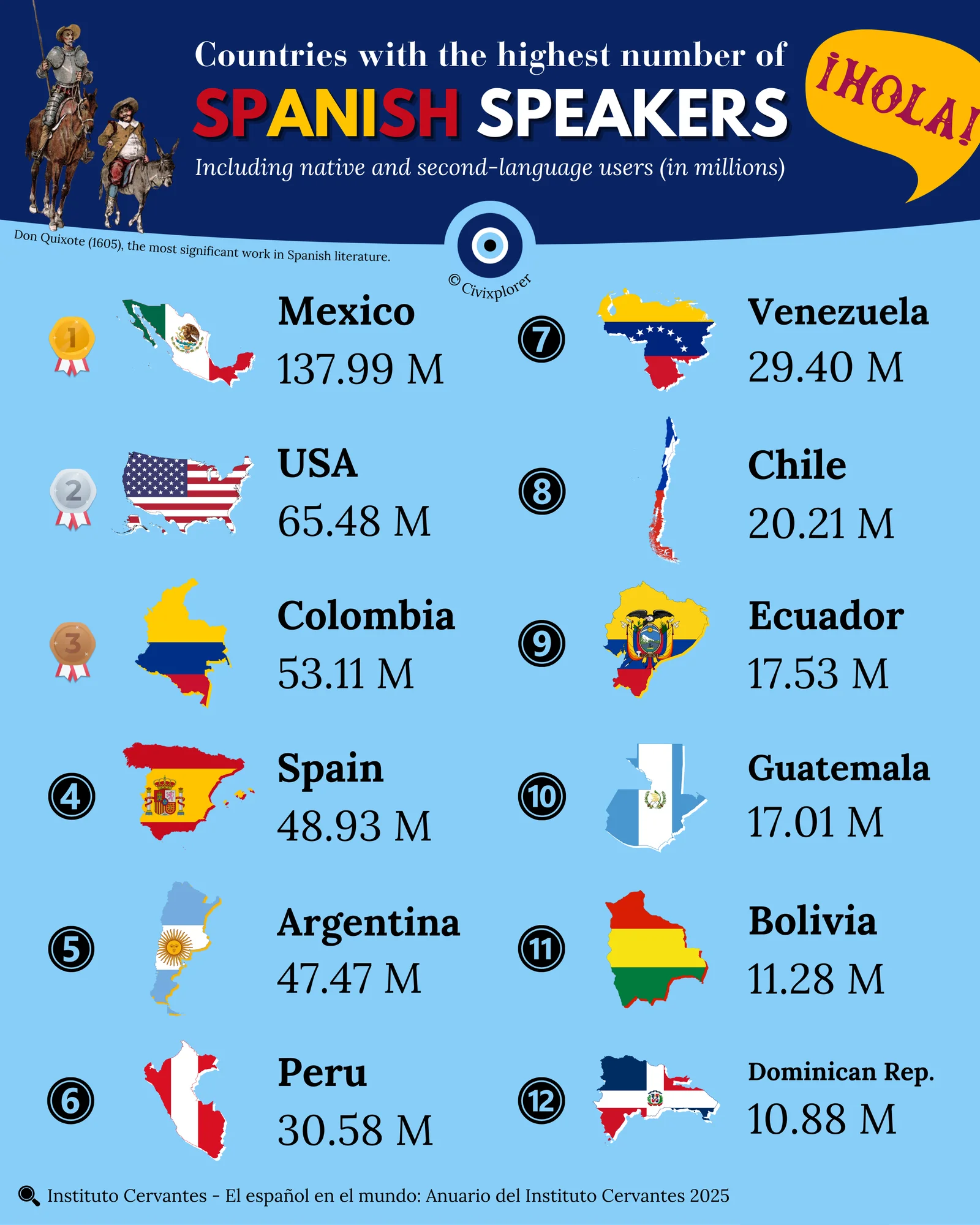
The demographic center of the Spanish language has officially shifted from its European origins to the Western Hemisphere. While Spanish originated in the Iberian Peninsula, today less than 10% of the world’s Spanish speakers reside in Spain. This transition highlights the language’s status as a pluricentric global giant with a massive footprint in the Americas.
Mexico remains the undisputed demographic engine of the language, with nearly 138 million speakers representing over a quarter of the global total. However, the most striking insight from the 2025 rankings is the rise of the United States. With approximately 65.5 million speakers, the US has surpassed both Colombia and Spain to become the second-largest Spanish-speaking community on Earth.
This growth in the US is driven by a combination of native speakers and a large group with limited competence, often referred to as heritage speakers. These individuals represent a cultural bridge, maintaining linguistic roots while navigating an English-dominant society. Meanwhile, Spain now ranks fourth, as its population growth has stabilized compared to the explosive expansion seen across Latin America.
The global reach of Spanish also extends into non-traditional territories through education and commerce. In the United Kingdom, Spanish is arguably the most vital foreign language for students, and in Brazil, it serves as a critical tool for regional trade. From its origins in Castile to its modern role as a Pan-American powerhouse, Spanish continues to demonstrate incredible cultural resilience and global appeal.
Comments (0)
Join the Conversation
Login to share your thoughts with the community.
Login to Comment