
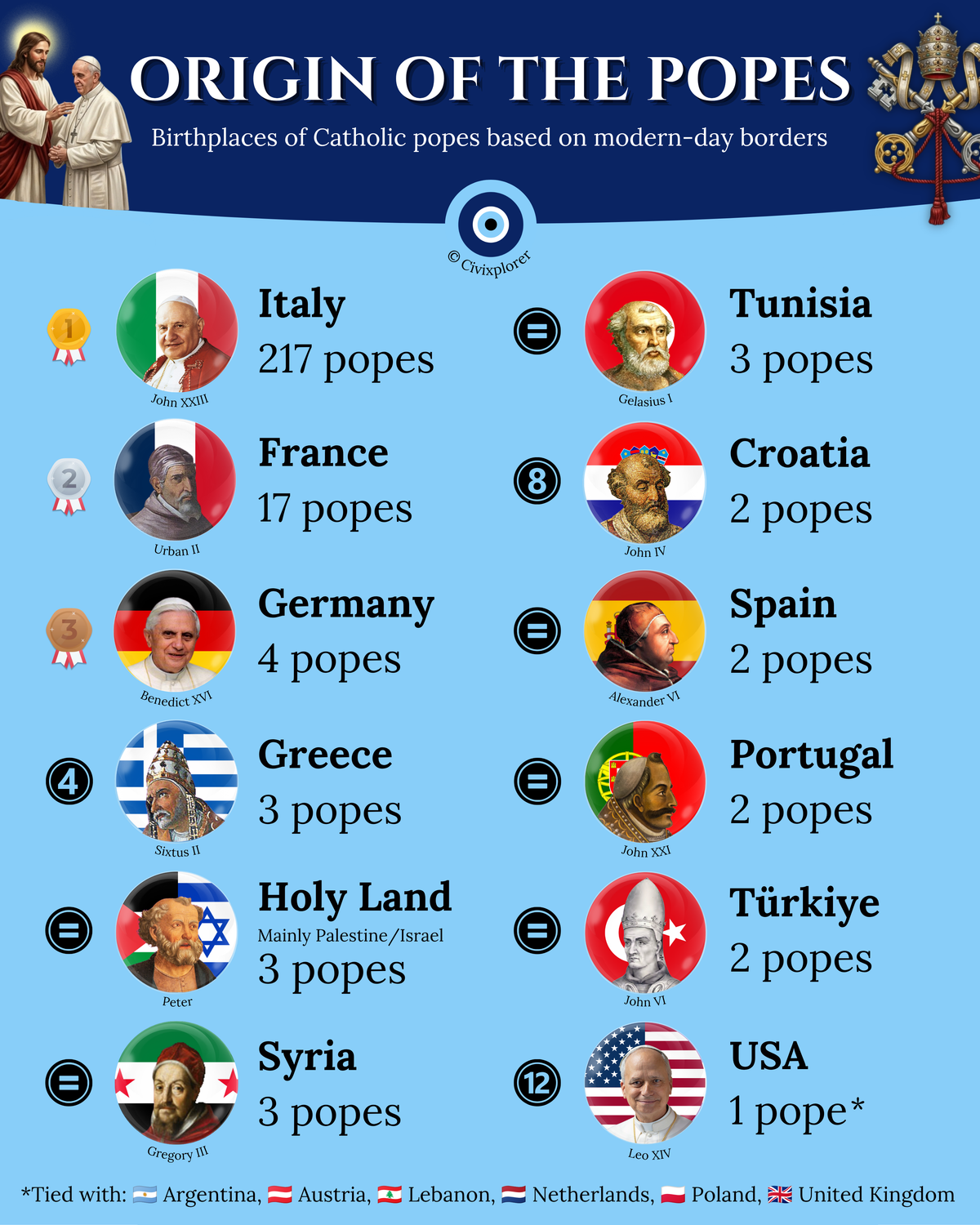
Mapping the birthplaces of Catholic popes onto modern international borders offers a fascinating lens through which to view the changing geopolitics of ecclesiastical power over the past two millennia. Although modern nation-states did not exist during antiquity or the Middle Ages, projecting contemporary boundaries onto ancient history highlights how the Church evolved from early Mediterranean origins to a centralized European institution, before expanding into a truly global entity. In the early centuries of Christianity, the papacy drew leadership from across the Mediterranean basin, reflecting the vast reach of the Roman Empire. Early bishops of Rome hailed from regions corresponding to modern-day Syria, Greece, and North Africa, including notable figures like Pope Victor I, Pope Miltiades, and Pope Gelasius I from the Roman province of Africa. This era of Mediterranean diversity was further sustained during the Byzantine Papacy, when papal appointments required imperial approval in Constantinople and brought numerous Greek and Syrian popes to the papal throne.
Over time, the administrative and spiritual centrality of Rome led to an overwhelming concentration of leadership within the Italian peninsula. Italy accounts for 217 popes—representing approximately 82% of all distinct pontiffs—a dominance reinforced by the influence of Roman noble families, the Papal States, and an Italian-dominated College of Cardinals. This regional monopoly culminated in an unbroken 455-year streak of Italian popes extending from the election of Pope Clement VII in 1523 until 1978. The primary historical exception to this Italian centralization was France, which claims 17 popes within its modern boundaries. This cluster was driven largely by the Avignon Papacy during the 14th century, when political pressures forced the papal court to relocate to Avignon, resulting in seven consecutive French popes. Other European nations appear in smaller numbers, such as Spain with two Renaissance pontiffs from the famous Borgia family and Portugal with two historical entries.
While mapping historical birthplaces to modern states provides clear visual insights, scholars note that it involves significant methodological nuances. Because modern territorial designations do not equate to ancient ethnic or national identities, assigning popes born in historical regions like Roman Africa or ancient Dalmatia to modern countries like Tunisia or Croatia remains a cartographic exercise rather than a reflection of contemporary nationality.
In the late 20th and early 21st centuries, the papacy entered a transformative era of modern internationalization following the expanded global representation of the College of Cardinals after Vatican II. The continuous line of Italian successors was famously broken in 1978 with the election of Pope John Paul II from Poland, followed by Pope Benedict XVI from Germany, Pope Francis from Argentina as the first pope from the Americas, and Pope Leo XIV from the United States. This dramatic shift illustrates how an institution once centered strictly around the Mediterranean and Italy has transformed into a globally representative leadership reflectively serving a worldwide population.

Comments (0)
Join the Conversation
Login to share your thoughts with the community.
Login to Comment