
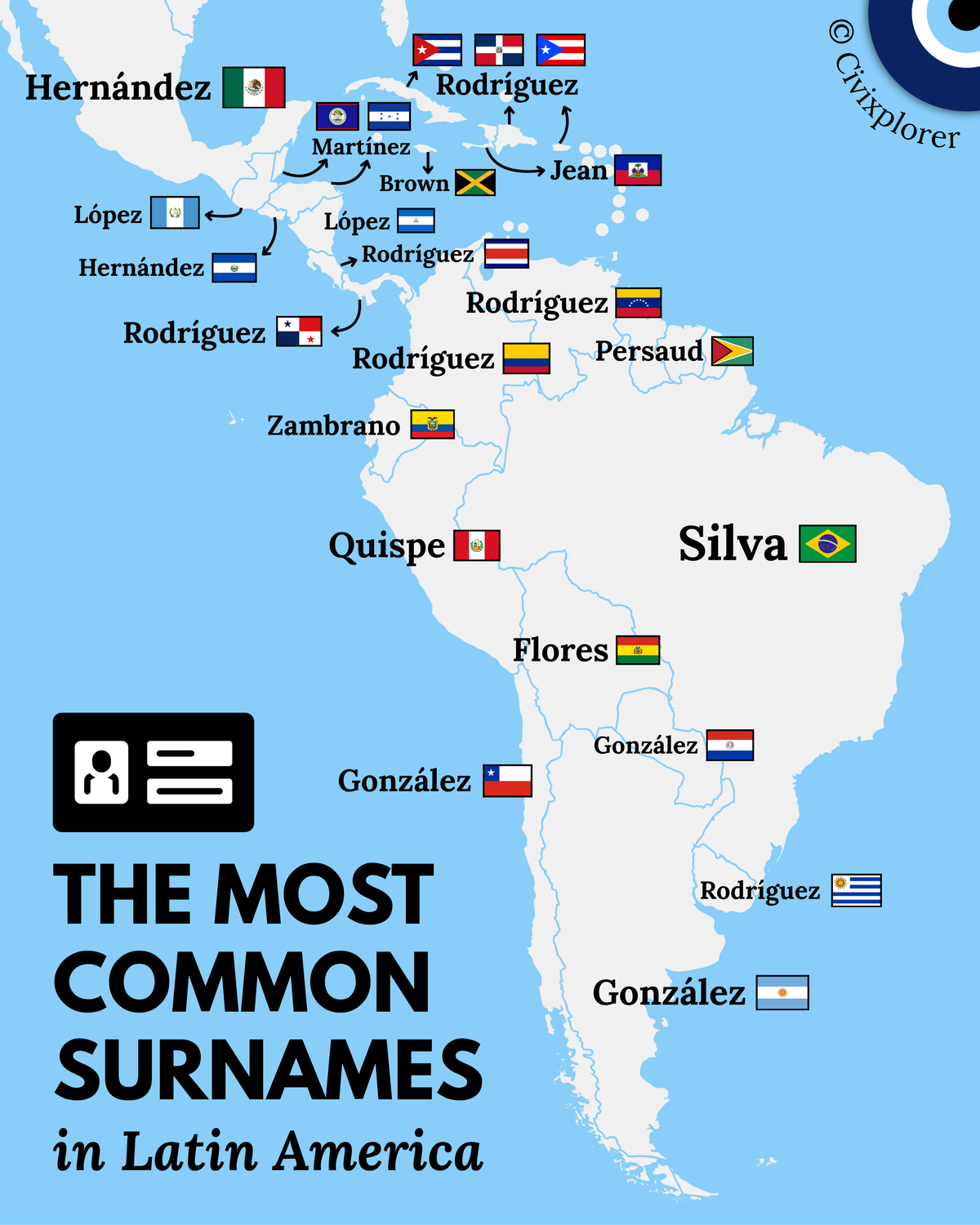
The map of Latin American surnames is far more than a collection of labels; it is a demographic canvas reflecting centuries of human history, European colonization, and indigenous survival. While a glance at the region might suggest a monolithic block of Iberian names, looking beneath the surface reveals a palimpsest of layered histories involving the transatlantic slave trade, global labor migrations, and pre-Columbian roots.
The Iberian Patronymic Monolith: The Power of "-ez"
The most striking feature of the Hispanic mainland is the overwhelming dominance of surnames ending in “-ez”, such as Rodríguez, González, Hernández, and Martínez. These are patronymic surnames, a linguistic mechanism derived from Visigothic and old Iberian grammar meaning "son of". For example, Rodríguez signifies "son of Rodrigo," while López stems from the Latin lupus, meaning wolf.
These names became institutionalized during the 16th century as Spanish conquistadors and missionaries established colonial administrations. Because land registries and Catholic Church baptismal records required systematic identification, these surnames were often assigned to or adopted by indigenous populations and enslaved Africans. Consequently, these names act as markers of colonial institutions rather than direct biological ancestry tests.
Regional Patterns and the "Silva" Dominance in Brazil
Regional variations tell specific stories of settlement. Rodríguez is particularly prominent in the Caribbean and northern South America, while González dominates the Southern Cone, reflecting massive migration waves to Argentina and Chile.
The most significant departure from the Spanish pattern is Brazil, where the name Silva is shared by millions. Derived from the Latin word for "forest" or "woodland," it was brought by Portuguese settlers. Its massive proliferation is tied to the legacy of emancipation; following the abolition of slavery in 1888, many freed individuals adopted Silva to begin their lives as free citizens, turning the name into a unifying symbol of cultural heritage.
Indigenous Resilience and Global Migration
Notable exceptions on the map highlight the persistence of non-European identities. In Peru, the most common surname is Quispe, which has Quechua roots meaning "free" or "crystal". Its prevalence stands as a testament to the demographic weight and cultural survival of Andean populations despite centuries of colonial rule.
In the Guianas and the Caribbean, different colonial trajectories are visible. Guyana’s top surname, Persaud, is a variant of the Indian name Prasad. This reflects the history of indentured laborers brought from India between 1838 and 1917 to work on sugar plantations. Similarly, Jamaica's "Brown" and Haiti's "Jean" reflect the British and French colonial systems, respectively, and the subsequent adoption of European names by formerly enslaved populations following their revolutions and emancipations.
Ultimately, these surnames are cultural artifacts. Whether it is a Basque toponymic name like Zambrano in Ecuador or an English descriptive name in the West Indies, each identifier encodes over 500 years of power, resistance, and the blending of worlds.

Comments (0)
Join the Conversation
Login to share your thoughts with the community.
Login to Comment