
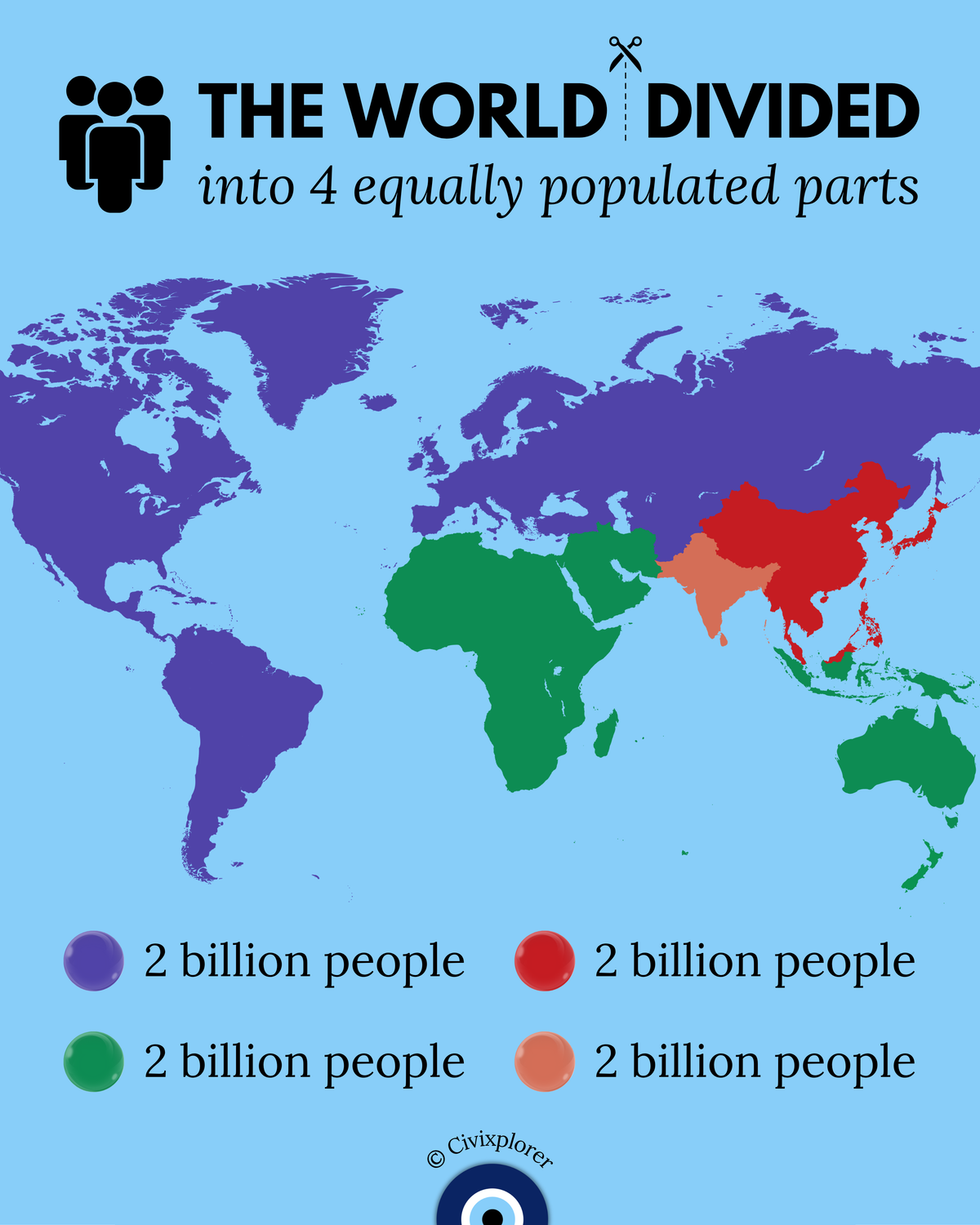
In November 2022, humanity reached a staggering milestone: a total global population of 8 billion people. While we often view the world through political borders or vast landmasses, these traditional perspectives rarely reflect the reality of where people actually live. To truly understand our planet, we must look at it through the lens of demographic concentration.
This population cartogram acts as a powerful visual corrective, shattering the common cognitive bias that equates territory with human presence. By dividing the world into four color-coded regions of approximately 2 billion people each, we can see the extreme unevenness of our global distribution.
The Orange Region: The Subcontinental Powerhouse
The most striking feature of this visualization is the orange zone, centered on the Indian Subcontinent. This region, comprising India, Pakistan, and Bangladesh, represents only about 3-4% of the Earth's total land area, yet it home to 25% of the human race. This incredible carrying capacity is driven by the Indo-Gangetic Plain, where fertile soils fed by major river systems and sustained by monsoon rainfall have supported intensive agriculture for millennia. As India officially surpasses China as the world’s most populous nation, this small pocket remains the densest epicenter of humanity.
The Red Region: The East Asian Demographic Peak
Anchored by China, the red region includes Japan, the Korean Peninsula, and mainland Southeast Asia. Historically, this area mirrored South Asia's growth through high-yield rice cultivation in fertile river valleys. However, today this region represents a demographic anomaly. It contains some of the world’s most rapidly aging populations and lowest fertility rates, with some areas averaging just 1.0 birth per woman. Unlike the other zones, the population here is actively plateauing and beginning to shrink, marking a significant shift in the global balance of power.
The Green Region: The Engine of Future Growth
The green bloc is a fascinating patchwork that groups the entire continent of Africa with the Arabian Peninsula, Indonesia, and Oceania. While it currently matches the other regions at 2 billion people, its trajectory is unique. With a median age of roughly 19, Africa is the undisputed engine of future global growth. Projections suggest that by 2050, one in four people on Earth will be African. Currently, this region combines some of the most rapidly growing nations with nearly empty landmasses like the Australian outback.
The Purple Region: The Sparse Giants
Covering the vast majority of the Earth's habitable landmass, the purple region encompasses the Americas, Europe, Russia, and Central Asia. Despite its immense geographic size, it contains only 25% of the global population. This zone highlights the illusion of space, where massive territories like the Canadian tundra, the Amazon Basin, and the Siberian taiga remain almost entirely empty. The populations here are highly urbanized, clustering in coastal mega-regions while leaving the interior continental expanses incredibly sparse.
Final Reflections
When we strip away political boundaries and focus on headcount, the "Asian Demographic Heavyweight" reality becomes undeniable. Over half of humanity is squeezed into a remarkably localized geographic radius in the East and South. This map is not just a snapshot of where we are today; it is a guide to the geopolitical, economic, and environmental stakes of the 21st century, revealing how profoundly history and climate have shaped the human map.

Comments (0)
Join the Conversation
Login to share your thoughts with the community.
Login to Comment