
The flag of Switzerland is one of the most recognizable and unique national symbols in the world. Standing out for its perfect square (1:1 ratio), it is one of only two sovereign flags globally to use this format, the other being Vatican City. Its design—a bold, white equilateral cross on a vibrant red field—is governed by strict proportions: each arm of the cross must be precisely one-sixth longer than its width.
The origins of this iconic emblem date back to the late 13th century, emerging as a field sign for the Old Swiss Confederacy. Its first major documented use as a unifying badge occurred at the Battle of Laupen in 1339, where soldiers sewed white crosses onto their chainmail to distinguish themselves from their enemies. While it was used for centuries as a military and cantonal banner, it was not officially adopted as the national flag until 1889. Historically, the red background represents the blood shed to defend independence, while the white cross symbolizes peace, Christianity, and the nation's long-standing neutrality.
Beyond its own borders, the Swiss design has influenced global history. The International Red Cross emblem was created by reversing the colors of the Swiss flag to honor its Swiss founder, Henri Dunant. This deep connection to humanitarianism makes the "Swiss style" a fascinating lens through which to view other national identities.
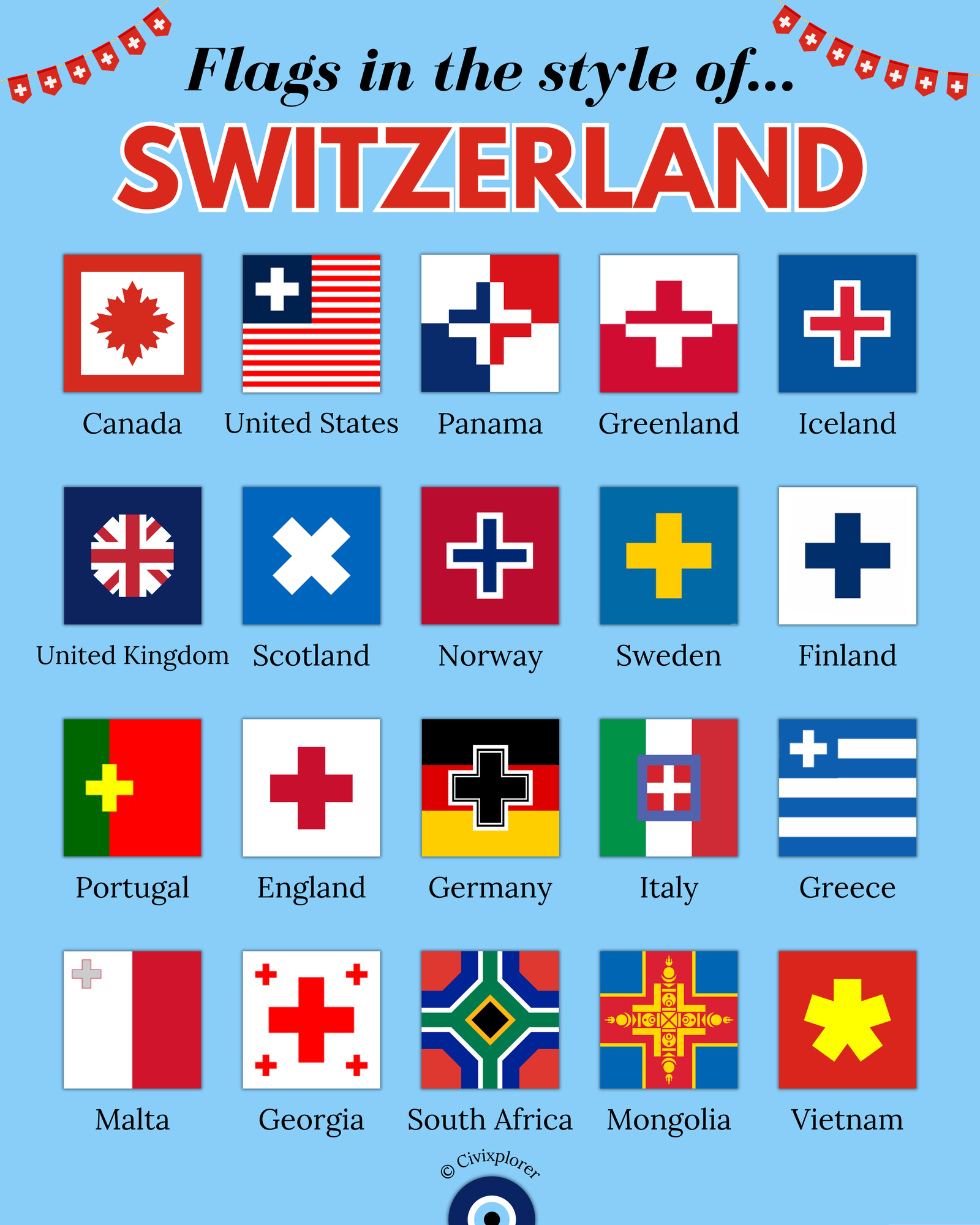
In a creative exercise in vexillology, we can reimagine other world flags through the minimalist constraints of the Swiss template. For instance, England’s St. George’s Cross fits perfectly into the square format, creating a striking visual coincidence with the Red Cross emblem. More complex designs, such as the United Kingdom’s Union Jack, require clever simplification, condensing multiple overlapping crosses into a single, thick central figure.
Even flags without traditional crosses can be adapted. Canada’s maple leaf can be centered within a white square bordered by red, maintaining the Swiss aesthetic while preserving Canadian identity. Similarly, South Africa’s "Rainbow Nation" flag can be transformed into an intricate, multicolored geometric cross, proving that even the most complex national symbols can be distilled into the bold, minimalist elegance of the Swiss standard.
Comments (0)
Join the Conversation
Login to share your thoughts with the community.
Login to Comment