
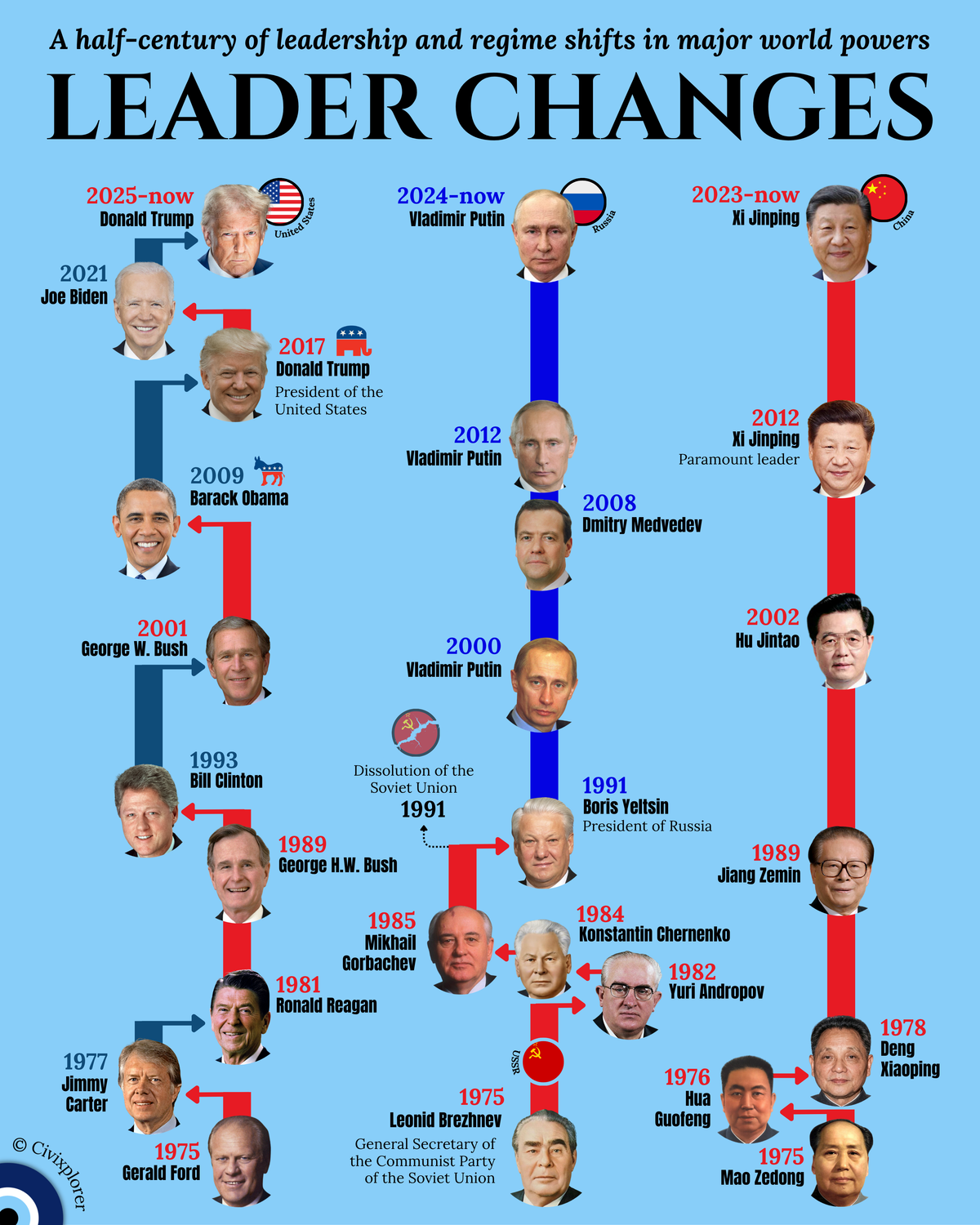
Tracking executive leadership from 1975 through 2026 across the United States, Russia (including the Soviet Union), and China presents a compelling visual history of global executive governance. While often framed as a simple record of regime changes, this timeline is more accurately understood as a comparison of leader successions across three distinct institutional models. Over half a century, the contrast has sharpened between constitutional democratic turn-over and the steady consolidation of indefinite personal rule.
In the United States, executive governance is anchored by regular electoral cycles and constitutional constraints, specifically governed by the Twenty-Second Amendment's two-term presidential limit. Across fifty-one years, nine distinct individuals have occupied the presidency, illustrating frequent leadership alternation within an enduring constitutional framework. The sequence records transitions starting with Gerald Ford, who assumed office in 1974 without winning a national presidential election following Richard Nixon's resignation, through Jimmy Carter, Ronald Reagan, George H. W. Bush, Bill Clinton, George W. Bush, Barack Obama, Donald Trump, Joe Biden, and Trump's return for a non-consecutive second term. This high frequency of leadership change reflects institutional churn rather than systemic regime replacement, ensuring that authority rotates predictably regardless of political rivalries.
In stark contrast, the trajectory in Moscow reveals a profound structural transformation. The late Soviet era was initially defined by severe gerontocracy, as aging leaders Leonid Brezhnev, Yuri Andropov, and Konstantin Chernenko died in rapid succession between 1982 and 1985. Mikhail Gorbachev's reform initiative of perestroika and glasnost culminated in a historic systemic rupture: the dissolution of the Soviet Union on December 25, 1991, and the establishment of the Russian Federation under President Boris Yeltsin. Following Boris Yeltsin's tenure, Vladimir Putin assumed the presidency in 2000, establishing a personalist regime that bypassed term limits through a strategic power-sharing tandem with Dmitry Medvedev from 2008 to 2012. Through constitutional amendments enacted in 2020 that reset his term count, Putin effectively eliminated succession guardrails to secure eligibility through 2036, cementing decades of continuous executive control.
China's leadership trajectory demonstrates a distinct cycle: moving from revolutionary dictatorship to institutionalized handover, and back toward centralized personal rule. Following the death of Mao Zedong in 1976 and Hua Guofeng's brief interlude, Deng Xiaoping emerged as paramount leader at the Third Plenum in December 1978. Deng established an informal system of collective leadership and de facto term limits to prevent another lifelong autocracy, facilitating orderly decade-long transitions to Jiang Zemin in 1989 and Hu Jintao in 2002. However, this institutionalized norm was dismantled under Xi Jinping, who assumed party leadership in 2012. In 2018, the National People's Congress eliminated presidential term limits, allowing Xi to consolidate power as paramount leader indefinitely and reversing the succession precedents set during the reform era.
Evaluating these three superpowers side-by-side demonstrates that their political developments proceed on entirely different institutional clocks. The pivotal year of 1989 vividly illustrates this divergence: the United States executed a routine electoral handover from Ronald Reagan to George H. W. Bush, the Soviet Union underwent transformative Cold War political reforms under Mikhail Gorbachev, and China experienced elite succession under Jiang Zemin following the Tiananmen crisis. Ultimately, while constitutional democratic institutions enforce predictable turnover through electoral mechanisms, non-democratic systems have increasingly manipulated legal frameworks to prioritize personal continuity over institutional rotation.

Comments (0)
Join the Conversation
Login to share your thoughts with the community.
Login to Comment