
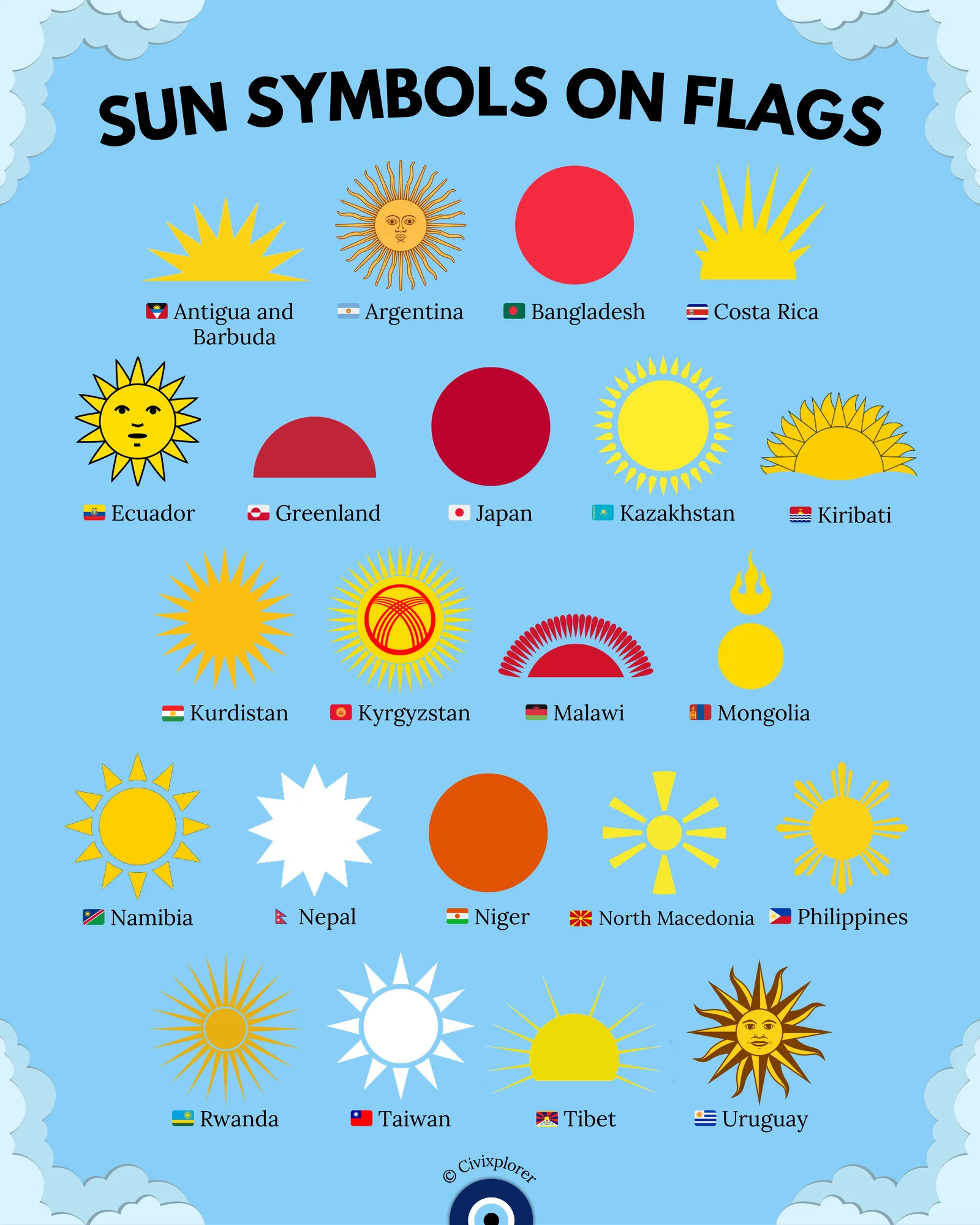
The sun is one of the most powerful universal symbols in vexillology, representing life, sovereignty, and ancient deities. From minimalist disks to intricate faces, these designs are deeply rooted in the specific history and geography of each nation.
Cultural heritage plays a massive role in these visual choices. For instance, Argentina and Uruguay feature the "Sun of May," a representation of the Incan god Inti that commemorates the dawn of independence. In the Philippines, the eight-rayed sun is a tribute to the first provinces that revolted against colonial rule, while Kyrgyzstan incorporates its nomadic heritage by centering the sun around a tunduk, the top of a traditional yurt.
Geography also dictates these symbols. Japan and Bangladesh utilize the solar disk to reflect their identities as lands of the rising sun. Conversely, Greenland depicts a semi-circle to represent the "midnight sun" over the Arctic horizon, and Kiribati celebrates its position as one of the first countries to see the dawn each day due to its proximity to the International Date Line. Other symbols, like the 12 rays on Taiwan’s flag or the "Vergina Sun" of North Macedonia, link modern states to ancient heritage and the spirit of progress.
Comments (0)
Join the Conversation
Login to share your thoughts with the community.
Login to Comment