
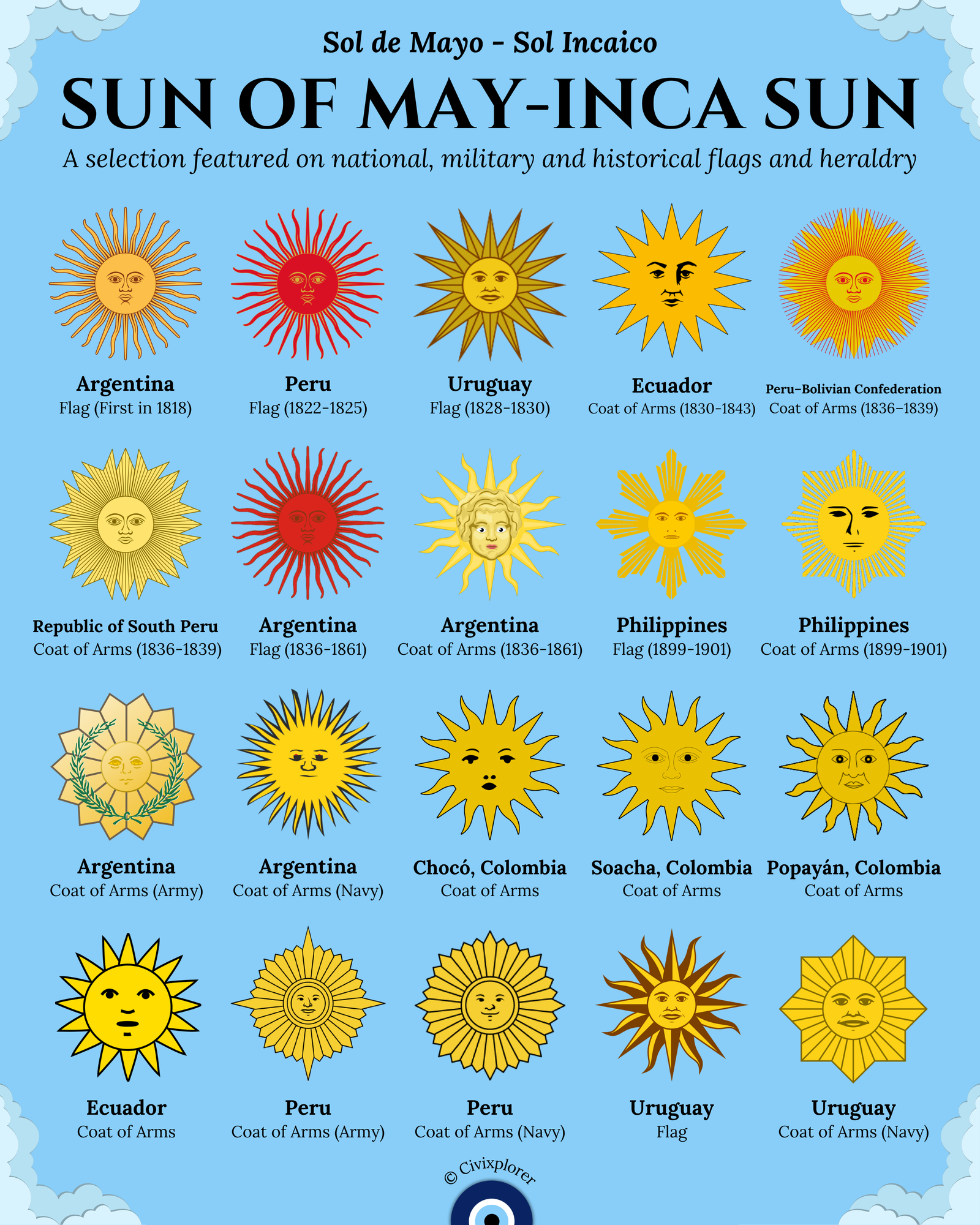
The Sun of May (Sol de Mayo) or Inca Sun is far more than a decorative emblem; it is a profound visual genealogy that maps the political, cultural, and revolutionary history of the former Spanish territories. While it appears as a collection of stylized faces, this grid of solar icons represents a sophisticated intersection of pre-Columbian heritage and Enlightenment-era ideals.
Origins: A Dual Identity of Revolution and Heritage
The symbol operates on two distinct historical levels: the indigenous and the revolutionary. Before European conquests, the sun was worshipped as Inti, the central deity of the Inca Empire. In Inca iconography, Inti was frequently depicted as a golden disk with a human face, radiating life and warmth.
The "May" in the title refers to the May Revolution of 1810 in Buenos Aires, which sparked the independence process for the Viceroyalty of the Río de la Plata. When these new republics needed to forge an identity separate from the Spanish Crown, they deliberately adopted indigenous iconography. By resurrecting the image of Inti, revolutionaries symbolically linked their new nations to ancient sovereignty, framing independence as a restoration of America’s original freedom.
The Anatomy of the Sun: Rays of Light and Heat
The design of these suns is strictly defined in heraldic vexillology. The straight rays represent light, while the wavy or flaming rays represent heat and fire. The Argentine Sun typically features 32 rays, while the Uruguayan Sun features 16. The first formal heraldic use was on the 1813 seal of the Argentine General Constituent Assembly, designed by Juan de Dios Rivera, a silversmith of Inca descent fittingly nicknamed "The Inca."
Regional Variations and Political Statements
Across South America, the sun was adapted to fit local narratives. In Argentina (1836–1861), under the rule of Juan Manuel de Rosas, the sun was famously rendered in a deep Federalist red as a political tool to dominate rivals. In Peru, the red sun used between 1822 and 1825 represented a direct claim to Inca ancestry, as Peru was the historical epicenter of the empire.
In Ecuador, the solar symbol takes on a calendrical meaning. The sun in the Ecuadorian coat of arms often contains the zodiac signs of Aries, Taurus, Gemini, and Cancer, representing the months of the struggle against local military rule. Even in Colombia, municipalities like Chocó and Soacha adopted the sun as a universal republican symbol of liberty and a "new dawn" for their citizens.
The Trans-Pacific Connection
One of the most fascinating outliers is the Philippine Sun. Despite being geographically detached from South America, the First Philippine Republic adopted a "smiling sun" during its revolution against Spain. The leaders of the Philippine revolution were heavily influenced by Freemasonry—which uses the sun as a symbol of enlightenment—and the successful models of South American republics. The eight main rays of the Philippine sun represent the first eight provinces that rebelled against Spanish rule.
A Language of Legitimacy
Ultimately, the infographic captures the spread of the solar emblem as a language of legitimacy. Whether it is announcing the birth of a republic in the Río de la Plata or bridging the gap to an indigenous past in the Andes, the sun remains a potent sign of sovereignty, continuity, and renewal.

Comments (0)
Join the Conversation
Login to share your thoughts with the community.
Login to Comment