
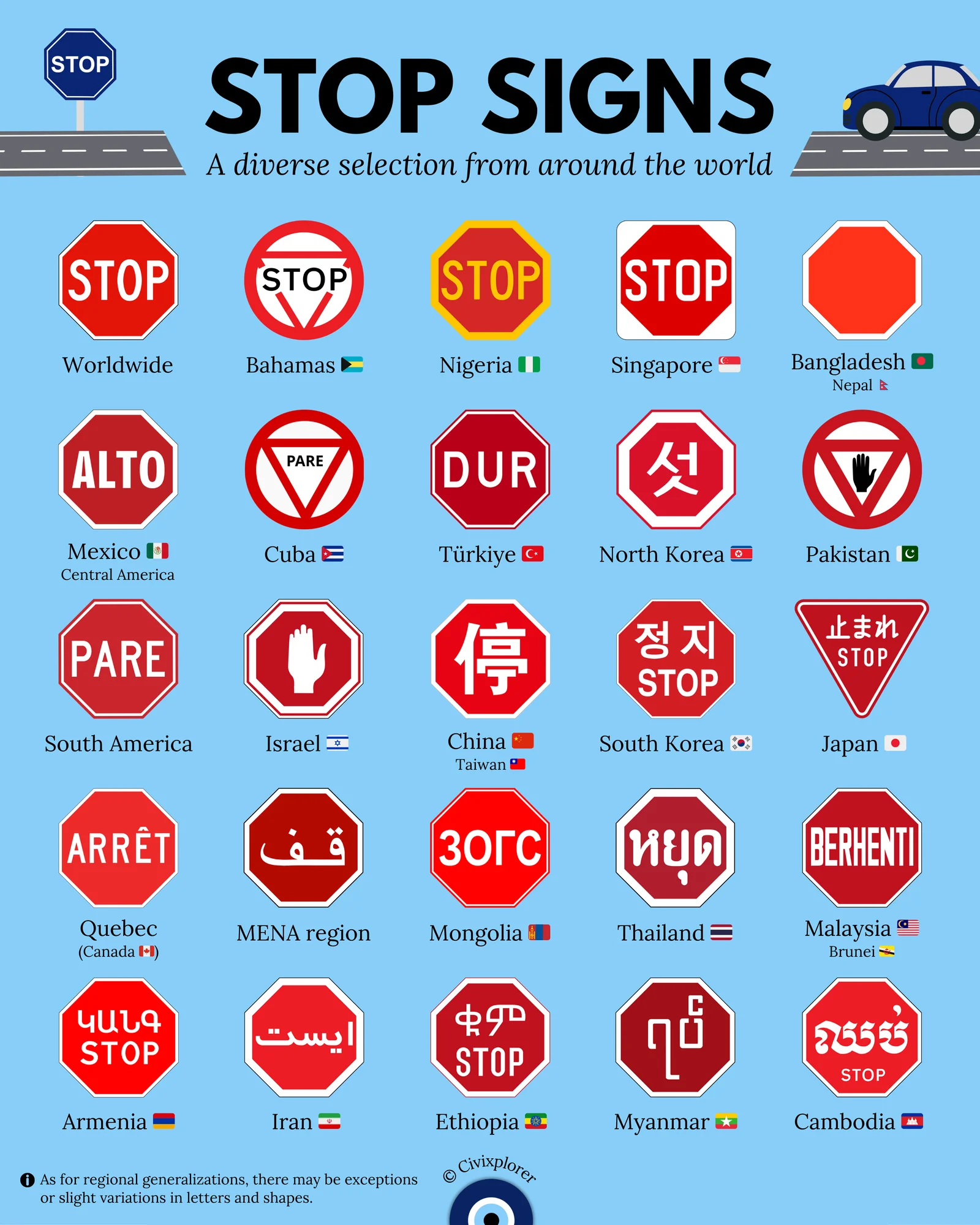
While the 1968 Vienna Convention on Road Signs and Signals aimed to standardize traffic rules globally, the red octagon still carries deep cultural and political variations. This iconic eight-sided shape was originally selected because its unique geometry allows drivers to identify the sign even from the back or when obscured by snow and mud.
However, not every nation follows the octagonal norm. 🇯🇵 Japan stands out with its red inverted triangle, while nations like 🇵🇰 Pakistan, 🇨🇺 Cuba, and the 🇧🇸 Bahamas utilize circular or triangular hybrids often influenced by colonial-era signage standards. In North America, 🇨🇦 Quebec’s use of "ARRÊT" serves as a strict protection of the French language, whereas France itself commonly uses the English "STOP".
In regions with multiple languages or literacy challenges, design choices become highly strategic. 🇮🇱 Israel utilizes a universal pictogram of a raised hand to avoid linguistic favoritism, while 🇧🇩 Bangladesh uses a completely blank red octagon to bypass language barriers entirely. Other nations, such as 🇪🇹 Ethiopia and 🇦🇲 Armenia, preserve their ancient scripts—Ge'ez and Armenian—alongside the English word to assist both local and international drivers. Even within the Spanish-speaking world, a linguistic divide exists: "ALTO" is the standard in 🇲🇽 Mexico and Central America, while "PARE" dominates 🇸🇦 South America.
Comments (0)
Join the Conversation
Login to share your thoughts with the community.
Login to Comment