
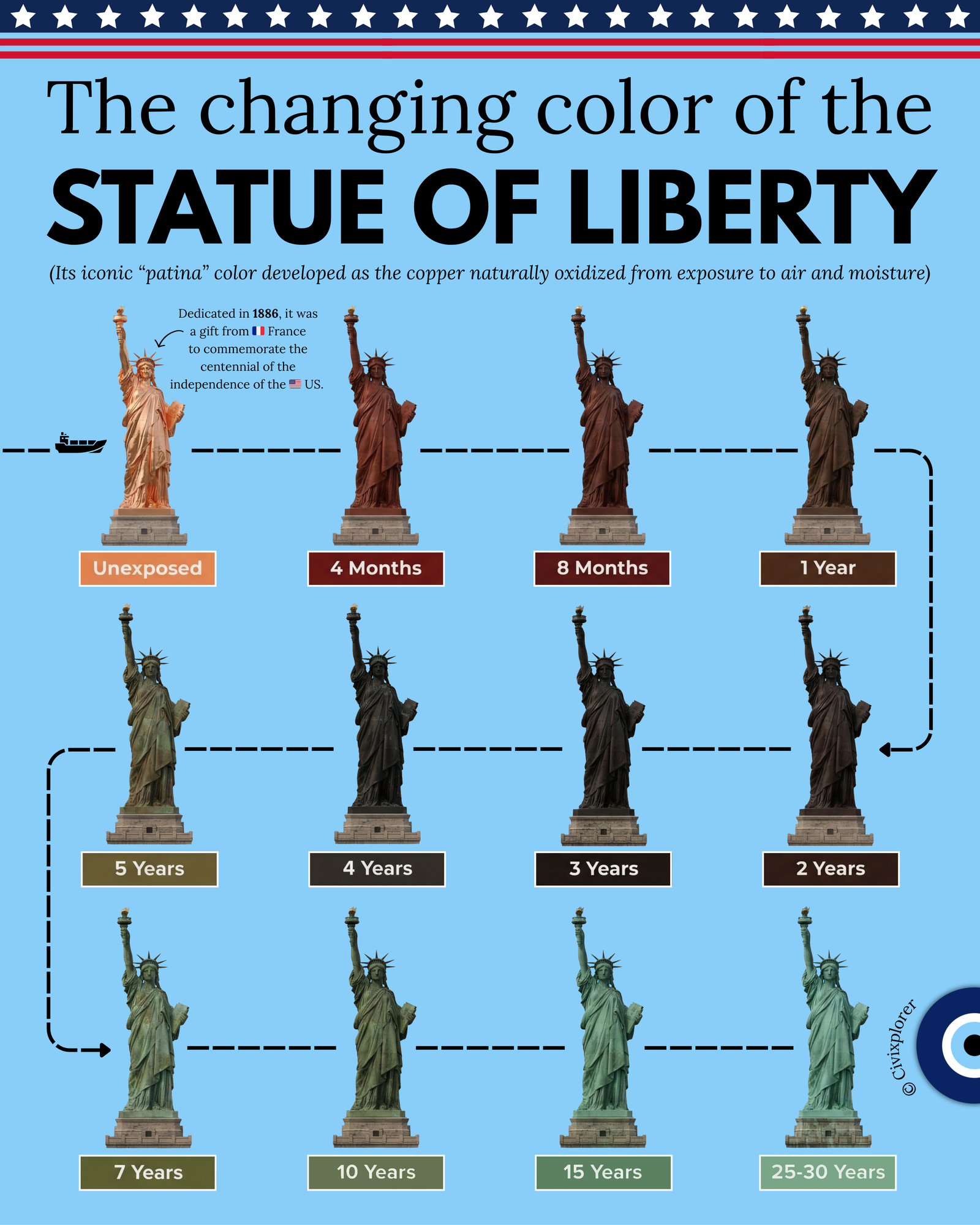
The Statue of Liberty is one of the most recognizable landmarks in the world, but its signature sea-foam green color wasn't part of the original design. When the monument was first unveiled in New York Harbor in 1886, it gleamed like a brand-new penny. A gift from France to commemorate the centennial of American independence and the end of slavery, the statue was designed by French sculptor Frédéric-Auguste Bartholdi, with an internal iron framework engineered by Gustave Eiffel.
The exterior of the statue consists of 300 individual copper plates, each roughly the thickness of two pennies. Because copper is highly reactive to the atmosphere, the transformation began almost immediately. Within the first few months, the reddish-orange metal oxidized into a dull, dark brown. By the early 20th century, heavy pollution from coal smoke and sulfur in the air reacted with the copper to create a nearly black appearance.
The final stage of this chemical evolution—the development of the green patina—occurred as the copper reacted with moisture, carbon dioxide, and sea spray. This process was gradual, with the statue appearing half-green by 1910 and reaching its fully iconic shade by approximately 1920.
Interestingly, the public and the press initially viewed this change as a sign of decay. In 1906, Congress even considered allocating funds to paint the statue to restore its original copper shine. However, the Army Corps of Engineers intervened after discovering that the patina was not destructive rust. Instead, it formed a protective crystalline layer—composed of minerals like brochantite—that seals the copper and prevents further corrosion. This natural shield has allowed the statue’s thin metal skin to endure the harsh, salty winds of the harbor for over a century.
Comments (0)
Join the Conversation
Login to share your thoughts with the community.
Login to Comment