
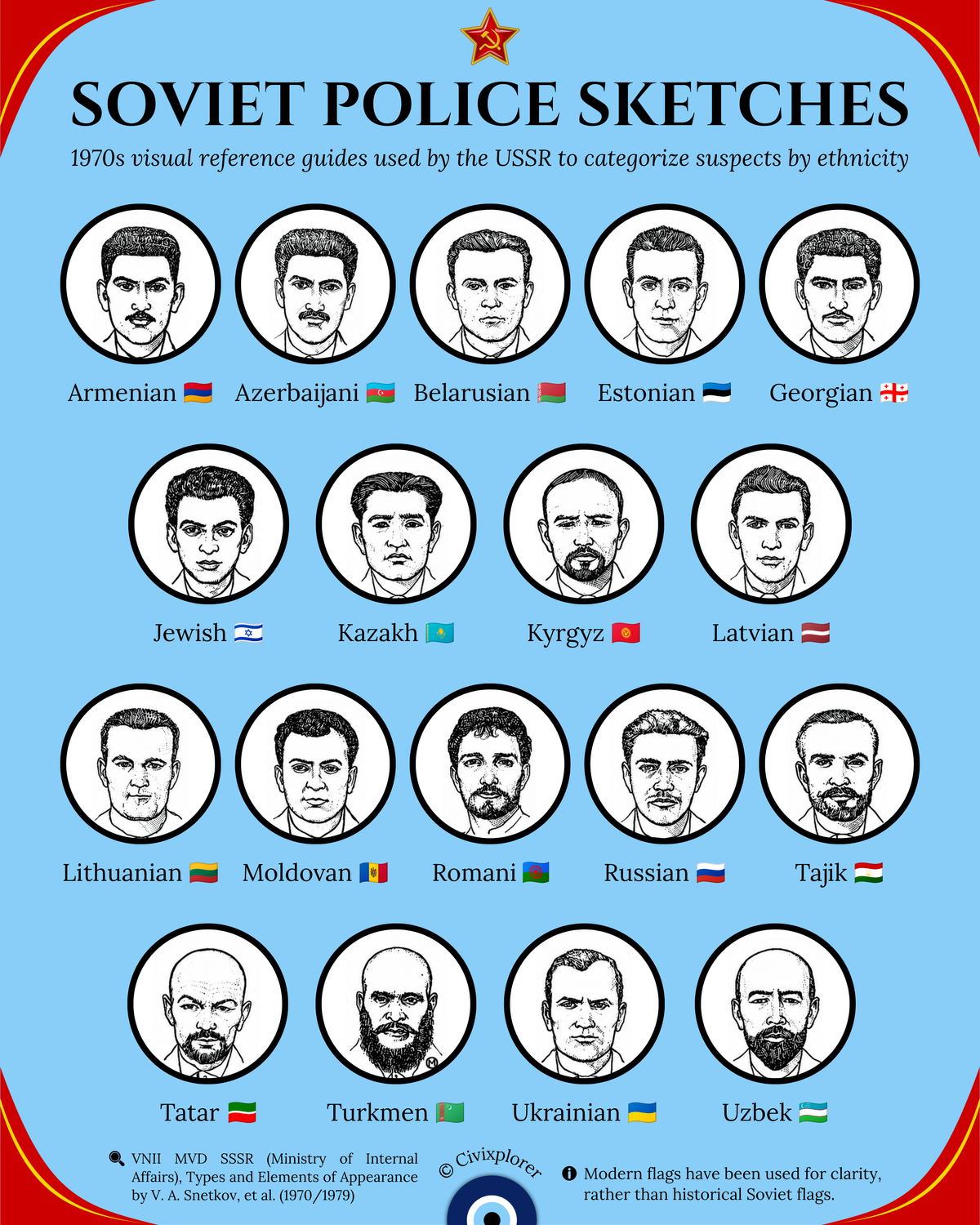
The striking visual of Soviet police sketches often circulating online is more than just a collection of faces; it is a gateway into a sophisticated and rigid system of state-mandated ethnic categorization. These illustrations are rooted in a genuine forensic reference manual titled "Types and Elements of Appearance" (ТЭВ), primarily authored by V. A. Snetkov and published by the All-Union Scientific Research Institute of the Ministry of Internal Affairs (VNII MVD SSSR). While the first edition appeared in 1970, a substantially expanded version followed in 1979, containing over 1,400 illustrations designed to assist the Soviet militia in criminal identification.
At the heart of this initiative was a branch of forensic science known in the USSR as habitology (габитоскопия). This discipline focused on the systematic study of a person's external appearance to create a "verbal portrait" that could be used by investigators across the vast, multi-ethnic Soviet sphere. Because the USSR spanned from the Baltic Sea to the Pacific Ocean, a detective in Estonia might have little familiarity with the typical facial features of someone from Tajikistan. These sketches served as a standardized visual vocabulary, allowing officers to communicate physical descriptions with high precision before the era of digital databases.
It is essential to understand that these sketches were not "criminal stereotypes" but were based on photographs of actual individuals deemed representative of specific anthropological types. The creators drew from extensive anthropological and ethnographic expeditions, including the work of prominent scientists like V. V. Bunak. By exaggerating certain characteristic features—such as cheekbone height, nose structure, and eye shape—the artists created idealized archetypes that helped investigators distinguish between the more than one hundred recognized nationalities within the Union.
This system was deeply intertwined with the Soviet concept of the "fifth heading" (пятая графа). In the USSR, "citizenship" was universally Soviet, but "nationality" strictly denoted a person’s ethnocultural background and was legally recorded in internal passports. Whether one was Ukrainian, Uzbek, Jewish, or Romani, this designation was a fundamental part of their administrative identity. Consequently, the police did not just view suspects as citizens; they categorized them by these state-mandated ethnic definitions, which influenced everything from forensic profiling to social surveillance.
The modern infographic version of these sketches introduces several historical anachronisms for better visual recognition, most notably the use of modern national flags. For example, pairing the "Jewish" sketch with the flag of Israel creates a historical paradox, as the 1970s Soviet Union was officially anti-Zionist and held a complex, often exclusionary relationship with its Jewish population. Similarly, using the modern flag of Tatarstan or the internationally recognized Romani flag recontextualizes these genuine historical artifacts for a 21st-century audience.
Today, these sketches are viewed as historical documents that reflect the intersection of applied physical anthropology and state control. While modern science views human variation as a continuous spectrum rather than discrete "types," these drawings remain a fascinating look at how the Soviet state attempted to systematize the sheer human diversity of its empire into a practical tool for policing and social organization.

Comments (0)
Join the Conversation
Login to share your thoughts with the community.
Login to Comment