
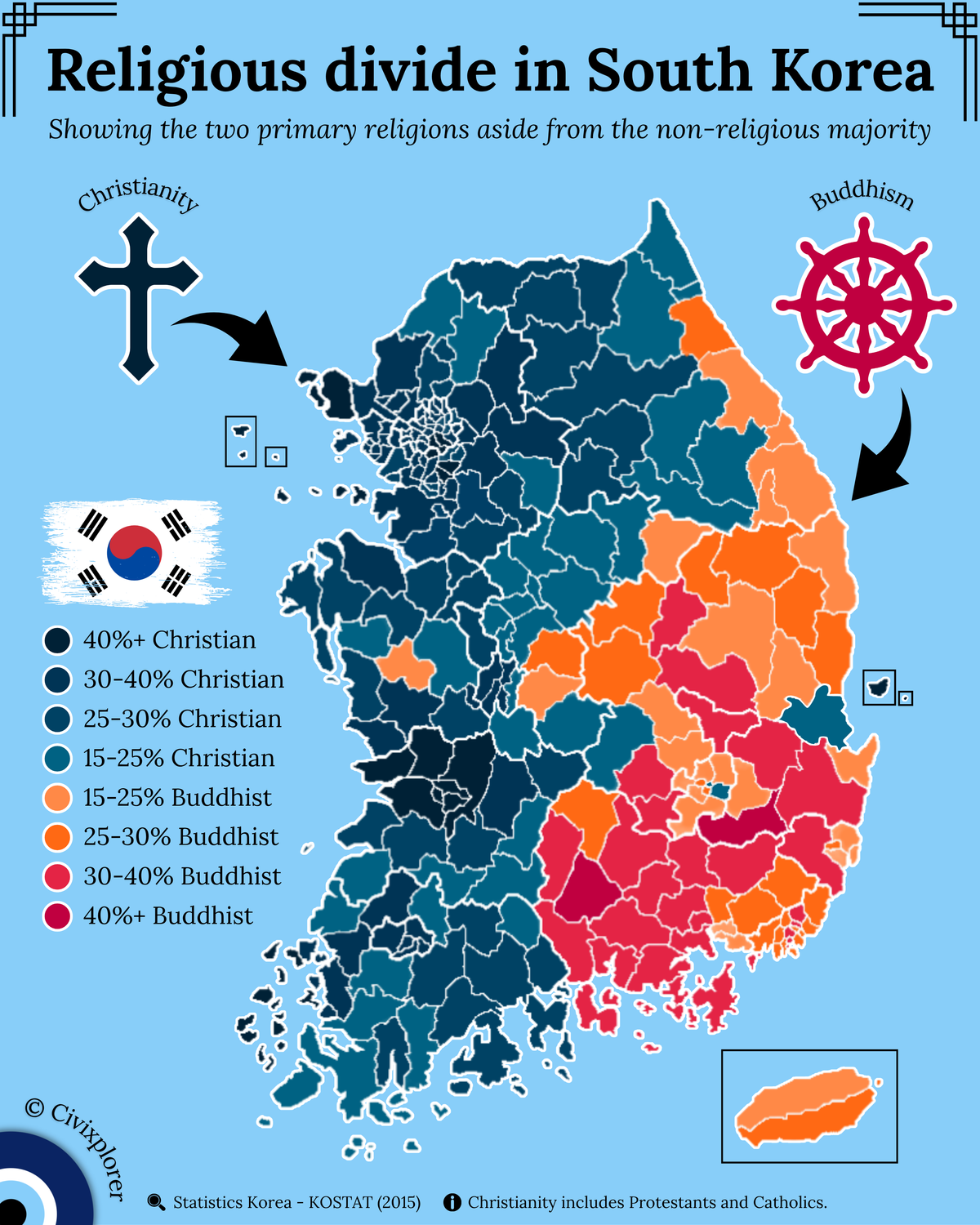
A visual analysis of South Korea's demographic landscape reveals a striking geographic pattern hidden beneath a national majority of non-affiliated citizens. According to census data from Statistics Korea, more than 56 percent of the population reports no formal religious affiliation. However, among those who identify with an organized faith, the country shows a clear demographic contrast between a Christian-leaning west and a Buddhist-leaning southeast. Combining Protestantism at nearly 20 percent and Catholicism at roughly 8 percent, Christianity maintains a strong presence across the Seoul Capital Area and the western provinces, while Buddhism remains deeply entrenched in the southeastern Yeongnam region.
The concentration of Buddhism in the southeast is rooted in over fifteen centuries of peninsular history. During the Three Kingdoms period, the ancient Silla Kingdom established its capital in Gyeongju and heavily promoted Buddhism as the unifying state religion. Even when the subsequent Joseon Dynasty elevated Neo-Confucianism and institutionalized the suppression of Buddhist clergy, historic monasteries survived within the rugged mountain sanctuaries of the east and southeast. This legacy created a resilient institutional framework that enabled traditional Buddhist practice to endure through modern industrialization in major metropolitan areas like Busan and Ulsan.
Conversely, the emergence of the Christian west aligns with twentieth-century social, educational, and geopolitical transformations. Late nineteenth-century Protestant missionaries established prominent schools, medical clinics, and publishing houses in urban centers, closely linking the faith with Western education and modernization. In the agricultural southwest, historical mission comity agreements assigned the Jeolla region to American Southern Presbyterian missions, establishing robust local church networks that created long-term institutional path dependency. Furthermore, following the Korean War and the division of the peninsula, thousands of Christian refugees fled south from Pyongyang—once known as the "Jerusalem of the East"—and settled predominantly in the expanding capital region.
Rather than signaling a rigid religious partition, this regional contrast operates within a broader nationwide trend toward secularization. While younger generations overwhelmingly report no religious affiliation, the geographical distinction between the Protestant-leaning west and Buddhist-leaning southeast remains remarkably persistent in contemporary demographic surveys. Ultimately, South Korea's religious geography reflects three distinct historical layers: ancient Buddhist heritage, rapid modern Christian expansion, and a growing secular majority.

Comments (0)
Join the Conversation
Login to share your thoughts with the community.
Login to Comment