
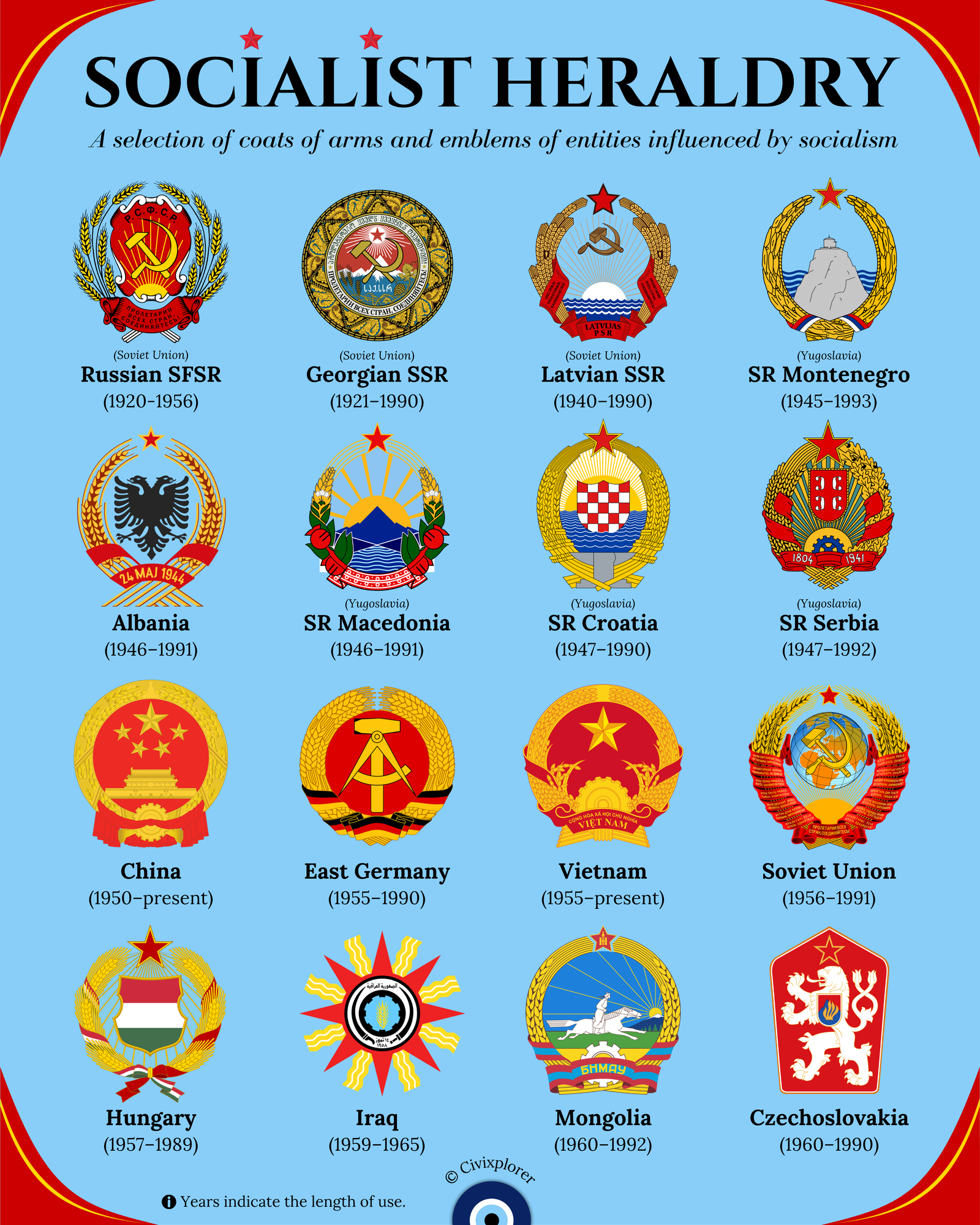
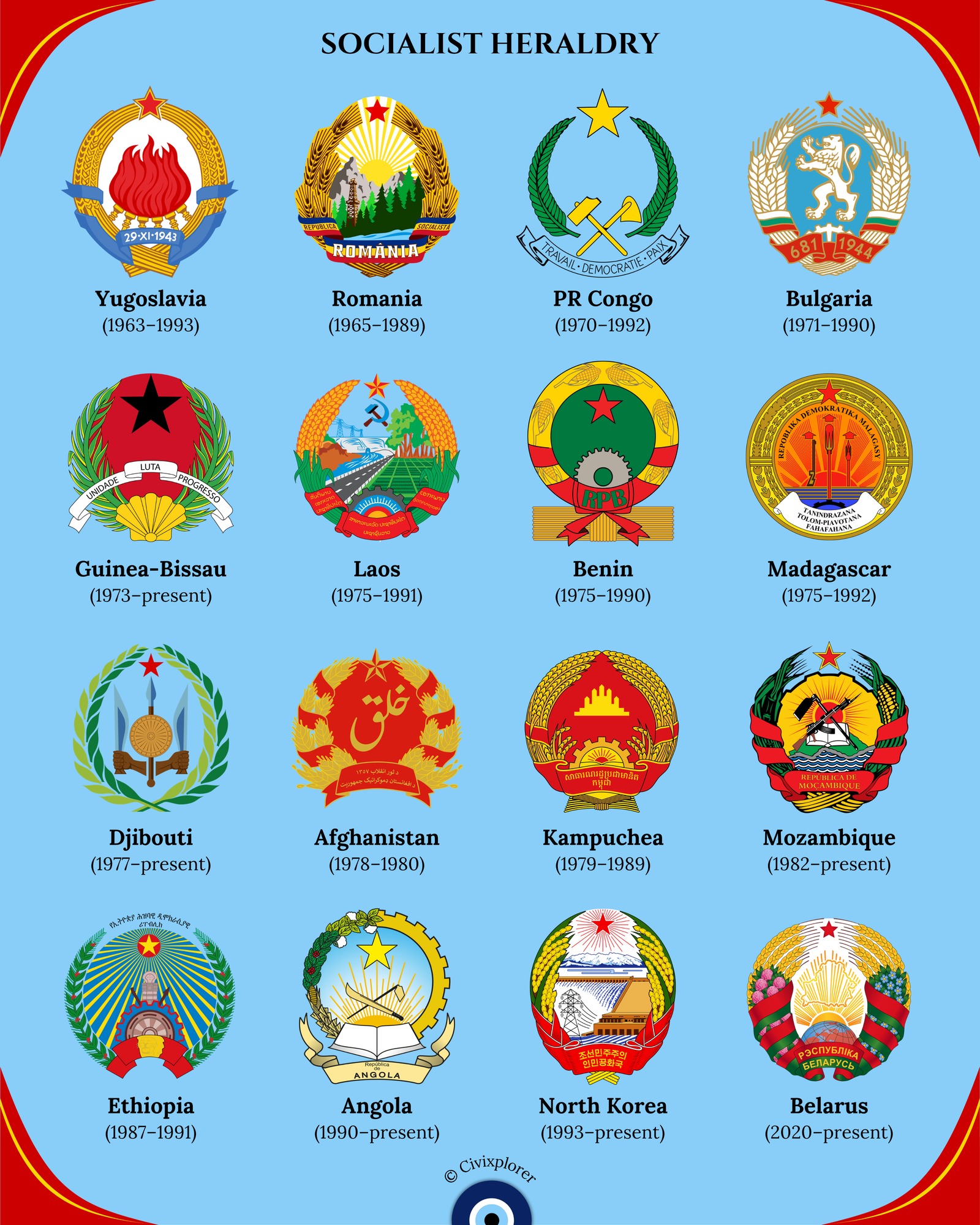
Socialist heraldry represents one of the most distinct visual shifts in 20th-century political history. Unlike traditional European heraldry, which relies on feudal symbols like shields, lions, and crowns to denote nobility, socialist emblems were a deliberate rejection of the past. These designs were created to represent a new political era focused on the working class, industrial progress, and revolutionary optimism.
The foundational blueprint for this style emerged in Soviet Russia following the 1917 Bolshevik Revolution. By replacing aristocratic motifs with tools of labor, the Soviet Union established a "socialist heraldry" that would eventually be exported to over a third of the world. The core iconography remained remarkably consistent across different nations, emphasizing proletarian unity through several recurring elements:
- The Wheat Wreath: Almost all socialist emblems use a circular frame made of agricultural products, usually wheat, rye, or rice. This symbolizes agricultural wealth and the vital role of the peasantry.
- The Rising Sun: Often positioned at the base or center, the sun represents the dawn of a new era, dispelling the darkness of capitalist or colonial history.
- The Red Star: Usually crowning the emblem, the five-pointed star represents the Communist Party and the five inhabited continents united in internationalism.
- The Red Ribbon: These wreaths are typically bound by a red ribbon, which often bears the state name or the classic Marxist motto, "Workers of the world, unite!"
While the Soviet template was rigid, some of the most fascinating examples are those that adapted these symbols to reflect local socio-economic realities. For instance, East Germany (GDR) replaced the sickle with a compass to represent the technical intelligentsia and scientists, highlighting the nation's focus on industrial and intellectual progress. In contrast, post-colonial states in Africa often incorporated symbols of armed struggle; Mozambique famously features an AK-47 assault rifle crossed with a hoe, representing the defense of the revolution and the importance of agriculture.
Other nations used their emblems to ground ideology in national landmarks. The emblem of China features the Tiananmen Gate, the physical site where the People's Republic was proclaimed, surrounded by five stars representing the unity of social classes. Similarly, North Korea transitioned from generic Soviet motifs to a design featuring the Sup'ung hydroelectric dam, symbolizing rapid industrialization and the doctrine of self-reliance.
Today, while most Eastern Bloc nations reverted to pre-communist heraldry after 1991, the style persists in several countries. Belarus remains a striking modern survivor; in 2020, it updated its emblem—which is a direct descendant of its Soviet-era design—to center the globe on Europe. This persistence highlights the enduring visual power of an aesthetic that was once designed to forge a "new socialist man" through the language of industry and labor.

Comments (0)
Join the Conversation
Login to share your thoughts with the community.
Login to Comment