
The Origins of Aerial Identification
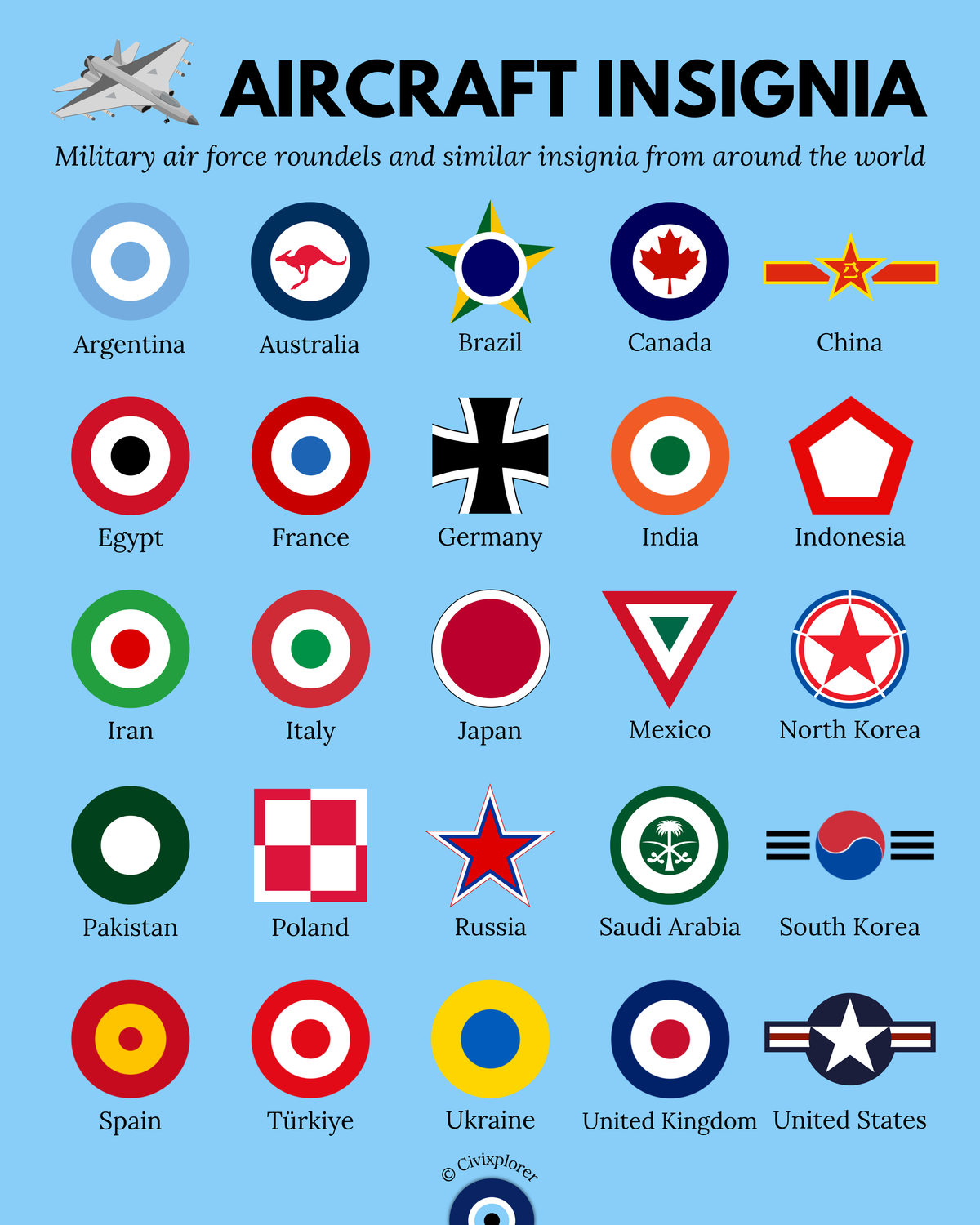
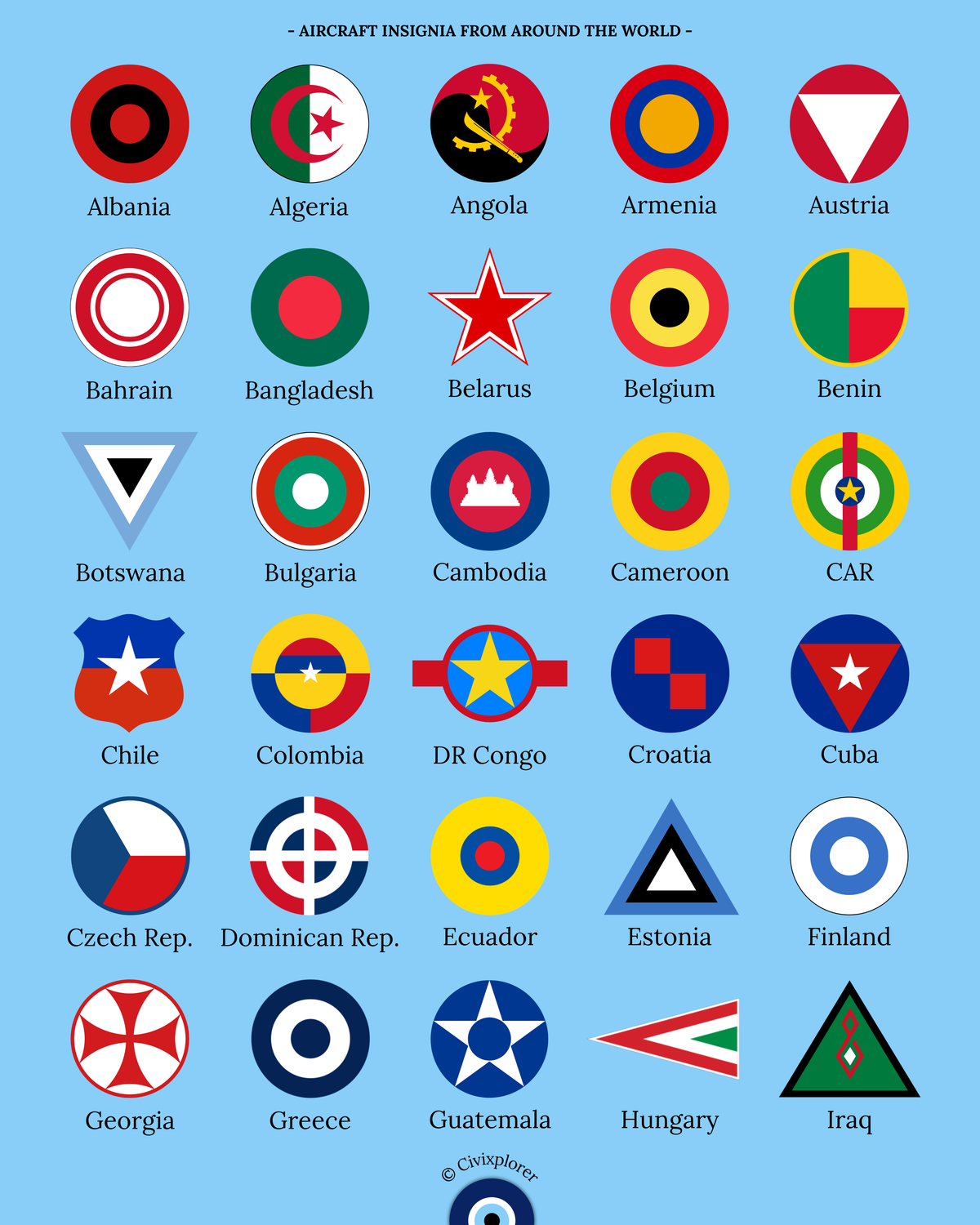
Military aircraft insignia emerged out of absolute necessity during the early years of World War I. Before standardized markings, ground troops and pilots frequently fired upon their own aircraft because they could not distinguish friend from foe at high altitudes. France pioneered the system in 1912, mandating the use of roundels based on the national cockade. This practical, symmetrical format spread rapidly because circles are directionally neutral, easy to paint on curved surfaces, and provide high contrast against the sky.
The United Kingdom initially utilized Union Jack flags, but from a distance, the intersecting lines were frequently mistaken for the German cross, leading to catastrophic friendly fire. The British swiftly adopted the French circular style but reversed the colors—placing a red center inside a white ring and blue outer ring—to maintain a distinct identity while utilizing the proven roundel template.
Evolution within the Commonwealth
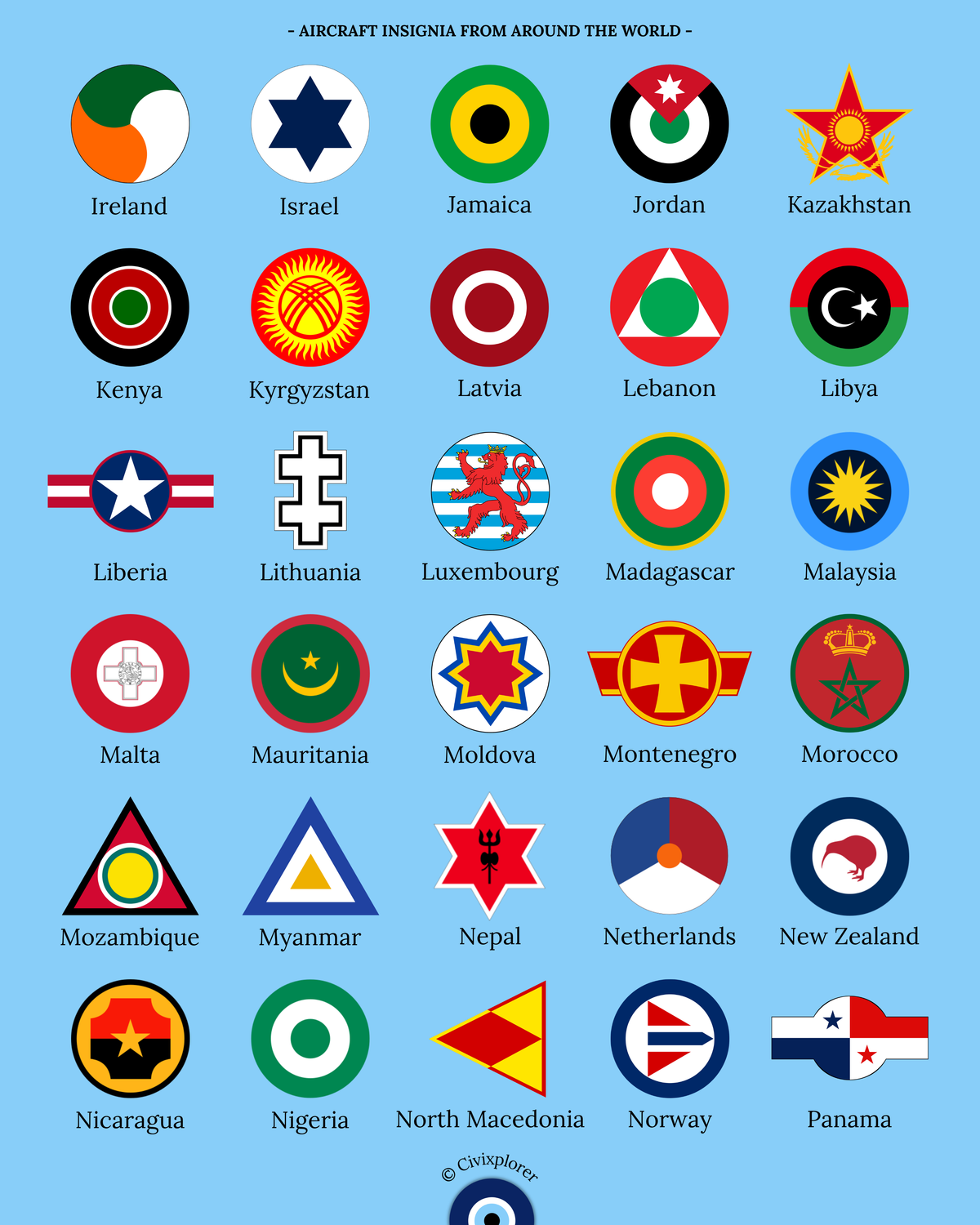
Geopolitical shifts and practical theater-of-war requirements eventually led to a divergence in design among Commonwealth nations. During World War II, the Royal Australian Air Force (RAAF) removed the red center from their roundels in the Pacific theater to avoid confusion with Japan’s Hinomaru (the solid red "Rising Sun" roundel). By 1956, Australia solidified its identity by placing a leaping red kangaroo at the center of its insignia. Similarly, New Zealand adopted the silhouette of the flightless Kiwi bird, and Canada replaced the traditional center with its iconic maple leaf.
Ideological Geometry and the Red Star
The star is the second most common motif in global aviation, deeply tied to mid-20th-century geopolitical alignments. The red star is a universal symbol of communism and socialism, utilized by Russia and former Soviet states. The People’s Liberation Army Air Force (PLAAF) of China features a red star flanked by wings, containing the characters "8-1" to commemorate the founding date of the People's Liberation Army on August 1, 1927.
Geometric Departures and Heraldry
While circular roundels dominate, several nations utilize distinct geometric shapes rooted in deep historical traditions:
- Germany: The modern Luftwaffe uses a stylized Cross Pattée (Iron Cross), rooted in Prussian military history. This curved-arm variant deliberately distances the modern military from the straight-armed Balkenkreuz used during the Nazi era.
- Poland: The Polish checkerboard (szachownica) is one of the few strictly square insignias in the world, originally the personal emblem of a pioneering pilot.
- Lithuania: Uses the Cross of Vytis, a double cross tied to the medieval Jagiellonian dynasty.
Cultural and Regional Symbolism
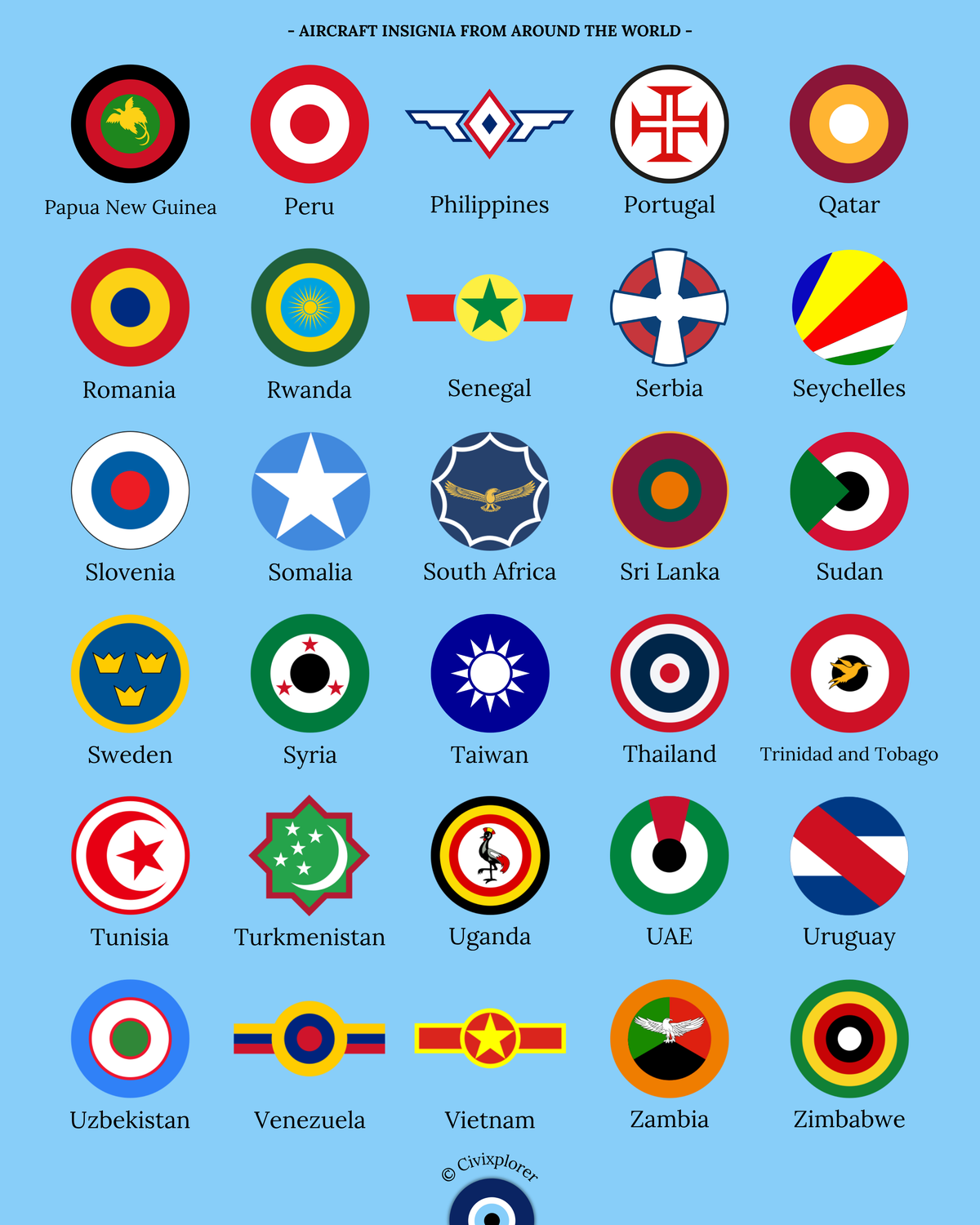
Many nations incorporate local fauna or religious artifacts to ensure immediate recognition. Saudi Arabia features a palm tree above two crossed swords, symbolizing prosperity and justice. Uganda utilizes the Grey Crowned Crane, a symbol of the nation's gentle nature, while South Africa features the Bateleur eagle, a bird known for its exceptional aerial acrobatics.
Ultimately, aircraft insignia represent a visual map of 20th-century geopolitics and the constraints of aerial perception. They encapsulate national sovereignty and military tradition while serving the universal practical need for safety in the skies.

Comments (0)
Join the Conversation
Login to share your thoughts with the community.
Login to Comment