
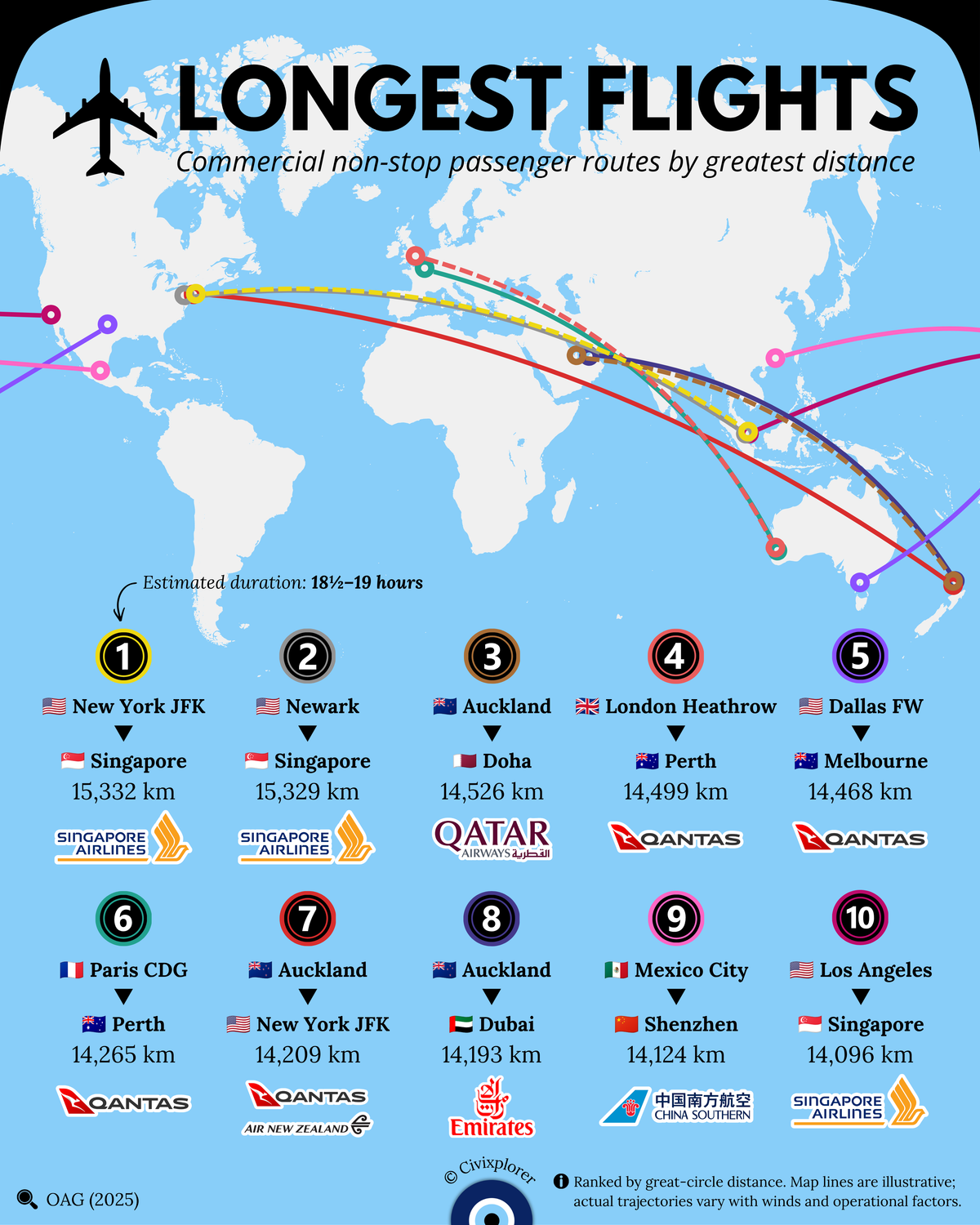
The landscape of modern commercial aviation is currently defined by a fascinating pursuit of distance, where the world's most extreme routes push the 19-hour mark through a complex intersection of geographical necessity and cutting-edge technology. Based on 2025 data from the Official Airline Guide (OAG), the ranking of the world's longest non-stop passenger flights reveals a industry operating at the absolute limits of terrestrial travel.
The Reign of Singapore Airlines
The top of the leaderboard is dominated by Singapore Airlines, which holds both the first and second positions with its services from New York (JFK) and Newark (EWR) to Singapore. These two routes are separated by a mere 3 kilometers in geographic distance, representing a deliberate commercial strategy to link one of Asia's most critical financial hubs with the New York metropolitan market. The leading flight from JFK spans 15,332 kilometers, utilizing roughly 85 percent of the current aircraft's maximum range capability.
The Geography of Isolation
A striking feature of ultra-long-haul aviation is the prominence of Oceania. Airports in Australia and New Zealand anchor six of the top ten routes, a direct result of their immense geographical distance from major financial centers in the Northern Hemisphere. Carriers like Qantas and Air New Zealand have turned this isolation into a competitive advantage, offering non-stop links such as Perth to London (14,499 km) and Auckland to New York (14,209 km) to cater to travelers who prioritize time savings over connecting itineraries.
The Twin-Engine Revolution
This expansion in distance—which has grown by 14.5% since the year 2000—is powered by a new generation of efficient twin-engine widebody aircraft. The industry has largely abandoned heavy, fuel-hungry four-engine models like the Boeing 747 in favor of highly efficient platforms like the Airbus A350-900ULR and the Boeing 787-9. The A350-900ULR, specifically, features modified fuel systems that allow it to carry approximately 110,000 kilograms of jet fuel, making 18- to 19-hour journeys commercially viable.
Economics and Passenger Psychology
Operating these routes requires a specialized business model. To compensate for heavy fuel loads, airlines often reduce passenger payload. For instance, Singapore Airlines operates its ultra-long-range flights exclusively with Business and Premium Economy classes, removing standard economy entirely to maximize revenue from high-yield travelers. Inside the cabin, crews utilize structured lighting and meal timing to help passengers battle the physiological challenges of crossing up to 12 distinct time zones in a single sitting.
The Next Frontier: Project Sunrise
While the current record stands at 15,332 km, the aviation industry is already preparing to stretch the map further. Qantas is advancing "Project Sunrise," which aims to introduce 22-hour non-stop flights connecting Sydney directly to London and New York. Utilizing specially redesigned Airbus A350-1000ULR aircraft, the planned Sydney–London route will span roughly 17,000 kilometers, exceeding current records by 1,700 kilometers when it enters service in late 2027.

Comments (0)
Join the Conversation
Login to share your thoughts with the community.
Login to Comment