
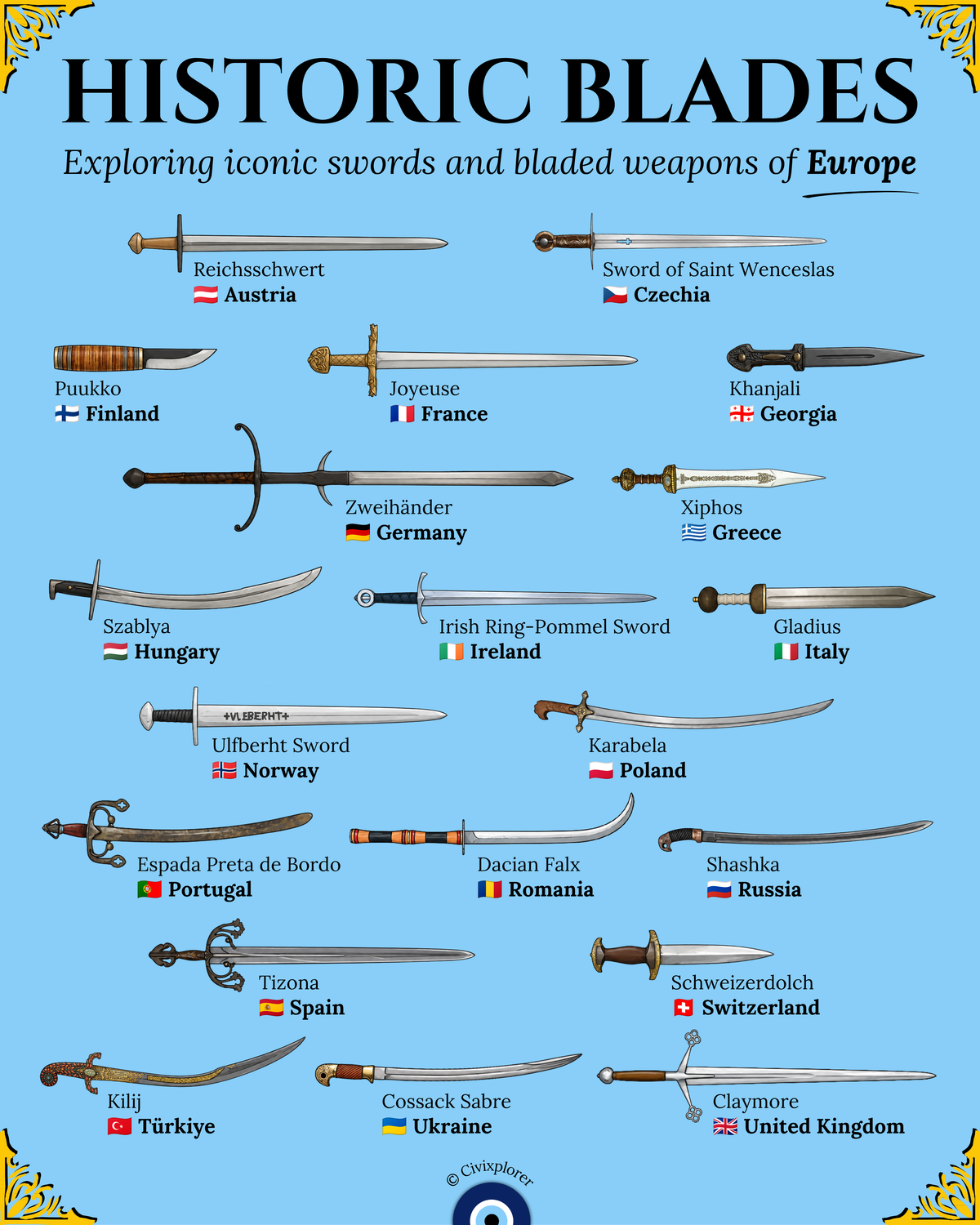
The history of Europe is often written in steel. Beyond being mere tools of war, swords and bladed weapons have served as potent symbols of sovereignty, social status, and cultural identity for millennia. In this exploration, we delve into the diverse martial traditions of the continent, moving from the disciplined ranks of Antiquity to the specialized mercenary companies of the Renaissance.
The Foundation of European Warfare: Ancient Antiquity
European sword traditions find their roots in the classical Mediterranean, where the Xiphos and the Gladius became legendary. The Greek Xiphos, a double-edged shortsword often featuring a leaf-shaped blade, was the secondary weapon of the hoplite. Designed for the chaotic crush of infantry combat when spears were broken, its shape offered a perfect balance between cutting and thrusting.
Meanwhile, the Roman Gladius became the emblem of an empire. Standardized and engineered for efficiency, the Gladius—particularly the Hispaniensis type adopted from Celtiberian designs—prioritized controlled thrusting from behind a large shield. This weapon reflected the core of Roman military success: discipline and standardization. In contrast, the Dacian Falx from the territory of modern Romania represented a unique mechanical challenge to Rome. Its forward-curving blade was so devastating that Roman engineers had to reinforce legionary helmets with crossbars to survive its downward strikes.
Legendary Relics and Royal Sovereignty
Many of the blades featured in European history are not just types of weapons but specific, legendary artifacts used to legitimize power. Joyeuse, the coronation sword of French kings, is traditionally linked to Charlemagne. Though it is a composite object with parts spanning several centuries, it represents the ideal of the sacred ruler. Similarly, the Tizona is famously attributed to the Castilian hero El Cid. Metallurgical analysis has confirmed that its blade contains Damascus steel dating to the 11th century, grounding the legend in historical reality.
In Central Europe, the Reichsschwert (Imperial Sword) served as a centerpiece of the Holy Roman Empire’s regalia. Used in coronations and preserved in Vienna, it symbolizes the multi-ethnic authority of an empire that once spanned the heart of the continent.
The Evolution of the Sabre: Eastern Influences
A clear narrative in European weaponry is the cross-pollination between East and West. In Eastern Europe, the deep curve of the Turkish Kilij influenced generations of cavalrymen. This design was optimized for devastating slashing attacks from horseback. Hungarian and Polish forces, frequently clashing with Ottoman and Tatar cavalry, adopted these forms into the Szablya and the Karabela. The Karabela, in particular, became an iconic symbol of the Polish nobility, reflecting a cultural identity that embraced nomadic, Sarmatian roots.
Further east, the Shashka—originating in the Caucasus and adopted by Russian and Ukrainian Cossacks—showcases a different philosophy. Lacking a crossguard, it was designed to be drawn and struck in a single, fluid motion, prioritizing aggressive speed over defensive parrying.
Specialized Engineering for the Modern Era
As warfare evolved, so did the steel. The Zweihänder of Germany was a massive two-handed tool used by elite mercenaries known as Doppelsöldner. These swords were not for dueling but were specialized polearms designed to shatter enemy pike formations.
On the high seas, the Portuguese Espada Preta de Bordo (Black Ship Sword) solved environmental problems. Its iron guards were frequently painted black to prevent corrosion from sea salt and to avoid reflecting light during nighttime boarding raids. In the north, the Ulfberht swords of the Viking Age represented a peak of early medieval globalization. Made from high-carbon crucible steel likely sourced via trade routes from Central Asia, these blades were significantly stronger and more flexible than their contemporaries.
From the utility-focused Finnish Puukko to the iconic Scottish Claymore, these blades prove that European martial history was never a single tradition. Instead, it was a constantly changing conversation between geography, technology, and the enduring human desire for status and protection.

Comments (0)
Join the Conversation
Login to share your thoughts with the community.
Login to Comment