
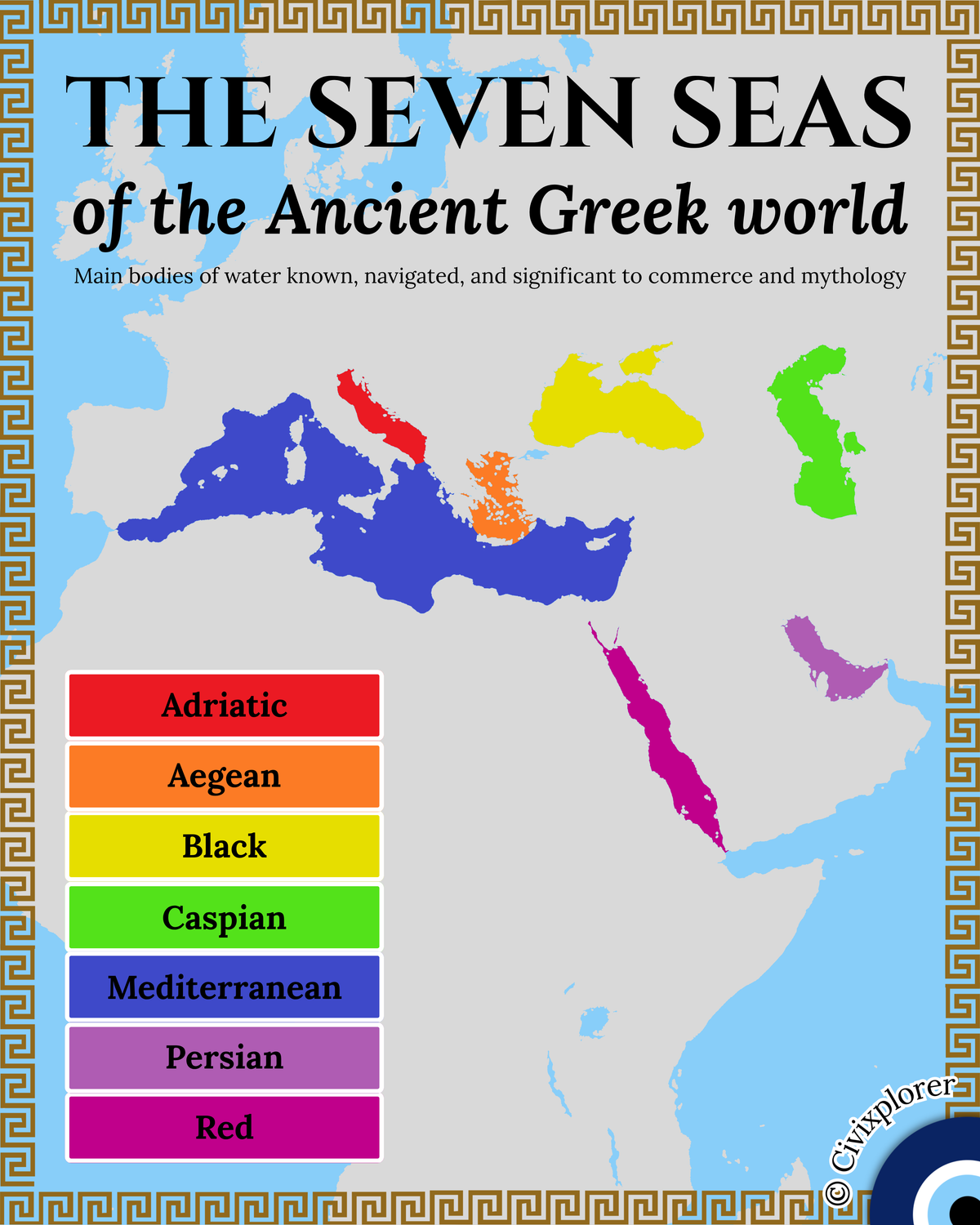
The concept of the Seven Seas is one of the most enduring maritime phrases in human history, tracing its roots back to classical antiquity and ancient literature. Rather than representing a modern scientific division of independent ocean basins, this traditional grouping reflects the evolving geographical horizons and trade networks of the ancient Greek world. The map categorizes seven distinct bodies of water—the Aegean, Adriatic, Mediterranean, Black, Caspian, Red Sea, and Persian Gulf—that together defined how classical scholars and navigators conceptualized their known universe.
At the center of this worldview lay the maritime heartland of Greek civilization. The Aegean Sea served as the primary highway connecting mainland Greece, the archipelagos, and the settlements along western Anatolia. Branching outward, the broader Mediterranean Sea facilitated vital trade and cultural exchanges between Greeks, Phoenicians, Egyptians, and neighboring societies. Subdivisions like the Adriatic Sea provided routes toward Italy and the Balkans, while the Black Sea functioned as a crucial economic frontier, supplying Greek city-states with grain, fish, and valuable raw materials.
Farther to the east, the selection highlights the dramatic expansion of Greek geographical knowledge during the Hellenistic era. The landlocked Caspian Sea fascinated classical writers, sparking centuries of debate among scholars over whether it was an enclosed basin or connected to a vast northern ocean. Meanwhile, direct interaction with the Persian Gulf and the Red Sea expanded rapidly following the conquests of Alexander the Great and the development of Ptolemaic trade infrastructure in Egypt, opening commercial routes toward Arabia and the Indian subcontinent.
Together, these seven waters illustrate how ancient Greek cartography blended empirical navigation, cultural symbolism, and expanding commercial horizons into a unified spatial tradition. Exploring this historical map allows us to see how early civilizations mapped the contours of the classical world.

Comments (0)
Join the Conversation
Login to share your thoughts with the community.
Login to Comment