
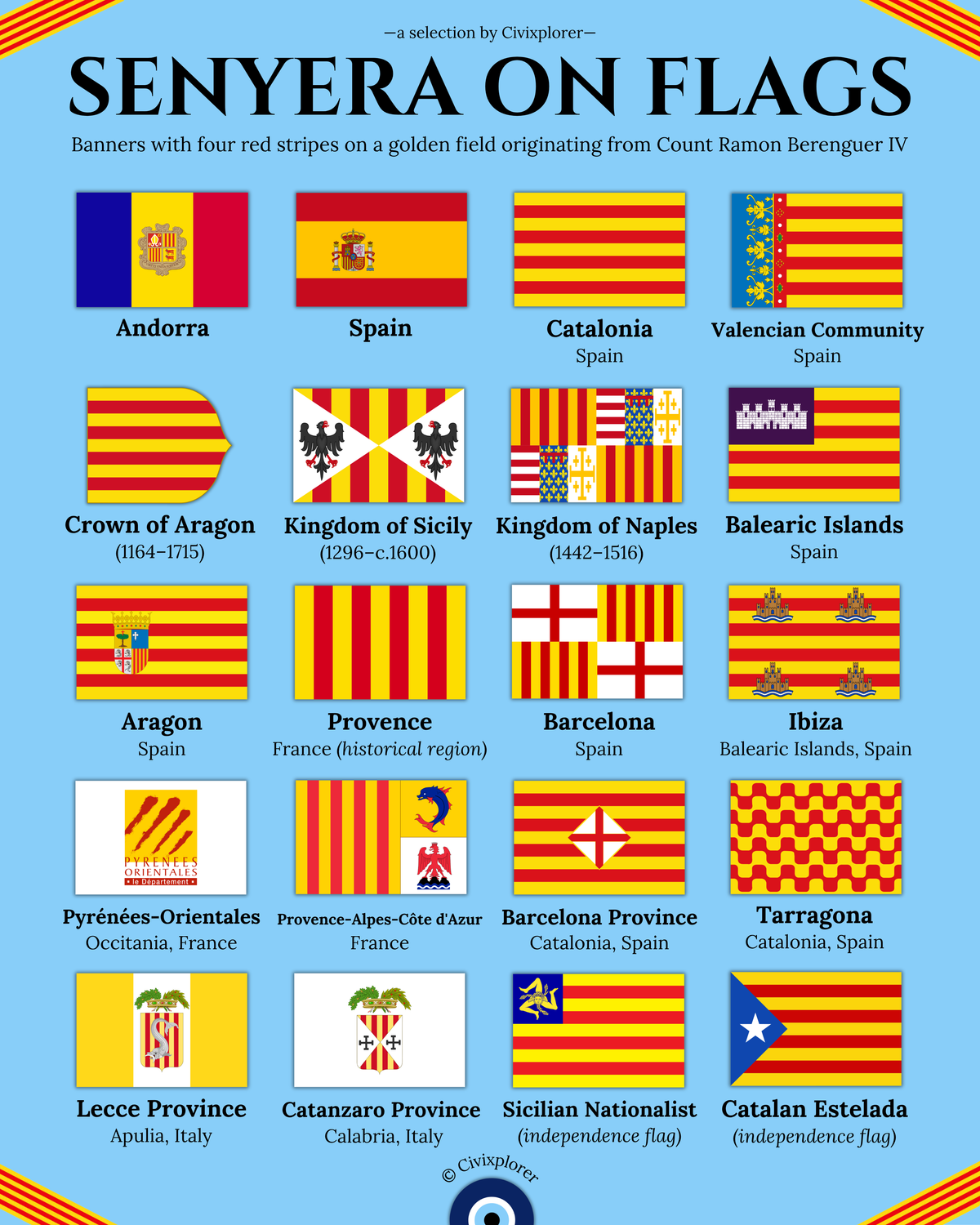
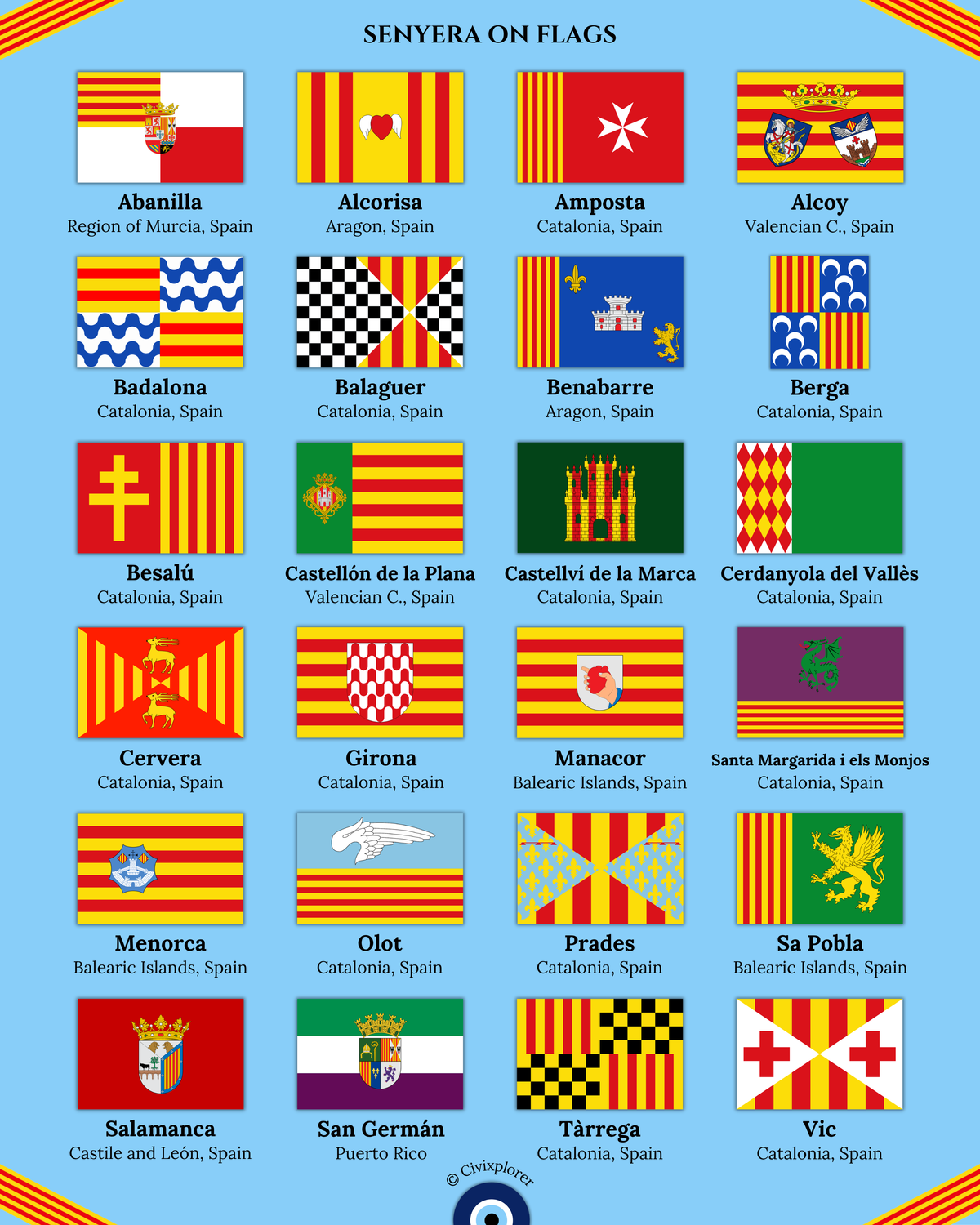
The iconic Senyera, characterized by four red stripes on a golden field, represents one of Europe’s oldest and most enduring heraldic designs. While widely recognized today as the official symbol of Catalonia, its origins trace back to a 12th-century dynastic emblem associated with the House of Barcelona. The earliest secure documentary evidence appears on a seal dated to 1150 belonging to Count Ramon Berenguer IV, whose union with Queen Petronilla of Aragon forged the Crown of Aragon. This medieval composite monarchy established the emblem as a sovereign mark across diverse Mediterranean realms. Popular myth often attributes the heraldry to the 9th-century count Wilfred the Hairy, claiming a Frankish king drew four blood-stained fingers across a golden shield, though historians confirm this story emerged centuries later in the 16th century as a romantic founding legend.
Understanding the global visual presence of the Senyera requires distinguishing between a heraldic coat of arms and a flag. On traditional shields, the red divisions appear as vertical pales, whereas attaching the design to a flagpole turned the emblem into horizontal stripes. As the Crown of Aragon built a maritime empire, this visual motif traveled across southwestern Europe and the Mediterranean basin. In Provence, heraldic ties introduced the four bars following the 12th-century marriage of Count Ramon Berenguer III to Douce of Provence. In Sicily, Aragonese monarchs combined the red stripes with black eagles following the Sicilian Vespers of 1282, creating a quartered saltire design. Similarly, the Kingdom of Naples integrated the Aragonese pales into its composite royal arms in 1442, leaving lasting heraldic footprints in southern Italian provincial symbols such as Lecce and Catanzaro.
Over time, the inherited heraldic emblem evolved from a royal family mark into distinct territorial and regional identities. In Spain, the plain four-bar design serves as the official flag of Catalonia, revived during the 19th-century Renaixença cultural movement. Other autonomous communities derived unique regional flags from the same dynastic root while adding local elements: the Valencian Community features the Senyera Coronada with a blue crowned band by the hoist, the Balearic Islands combines the bars with a purple canton bearing a five-towered castle, and Aragon incorporates the bars within its official shield. Modern political movements have further adapted the medieval bars to convey specific ideological messages. The Estelada, created in the early 20th century inspired by Cuban and Puerto Rican independence banners, adds a blue triangle with a white star to express Catalan independence aspirations. In contrast, the national flags of Spain and Andorra include the Aragonese bars strictly within their respective national coats of arms.
The legacy of the four red bars extends deep into municipal vexillology and across the Atlantic Ocean. Dozens of cities across Spain combine the royal bars with civic symbols, such as Barcelona and Vic pairing the stripes with the red cross of Saint George, or Girona and Tarragona integrating the motif alongside castles and geometric patterns. Intriguingly, the heraldry reaches beyond the historical lands of Aragon into Salamanca in Castile and León, where four bars feature within the city's composite shield. Through early modern Spanish imperial expansion, the emblem even crossed the Atlantic to San Germán, Puerto Rico, whose municipal coat of arms incorporates the royal arms of Ferdinand the Catholic. Far from representing a single modern nation, the Senyera stands as a remarkable testament to how a single medieval dynastic device can branch into diverse civic, regional, and international identities.

Comments (0)
Join the Conversation
Login to share your thoughts with the community.
Login to Comment