
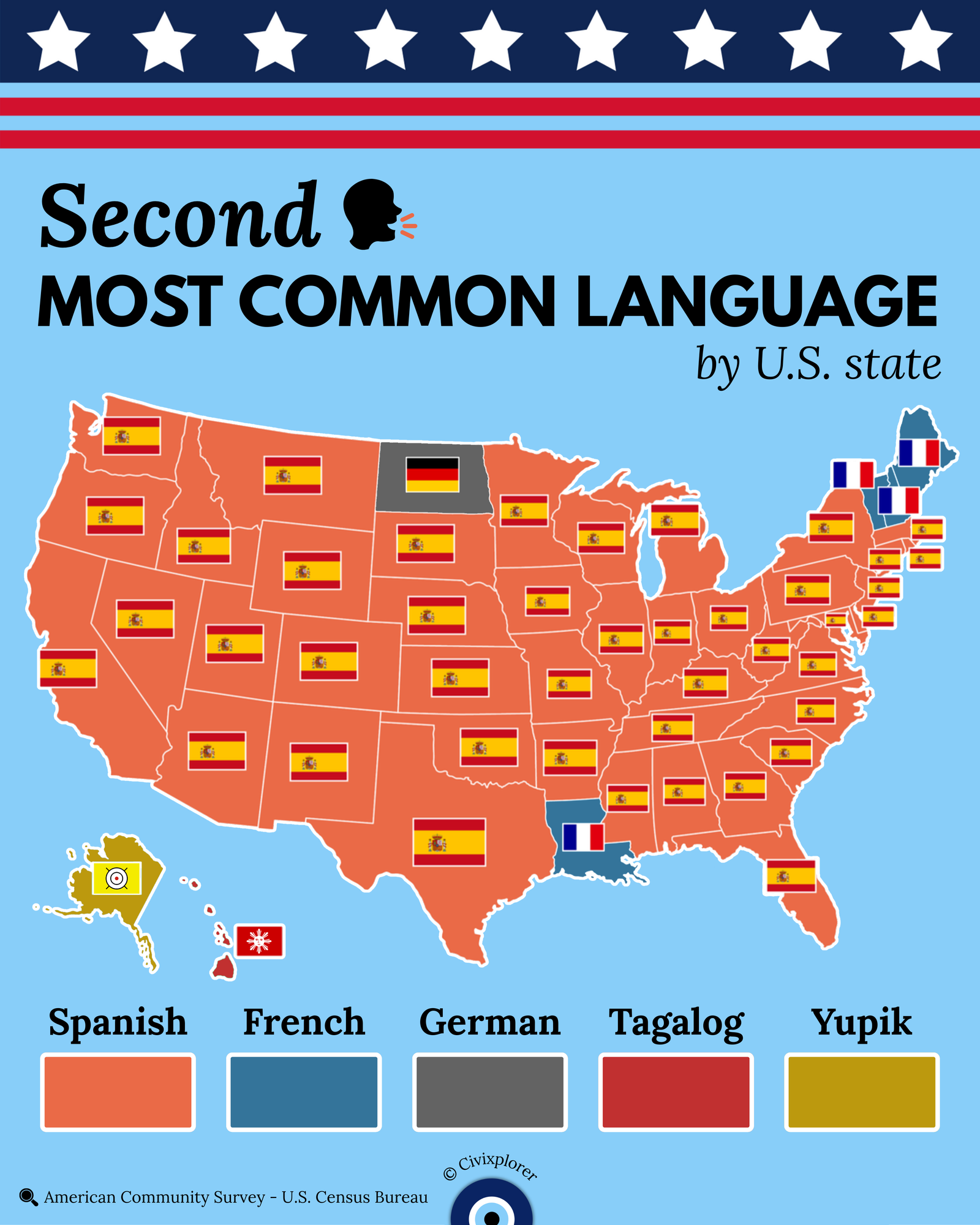
The linguistic landscape of the United States is a rich tapestry woven from centuries of migration, colonial history, and indigenous resilience. While English remains the primary language across the country, a closer look at the second most common languages spoken in each state offers a unique window into the nation’s past and present. Data from the U.S. Census Bureau’s American Community Survey reveals a mosaic of languages that tell stories of exiled settlers, agricultural labor, and isolated communities.
Spanish is the overwhelmingly dominant second language across the vast majority of the United States. Its prevalence is deeply rooted in historical borders, particularly in the West and Southwest, where states like California and Texas were once part of Spain and Mexico. Geographic proximity and continuous immigration from Latin American countries have further solidified Spanish as the nation's primary minority language.
In contrast, the presence of French highlights distinct regional histories. In Louisiana, the language persists due to colonial roots and the arrival of the Acadians—French settlers exiled from Canada in the 18th century. Meanwhile, in Northern New England, French speakers are primarily the descendants of French-Canadians who migrated south to work in textile mills during the 19th and 20th centuries.
One of the more surprising outliers is the persistence of German in North Dakota. Unlike the broader assimilation seen in other German-American communities after the World Wars, the "Germans from Russia" who settled in the Dakotas maintained their culture in isolated, rural farming communities, allowing the language to survive longer than in urban centers.
Finally, the non-European languages of Hawaii and Alaska reflect unique geographic identities. Tagalog's prominence in Hawaii is tied to the early 20th-century recruitment of Filipino laborers for sugar and pineapple plantations. In Alaska, the Yup'ik language underscores the resilience of indigenous communities whose geographic isolation helped protect their native tongue from being eroded by English-speaking settlement.
Comments (0)
Join the Conversation
Login to share your thoughts with the community.
Login to Comment