
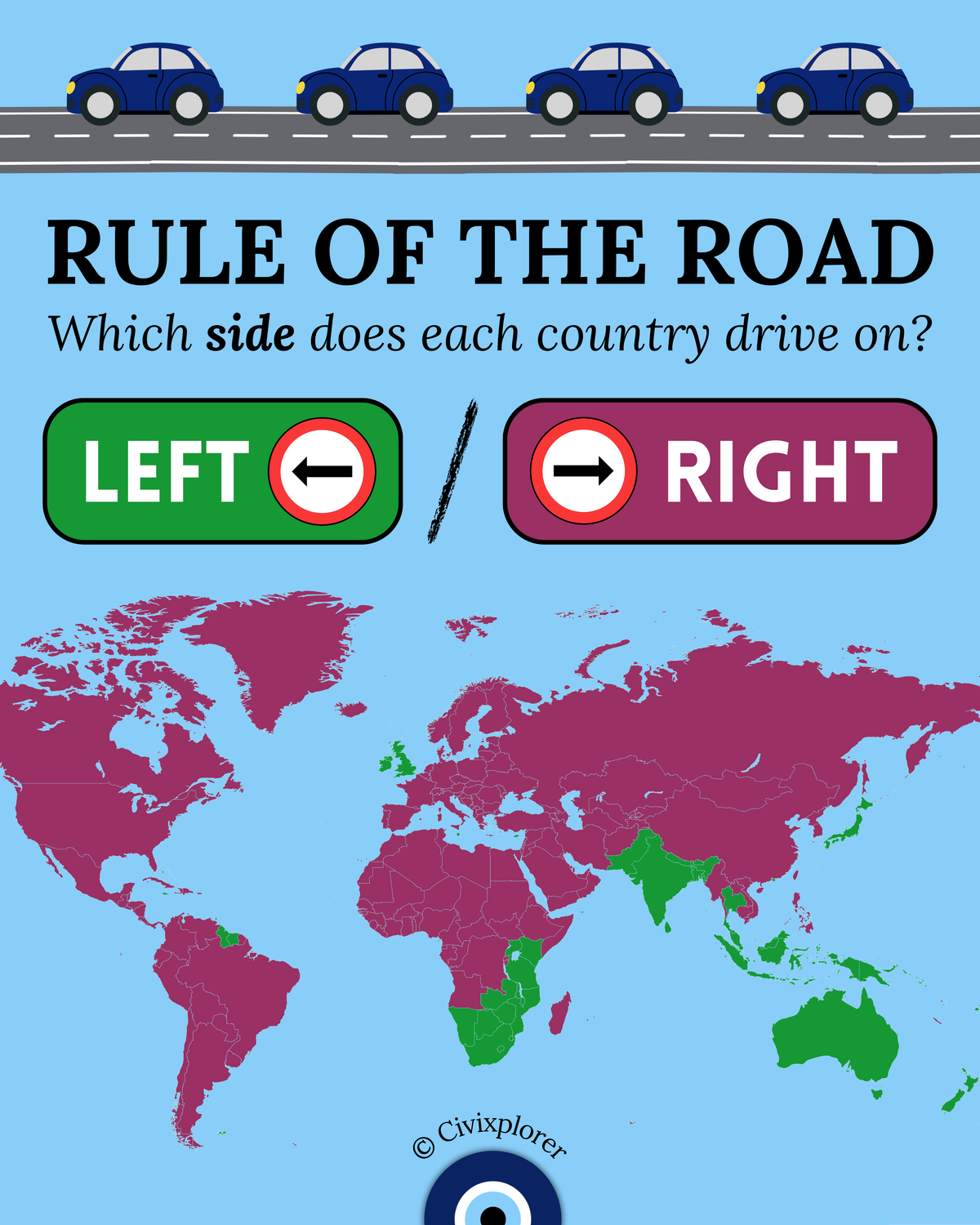
When looking at the global map of traffic conventions, the divide between driving on the left and driving on the right reveals how ancient traditions, colonial history, and economic forces shape our daily lives. Today, roughly seventy-five countries and territories adhere to left-hand traffic, representing approximately one-third of the world’s population. While the majority of the world’s landmass drives on the right, major demographic hubs like India, Indonesia, Pakistan, Bangladesh, and Japan ensure that left-hand driving remains a massive global norm. Rather than being a simple modern logistical choice, the side of the road a nation uses is a deeply path-dependent legal heritage that is notoriously difficult and expensive to alter once established.
The historical origins of driving on the left stretch back to pre-automotive travel, where personal safety dictated traffic flow. In medieval and ancient feudal societies, around ninety percent of human beings were right-handed, meaning travelers naturally preferred keeping to the left side of paths so their dominant right arm remained closer to oncoming strangers in case a sword needed to be drawn. Furthermore, wearing a scabbard on the left hip made it safer to mount a horse from the left side at the edge of the road, preventing travelers from stepping into the center of traffic. This long-standing customary practice was eventually codified into formal law by the British government through the General Highways Act of 1773 and the Highway Act of 1835.
Conversely, the shift toward right-hand traffic emerged during the late eighteenth century in France and the United States, driven by large agricultural freight wagons. Massive vehicles like the American Conestoga wagon lacked a built-in driver's seat, forcing the teamster to ride on the left-rear horse so he could use his right arm to whip the team of horses. Sitting on the left side of the team, drivers needed oncoming traffic to pass on their left so they could look down and ensure their wagon wheels safely cleared opposing vehicles, establishing a new keep-right convention. Following the French Revolution, Paris mandated right-hand travel in 1794 as an egalitarian statement, and Napoleon Bonaparte subsequently enforced the keep-right rule across continental Europe. In the twentieth century, Henry Ford cemented this standard globally by placing the Model T's steering wheel on the left side, which required driving on the right side of the road to allow safe passenger discharge onto sidewalks.
The modern worldwide distribution of traffic laws largely reflects nineteenth-century imperial expansion and subsequent regional integration. The British Empire exported left-hand traffic throughout South Asia, Oceania, and vast stretches of Southern and Eastern Africa. Interesting anomalies exist across the map, such as Japan, where samurai sword etiquette combined with late nineteenth-century British railway engineering to establish permanent left-hand traffic. Similarly, former Dutch colonies like Indonesia and Suriname retained left-hand traffic because the Netherlands still drove on the left when those territories were colonized, long before continental Europe standardized to the right.
Despite the immense cost of updating transportation infrastructure, several nations have changed sides over time to match neighboring markets or trade routes. Sweden executed its famous "Dagen H" switch in 1967, transitioning overnight from left to right to align with neighboring Norway and Finland. West African nations like Ghana also shifted to right-hand driving in 1974 to harmonize cross-border traffic with surrounding French-influenced neighbors. Conversely, Samoa became a rare modern example of switching to the left in 2009, enabling its citizens to import cheaper right-hand-drive vehicles from Australia, New Zealand, and Japan. Ultimately, traffic handedness illustrates how ancient customs, geopolitical influence, and economic practicalities remain locked into the modern physical infrastructure of our world.

Comments (0)
Join the Conversation
Login to share your thoughts with the community.
Login to Comment