
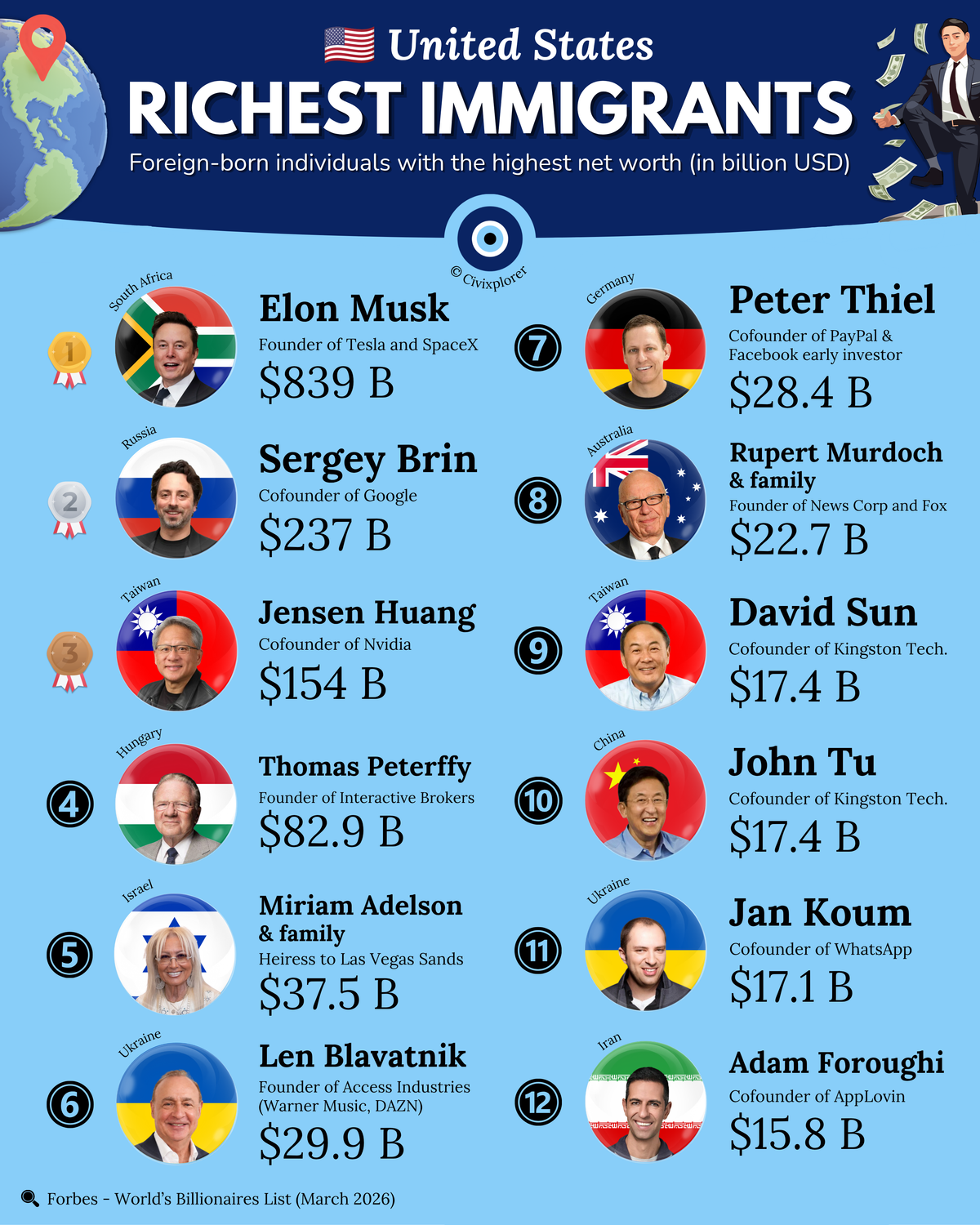
The economic footprint of foreign-born entrepreneurs in the United States highlights the nation's historic role as a magnet for global talent, scientific innovation, and venture capital. According to Forbes’ 2026 annual billionaire estimates, the top 12 wealthiest foreign-born individuals in America hold a staggering $1.50 trillion in combined net worth. However, this immense wealth displays an extraordinary level of concentration. A single individual, South African-born Elon Musk, accounts for $839 billion—representing 56% of the top 12 total on his own—through his leadership in Tesla and SpaceX. When combined with Google co-founder Sergey Brin ($237 billion) and Nvidia co-founder Jensen Huang ($154 billion), these top three figures command $1.23 trillion, or 82% of the collective wealth among this selected group.
The dominance of modern technology, particularly scalable hardware and artificial intelligence, forms the backbone of these vast fortunes. While consumer internet platforms like Google and messaging services like WhatsApp—co-founded by Ukrainian-born Jan Koum ($17.1 billion)—have reshaped global communication, hardware infrastructure has emerged as a primary wealth driver. Jensen Huang’s rapid fortune growth directly reflects the global demand for Nvidia’s specialized GPU chips that power artificial intelligence models. Similarly, Taiwan-born David Sun and China-born John Tu built identical $17.4 billion fortunes through Kingston Technology, producing essential computer memory and storage products that underpin the global digital architecture.
Behind these financial milestones lie remarkably diverse immigration journeys and educational paths. A prominent demographic cluster originates from Eastern Europe and former Soviet states, including Sergey Brin, media investor Len Blavatnik ($29.9 billion), and Jan Koum, reflecting strong regional STEM foundations and late twentieth-century emigration. Furthermore, the pathways to wealth extend beyond founding tech enterprises from scratch. Financial market automation pioneer Thomas Peterffy ($82.9 billion) transformed trading through Interactive Brokers, early PayPal co-founder Peter Thiel ($28.4 billion) built capital through venture investments, while media mogul Rupert Murdoch ($22.7 billion) expanded a global publishing empire, and Miriam Adelson ($37.5 billion) holds a majority stake in Las Vegas Sands.
Interpreting these figures requires understanding the nature of asset valuations and historical context. A billionaire's net worth consists of estimated market asset values rather than liquid cash, meaning fortunes tied to publicly traded shares or private company funding rounds can fluctuate significantly with market conditions. Additionally, national flags in wealth rankings represent birthplaces rather than current citizenship or historical political entities at the time of birth. Ultimately, while these exceptional figures illustrate how access to capital, education, and scaling opportunities intersect in the American economy, they represent the extreme upper tail of global entrepreneurship rather than the typical immigrant experience.

Comments (0)
Join the Conversation
Login to share your thoughts with the community.
Login to Comment