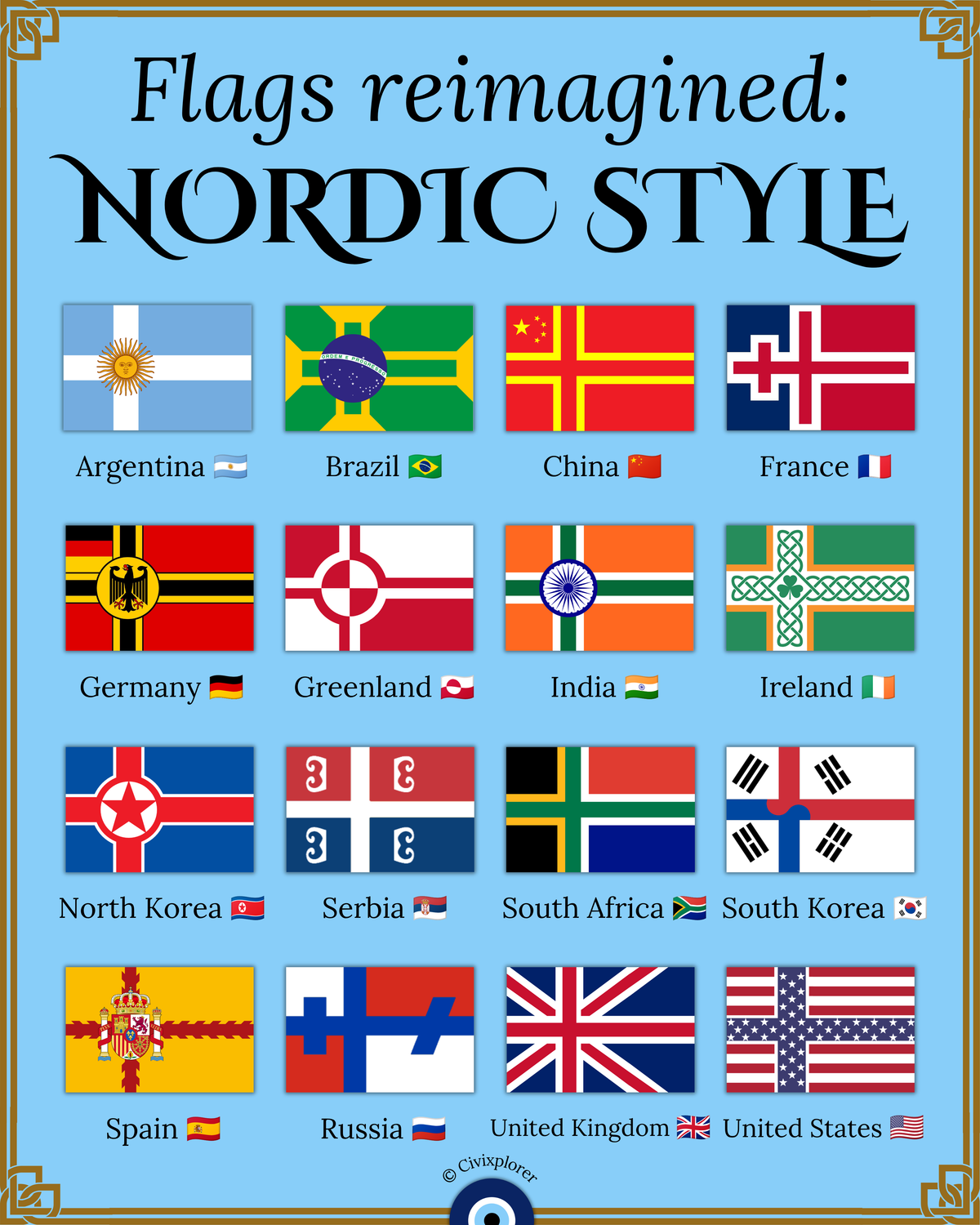
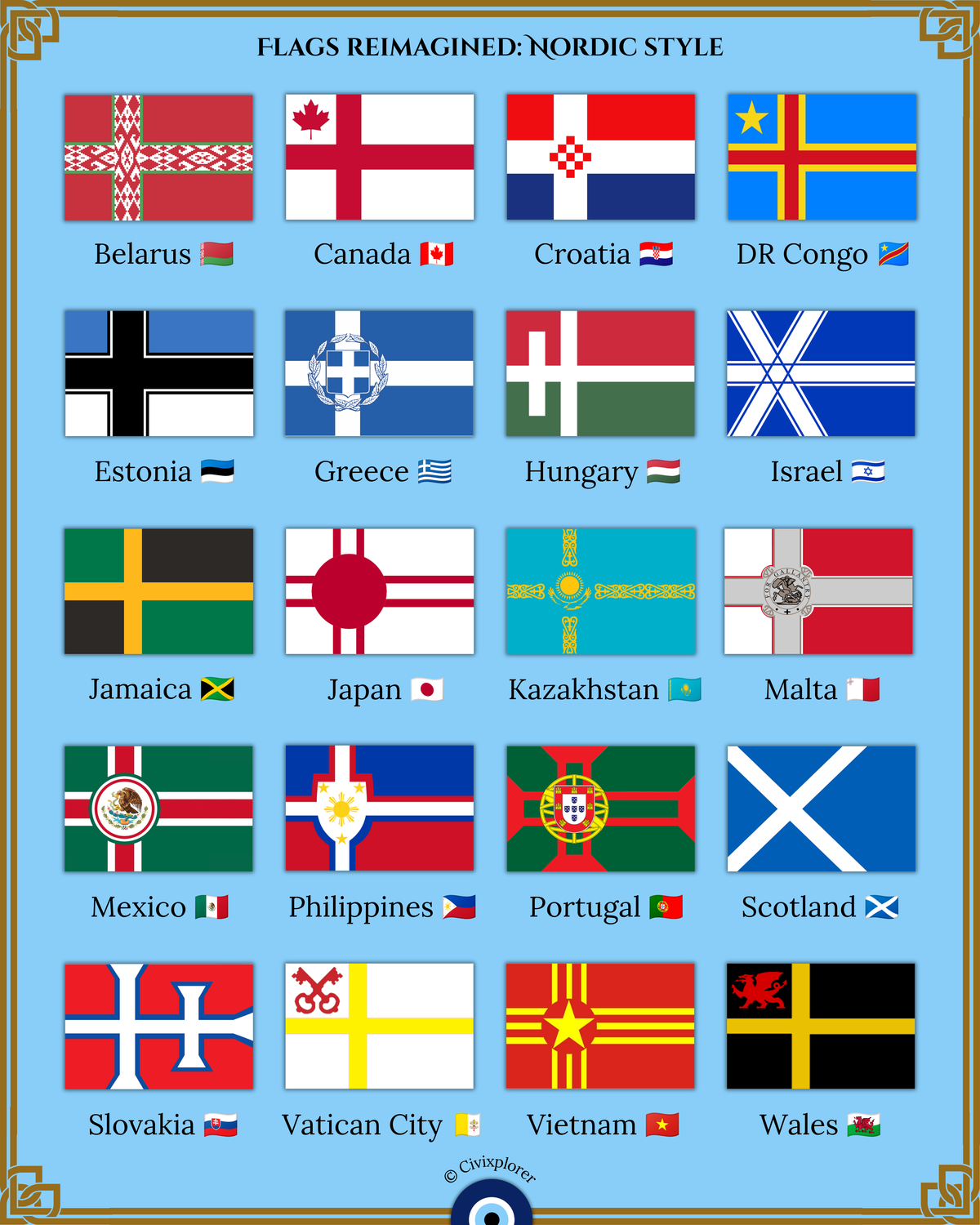
The Nordic cross, also known as the Scandinavian cross, is one of the most recognizable and enduring templates in the world of vexillology. Defined by its asymmetrical design where the vertical bar is shifted toward the hoist side, this layout creates a sense of movement and structural balance that has inspired designers for centuries. In this visual experiment, we explore what happens when the world’s most iconic national flags are stripped of their original layouts and rebuilt using this ancient Northern European skeleton.
The Origins of the Design
The foundation of this style lies with the Dannebrog, the national flag of Denmark, which is recognized as the oldest continuously used national flag in the world. Legend traces its origin to 1219, though it was formalized as a regional aesthetic marker for Sweden, Norway, Finland, and Iceland much later. While originally a symbol of shared medieval Christian heritage, the Nordic cross is now admired globally for its geometric strength, scalability, and the clean way it balances negative space with bold structure.
Historical Echoes in Redesign
Some of the reimagined flags in this collection are more than just artistic "what-if" scenarios; they mirror actual historical proposals and geopolitical debates.
- Germany: The redesign utilizes the democratic black, red, and gold palette but replaces the tricolor with a Nordic cross. This is a direct reference to the Wirmer-Flagge, designed in 1944 by resistance fighters who intended to use it as a symbol of a post-Nazi Germany aligned with democratic Northern European ideals.
- Estonia: The blue, black, and white Nordic version reflects a real and recurring debate within the country. Many Estonians advocate for this change to visually signal their Nordic identity and shared history with Sweden and Denmark, moving away from the post-Soviet Baltic grouping.
Adapting Cultural Iconography
To maintain the soul of each nation, the Nordic template must be flexible enough to incorporate unique regional symbols.
- France: Rather than a standard cross, the French version utilizes the Cross of Lorraine, the famous symbol of the Free France forces during World War II.
- Russia: The bars are restructured to form an Eastern Orthodox Cross, characterized by its distinct slanted footrest, rooting the design in the nation's dominant religious heritage.
- Spain: The horizontal bar features a saw-toothed edge, a sophisticated nod to the Cross of Burgundy, which served as a primary flag for the Spanish Empire for centuries.
- Ireland: Instead of solid colors, the cross is filled with an intricate Celtic knot, merging Scandinavian geometry with ancient Insular art traditions.
The Challenge of Symmetry
Adapting flags that rely on central symmetry, such as those of South Korea or Israel, requires significant geometric manipulation. For the South Korean redesign, the central Taegeuk (yin-yang) is placed at the off-center intersection, while the four black trigrams are distributed into the resulting unequal quadrants. Similarly, the Israel redesign manages a hybrid between a Nordic cross and a saltire to evoke the triangular strokes of the Star of David while maintaining the traditional blue and white prayer shawl colors.
Even the United Kingdom’s Union Jack, which is a complex overlay of three different crosses, is reimagined by shifting its center of gravity to the hoist. This creates an asymmetrical version that remains instantly recognizable while adhering to the Nordic framework.
A New Family Resemblance
By applying this single "skeleton" to diverse nations across all continents, we create an artificial family resemblance that highlights the power of simple geometric structures. These redesigns allow us to appreciate the distinctiveness of individual national colors and symbols while seeing them through a lens of visual harmony and unity. While real-world flag changes are rare and politically sensitive, these visual essays celebrate the endless possibilities of global design.
Comments (0)
Join the Conversation
Login to share your thoughts with the community.
Login to Comment