
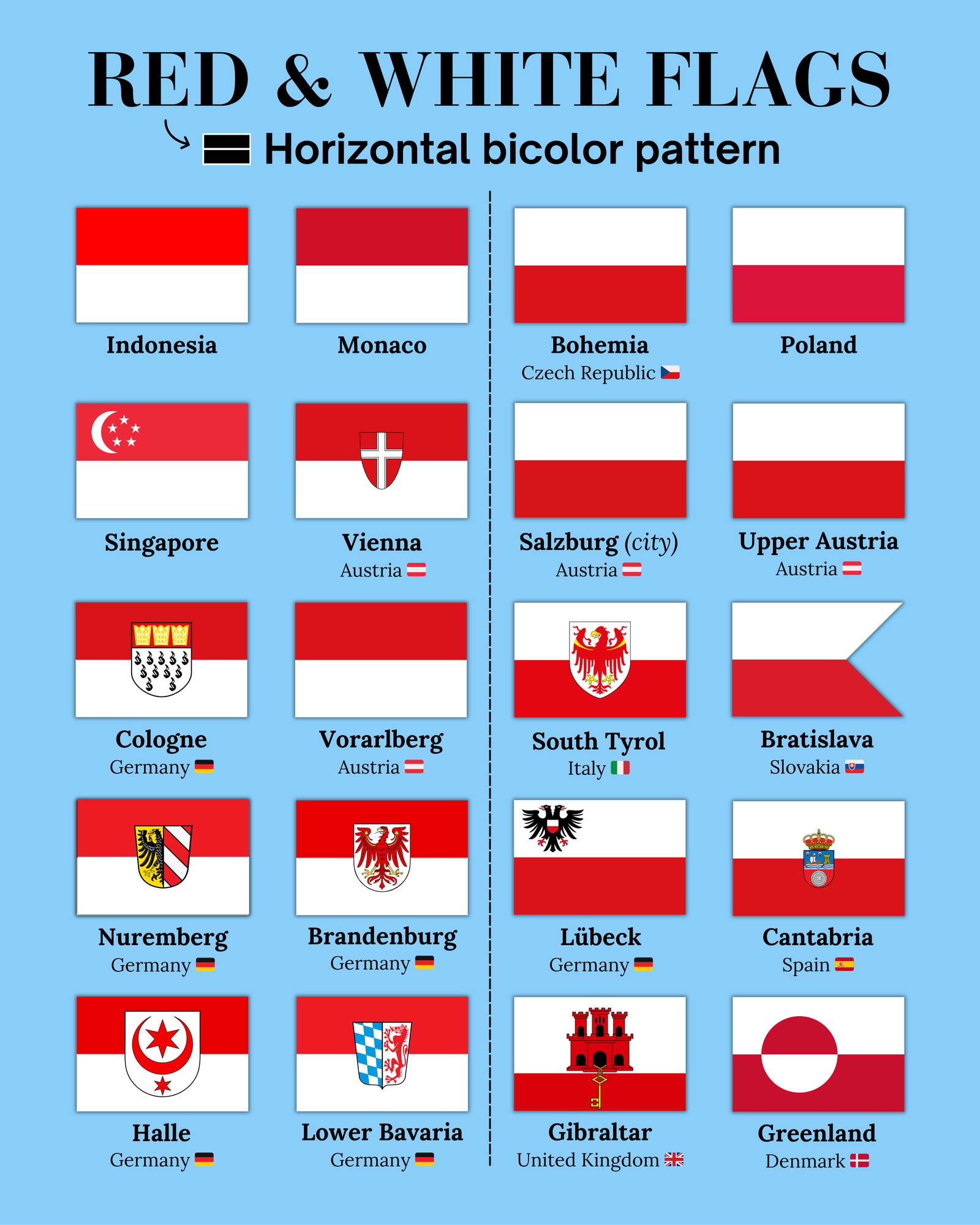
The horizontal red and white bicolor is one of the most common and visually clean flag patterns in the world. Because a simple two-stripe design is a fundamental vexillological pattern, it has been adopted by many unrelated entities throughout history, leading to some of the most famous visual overlaps in geography.
The Famous Identical Pairs
The most striking example of this design evolution is the near-identical nature of the national flags of Indonesia and Monaco. Despite their visual similarity, their origins are worlds apart: Monaco's colors derive from the heraldic shield of the House of Grimaldi, while Indonesia’s Sang Saka Merah Putih traces back to the 13th-century Majapahit Empire.
Similarly, the flags of Poland and Bohemia feature a white stripe over red. Both are rooted in classic heraldry where a white figure—an eagle for Poland and a lion for Bohemia—is placed upon a red shield.
The European Heart: Hanseatic and Austrian Legacies
In Central Europe, the heavy concentration of red and white flags is no coincidence. Many German cities, such as Lübeck and Cologne, adopted these colors from the Hanseatic League, a powerful medieval commercial confederation whose ships flew red-and-white banners.
Austria’s red-white palette has an even more legendary origin tied to the Babenberg dukes. Tradition holds that during the 1191 Siege of Acre, Duke Leopold V’s white tunic was so blood-stained that only a white band remained where his belt had been, creating the basis for the Austrian colors seen across various states and cities today.
Creative Variations and Universal Meaning
To stand out while maintaining this traditional palette, many nations have added unique elements. Singapore incorporates a crescent moon and five stars to represent its foundational ideals, while Greenland features a counter-changed circle representing the sun setting over the ice. Bratislava even uses a unique "swallowtail" shape to distinguish its bicolor.
Ultimately, the enduring popularity of this pattern lies in its symbolism: red typically evokes strength, courage, or sacrifice, while white stands for peace and purity. These universal meanings explain why a simple two-color design continues to unite diverse cultures across the globe.
Comments (0)
Join the Conversation
Login to share your thoughts with the community.
Login to Comment