
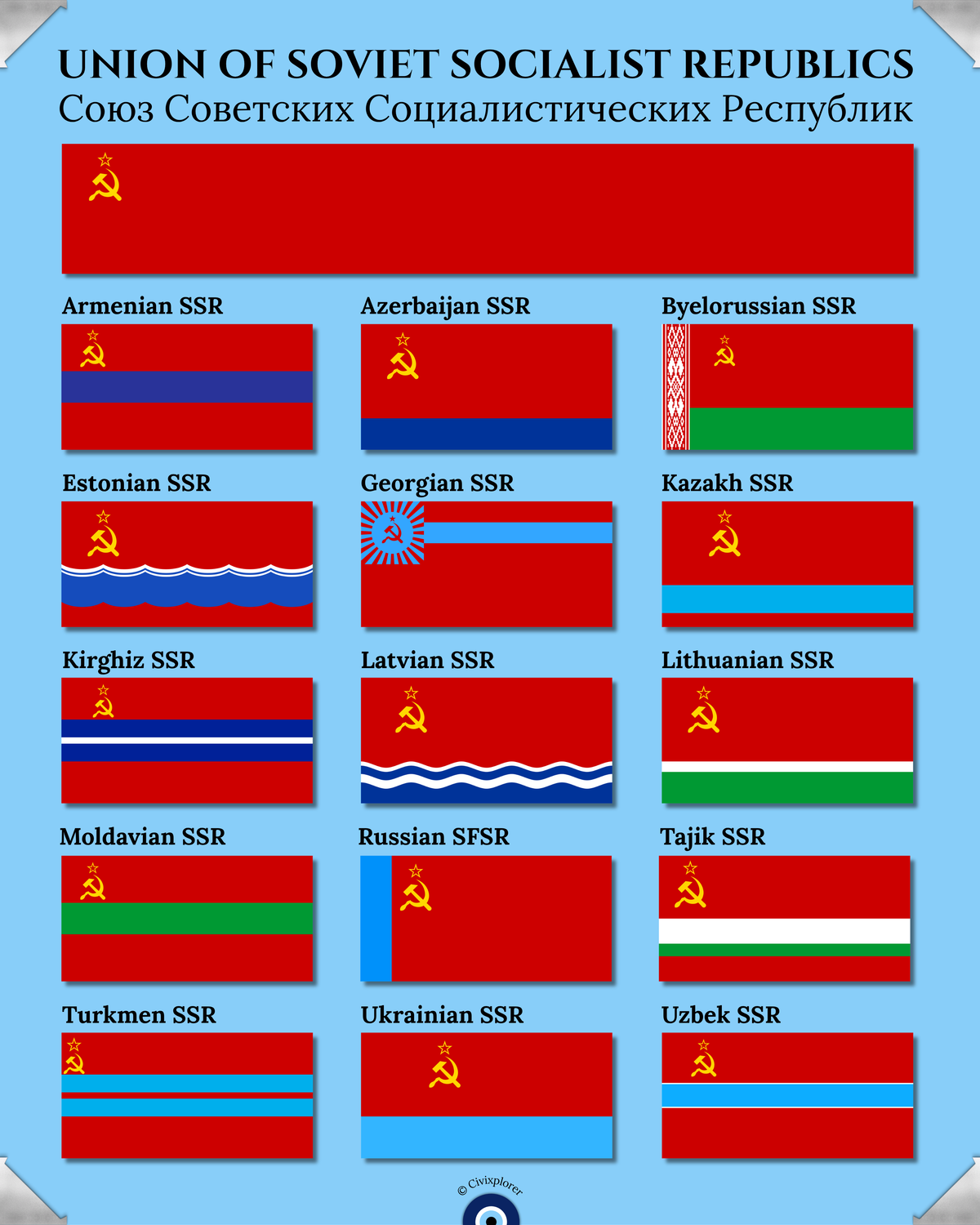
The visual branding of the Soviet Union was a masterclass in balancing ideological uniformity with controlled national expression. While the iconic red banner with the gold hammer and sickle is recognized globally, the individual flags of the 15 Soviet Socialist Republics (SSRs) tell a much more complex story of post-WWII diplomacy, geographical symbolism, and cultural survival.
Prior to the late 1940s, these flags were nearly indistinguishable—simple red sheets with gold text. However, a major shift occurred following the end of World War II. When the United Nations was founded in 1945, the Soviet Union maneuvered to secure independent voting seats for Ukraine and Byelorussia to increase its influence. To legitimize these republics as "sovereign" entities on the world stage, they required distinct visual identities. This led to a 1947 resolution by the Presidium of the Supreme Soviet, mandating that all republics adopt new designs that retained the red field and communist emblems while adding unique colors or patterns.
The resulting designs followed a strict vexillological blueprint. Every flag had to feature the gold hammer, sickle, and red star in the upper canton. The lower or middle portions were reserved for customization, often reflecting the specific geography or culture of the region. For example, the Estonian SSR and Latvian SSR utilized wavy blue and white lines to represent the waters of the Baltic Sea, while the Kazakh SSR and Uzbek SSR featured blue stripes representing the clear skies or vital irrigation of Central Asia.
Some republics took more creative liberties. The Georgian SSR was a notable outlier, featuring a unique blue sun disk with a red hammer and sickle inside—the only flag where these symbols were not gold. Meanwhile, the Byelorussian SSR incorporated a traditional white-on-red ornamental pattern at the hoist, inspired by a traditional rushnyk cloth. This design was so deeply rooted in the local identity that modern Belarus remains one of the few post-Soviet states to retain a modified version of its Soviet-era flag today.
In contrast, the Russian SFSR stood apart by choosing a vertical blue stripe along the hoist rather than the horizontal stripes used by the other fourteen republics. As the dominant political and demographic force within the Union, Russia’s design was the last to be finalized in 1954, underscoring its unique status.
One of the most fascinating "invisible" details of these flags involves their reverse sides. Following a 1980 amendment to Soviet law, the hammer, sickle, and star were officially supposed to appear only on the front. The back of every flag was legally meant to be a plain red field. In practice, however, manufacturing limitations meant most flags were printed through-and-through, making this one of the most frequently ignored laws in Soviet history.
Today, these flags remain a significant historical artifact of the Cold War era. While most were abandoned in 1991 in favor of pre-Soviet national symbols, they represent a unique period where fifteen distinct nations were visually united under a single ideological framework.

Comments (0)
Join the Conversation
Login to share your thoughts with the community.
Login to Comment