
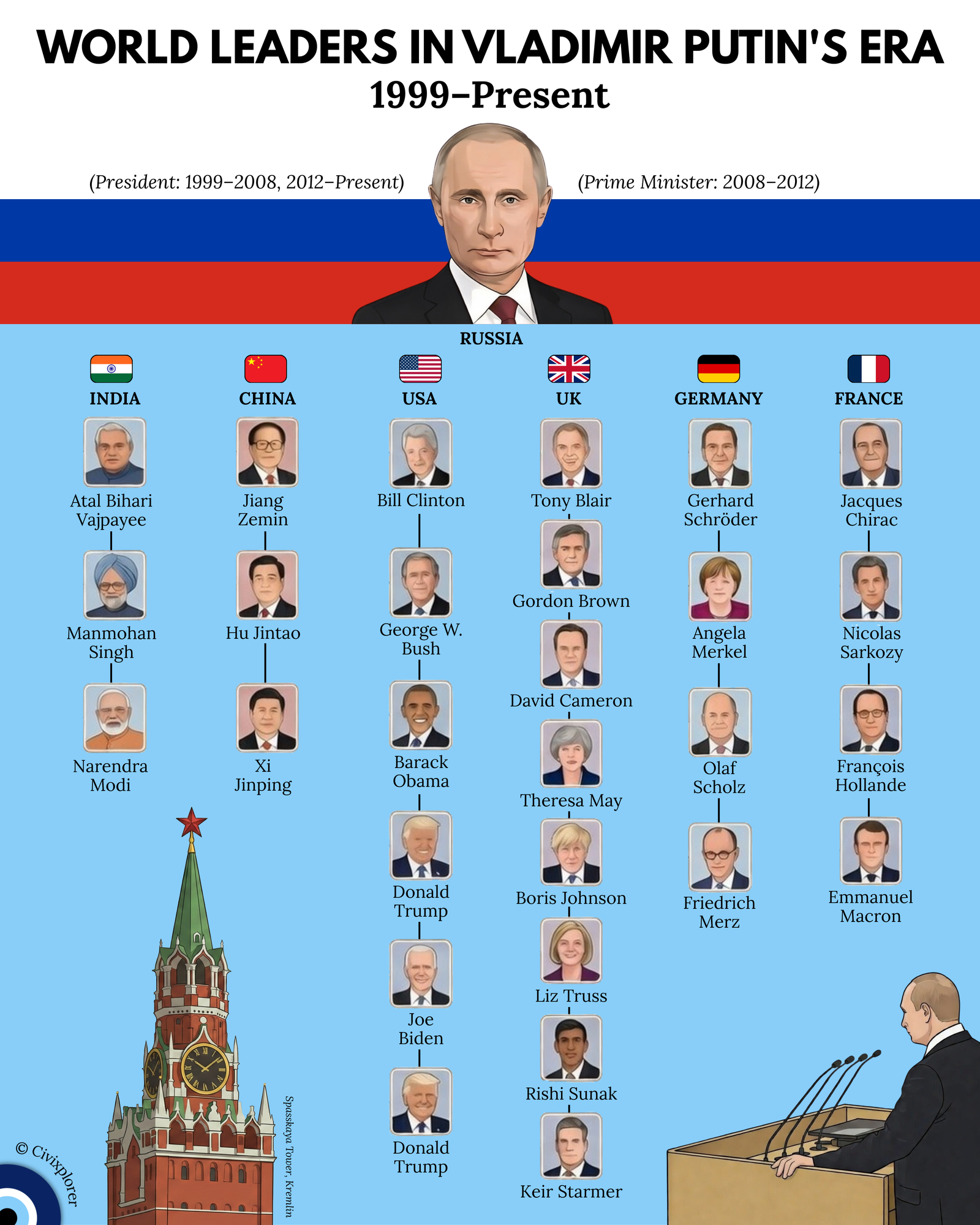
The global political landscape has undergone massive shifts since the turn of the millennium, yet one figure has remained a constant at the center of the world stage. Since 1999, Vladimir Putin has dominated Russian leadership, spanning over 26 years of continuous influence. This longevity stands in stark contrast to the rapid turnover seen in Western democracies, where elections and term limits create a revolving door of leadership.
To understand this endurance, one must look at the "Tandemocracy" period between 2008 and 2012. When faced with constitutional limits preventing a third consecutive term, Putin shifted to the role of Prime Minister while his protégé, Dmitry Medvedev, assumed the presidency. Despite this formal change, Putin retained de facto control, eventually returning to the presidency in 2012 after the term length was extended from four to six years.
The system further consolidated through a 2020 constitutional referendum that effectively "reset" Putin's term count. This legal maneuver allowed him to run in 2024 and potentially maintain power until 2036. By 2026, the Russian state has transitioned from a hybrid regime into a consolidated authoritarian system characterized by a "war economy" and a focus on nationalistic ideology.
The contrast with other major powers is striking. Since Putin first took office, the United Kingdom has cycled through eight different prime ministers, and the United States has seen six presidential terms, including the nonconsecutive terms of Donald Trump. In Germany, the era of coalition politics has led to four different chancellors, with Friedrich Merz succeeding Olaf Scholz in 2025. Even in China, while Xi Jinping has moved toward a similar "leader for life" model by removing term limits in 2018, the Russian model of personalist autocracy remains a unique study in political survival.
As of early 2026, the Russian system remains largely isolated from the Western bloc, focusing on internal security and military production. While leaders like Keir Starmer and Emmanuel Macron navigate the complexities of democratic dissent and economic flux, the Kremlin continues to project an image of unwavering stability—a testament to a system reshaped to endure across decades.
Comments (0)
Join the Conversation
Login to share your thoughts with the community.
Login to Comment