
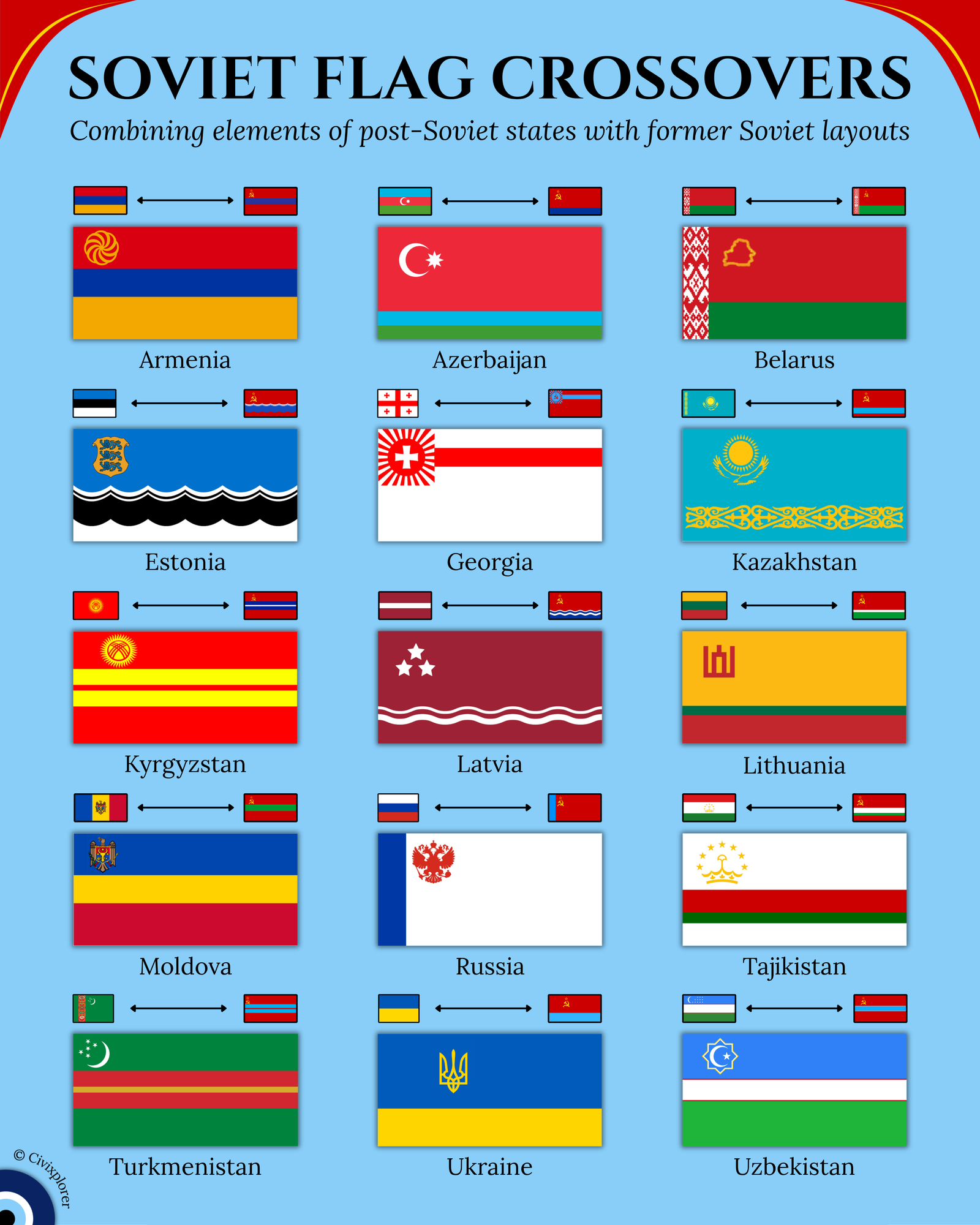
The collapse of the Soviet Union in 1991 didn't just redraw the borders of the world; it triggered one of the most significant mass-rebrandings in history. As fifteen nations emerged from the shadow of the USSR, they faced a critical question: what will our flag look like? This visual exploration takes the modern sovereign symbols of these independent states and forces them back into the rigid, standardized design templates of their former Soviet Socialist Republic (SSR) counterparts. The result is a striking look at how history, ideology, and national identity intersect.
To understand these "crossovers," we must first look at the strict rules of Soviet flag design. Until the late 1940s, the flags of the various republics were almost indistinguishable—plain red fields with gold text. In 1947, a decree from Joseph Stalin required each republic to adopt a distinct design to help differentiate them on the global stage. However, the constraints were narrow: every flag had to be predominantly red and feature the gold hammer, sickle, and star in the top-left corner. National flavor was permitted only through thin stripes or patterns at the bottom or along the hoist.
One of the most fascinating examples in this collection is the Russian crossover. The original Russian SFSR flag was a simple red field with a vertical blue stripe. In this reimagining, the artist replaces the communist hammer and sickle with the Double-Headed Eagle, a symbol of the Tsardom of Russia. This creates a historical paradox: the supreme symbol of the empire the Bolsheviks overthrew is forced into the exact geometric footprint of Soviet communism. It perfectly captures the dual identity of modern Russia, which often blends its imperial and Soviet legacies.
In contrast, the Baltic States—Estonia, Latvia, and Lithuania—represent a sharp rejection of Soviet aesthetics. During the Soviet era, these republics were the only ones to incorporate water motifs (representing the Baltic Sea) into their flags. Upon independence, they eagerly discarded these designs to return to their pre-WWII national colors. The crossover forces their modern, Western-leaning tricolors back into those red-heavy layouts, creating a visually jarring contrast that underscores how rapidly these nations pivoted away from the East.
Ukraine and Belarus offer two opposite stories of transition. Ukraine’s crossover replaces the communist symbols with the Tryzub (Trident), an ancient seal dating back to the medieval Kievan Rus'. Placing this millennium-old symbol onto the Soviet-style red-over-blue layout asserts that Ukrainian statehood far predates the USSR. Meanwhile, Belarus remains the outlier. It is the only former republic that officially reverted to a modified version of its Soviet flag in 1995. Because the real modern flag is so close to the original SSR design, the crossover highlights just how much the nation has clung to its Soviet visual identity.
Finally, the Central Asian republics—such as Uzbekistan and Turkmenistan—showcase a hybrid identity. Under the USSR, Islamic symbols were strictly suppressed in favor of state atheism. In these crossovers, the crescent moon and stars are proudly restored to the canton. By injecting these cultural and religious emblems into the Soviet framework, the artwork visualizes the post-1991 cultural revival of the region, where independence allowed for the reclamation of indigenous heritage within old structural templates.

Comments (0)
Join the Conversation
Login to share your thoughts with the community.
Login to Comment