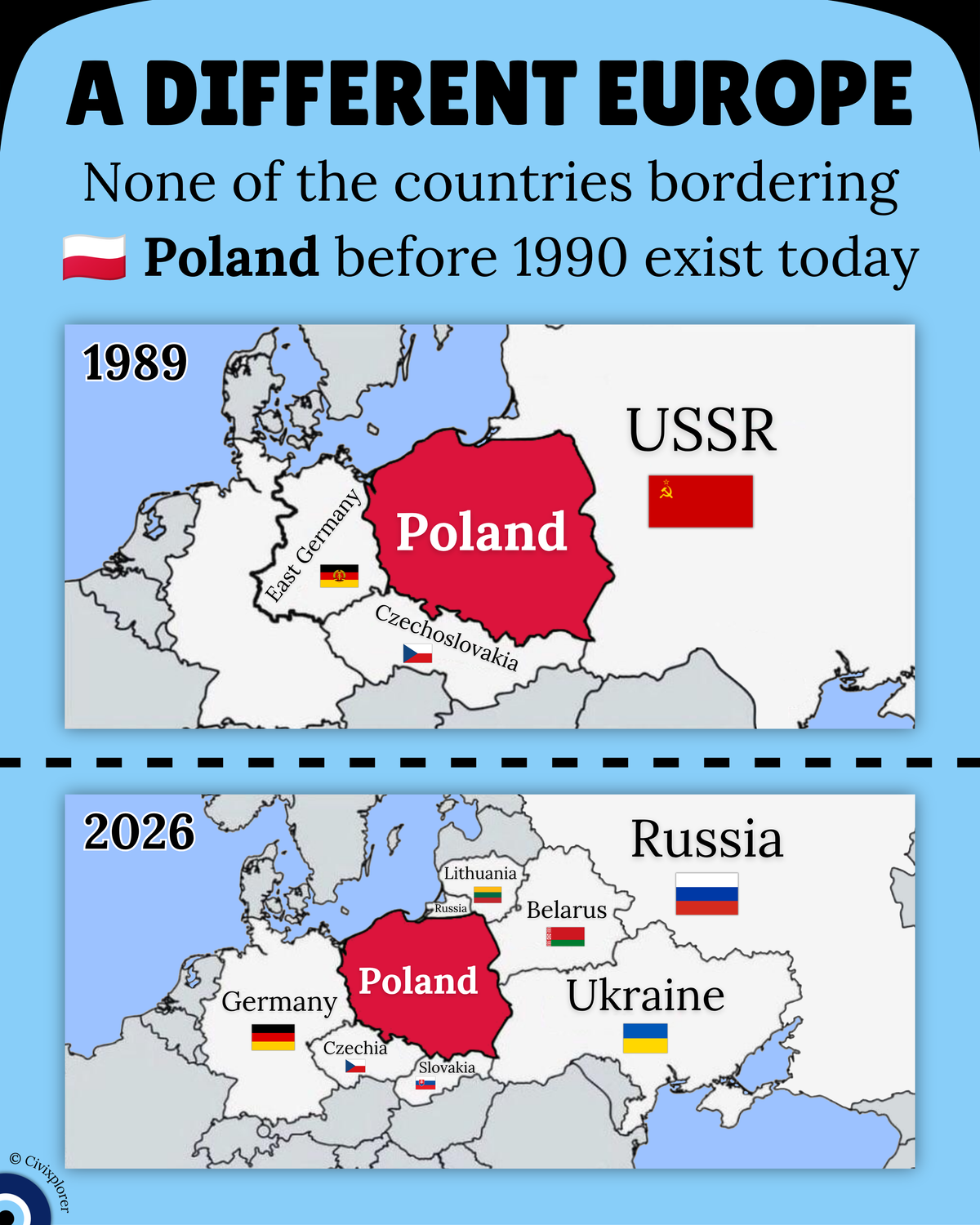
The political map of Europe underwent a breathtaking transformation at the end of the Cold War, but perhaps no country illustrates this shift more dramatically than Poland. In 1989, Poland shared its land borders with just three nations: the German Democratic Republic (East Germany), Czechoslovakia, and the Soviet Union. Within a brief span of just twenty-seven months, between October 1990 and January 1993, all three of those neighboring states completely ceased to exist. Today, Poland is surrounded by seven distinct sovereign nations, yet its own physical borders have remained entirely unaltered since the post-World War II settlements of 1945. This remarkable phenomenon represents a deep historical irony for a nation that, for centuries, was one of the most geographically volatile on the continent.
To understand how this occurred without Poland shifting a single border post, we must examine the rapid fragmentation of the Eastern Bloc. Poland’s western frontier had been established along the Oder-Neisse line after World War II, bordering East Germany. For decades, this boundary represented a tense division between competing geopolitical blocs. However, the fall of the Berlin Wall in November 1989 rapidly set the stage for German reunification. On October 3, 1990, East Germany was formally absorbed into the Federal Republic of Germany. With the signing of the German-Polish Border Treaty, the newly unified Germany permanently recognized the Oder-Neisse line as its official eastern border. Overnight, Poland’s western neighbor transformed from a Soviet-aligned communist state into a unified, democratic powerhouse and a vital economic partner.
A similarly profound and remarkably peaceful shift occurred to the south along Poland's border with Czechoslovakia. Following the Velvet Revolution of 1989, which successfully dismantled decades of communist rule, growing political and economic disagreements surfaced between the Czech and Slovak leaderships. Rather than descending into the violent disintegration seen elsewhere in Europe during the 1990s, the two nations negotiated a bloodless partition known as the Velvet Divorce. At midnight on December 31, 1992, Czechoslovakia dissolved, and on January 1, 1993, the independent Czech Republic and Slovakia emerged. While the physical layout of Poland's southern border remained virtually identical, it was now shared with two democratic nations instead of one communist federation.
The most expansive changes occurred on Poland's eastern frontier with the dissolution of the Soviet Union. In 1989, the entire eastern border was shared with the massive USSR. As Mikhail Gorbachev's reforms of glasnost and perestroika unintentionally weakened centralized Soviet control, independent movements gained unstoppable momentum. The signing of the Belavezha Accords in December 1991 marked the official demise of the Soviet Union, splintering the superpower into fifteen independent republics. For Poland, this meant its single eastern neighbor was replaced by four separate sovereign nations: Ukraine, Belarus, Lithuania, and Russia. The Russian border is represented by the highly strategic Kaliningrad exclave, a remnant of former East Prussia that remained under Moscow's control after the collapse.
This staggering series of events reflects a fascinating geopolitical transition. For centuries, Poland had experienced extreme geographic instability, having been entirely partitioned off the map in the eighteenth century and literally pushed hundreds of miles westward by Allied powers after World War II. Yet, during the monumental collapse of the Soviet sphere of influence, Poland stood as the sole geographic anchor in a sea of disintegrating federations and redrawn political boundaries. Rather than suffering territorial fragmentation, Poland navigated this period of regional instability to completely reorient its strategic posture, ultimately joining NATO in 1999 and the European Union in 2004, cementing its role as a central European crossroads.

Comments (0)
Join the Conversation
Login to share your thoughts with the community.
Login to Comment